Julius Global Health, Julius Center for Health Sciences and Primary Care, University Medical Center Utrecht, Utrecht University, Utrecht, NL.
Wits Reproductive Health and HIV Institute, Faculty of Health Sciences, University of the Witwatersrand, Johannesburg, ZA.
Glob Heart. 2020 Feb 12;15(1):17. doi: 10.5334/gh.532.
Antiretroviral therapy (ART) transformed human immunodeficiency virus (HIV) infection into a chronic disease. Possible HIV-associated complications have emerged including cardiovascular diseases (CVD).
This study aims to determine the heart rate variability (HRV) distribution and association between HRV and HIV treated with ART in a rural African population.
This cross-sectional study included 325 participants of the Ndlovu Cohort Study, South Africa. HRV was measured using a standardized five-minute resting ECG and assessed by the standard deviation of normal RR intervals (SDNN), root of mean squares of successive RR differences (RMSSD), percentage of RR intervals greater than 50 milliseconds different from its predecessor (pNN50), total-, low- and high-frequency power. CVD risk factors were assessed using measurements (blood pressure, anthropometry, cholesterol) and questionnaires (e.g. socio-demographics, alcohol, smoking, physical activity, age, diabetes). We used a Wilcoxon rank test to assess differences in medians between HIV-infected and HIV-uninfected participants and multivariable linear regression to investigate associations between HRV and HIV treated with ART.
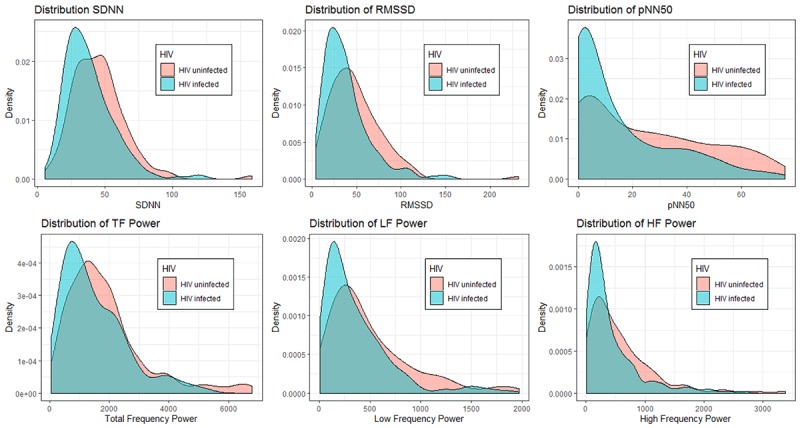
Of the participants, 196 (61.4%) were HIV-infected treated with ART and 123 (38.6%) were HIV-uninfected. HIV-infected consumed less alcohol, 52% versus 35%, smoked less, were less physically active, more often attained lower education, 26% versus 14%, and had lower systolic blood pressure, 134 mmHg versus 140 mmHg, compared to HIV-uninfected. Medians of all HRV parameters were lower for HIV-infected participants. The model fully adjusted for CVD risk factors showed a significant inverse association between HIV treated with ART and log RMSSD (-0.16) and log pnn50 (-0.61). Although HIV-infected participants treated with ART presented with less CVD risk factors they had a lower HRV indicating an increased risk of CVD.
抗逆转录病毒疗法(ART)将人类免疫缺陷病毒(HIV)感染转变为慢性病。可能出现与 HIV 相关的并发症,包括心血管疾病(CVD)。
本研究旨在确定在南非农村非洲人群中,接受 ART 治疗的 HIV 患者的心率变异性(HRV)分布以及 HRV 与 HIV 之间的关联。
这是一项横断面研究,纳入了南非 Ndlovu 队列研究的 325 名参与者。使用标准的五分钟静息心电图测量 HRV,并通过正常 RR 间期的标准差(SDNN)、连续 RR 差异的均方根(RMSSD)、RR 间期大于 50 毫秒的百分比与其前一个 RR 间期不同(pNN50)、总频带、低频带和高频带功率来评估。使用测量值(血压、人体测量学、胆固醇)和问卷(例如社会人口统计学、酒精、吸烟、体力活动、年龄、糖尿病)评估 CVD 风险因素。我们使用 Wilcoxon 秩检验评估 HIV 感染者和 HIV 未感染者之间中位数的差异,并使用多变量线性回归分析 HRV 与接受 ART 治疗的 HIV 之间的关联。
参与者中,196 名(61.4%)为接受 ART 治疗的 HIV 感染者,123 名(38.6%)为 HIV 未感染者。HIV 感染者饮酒较少,52%比 35%,吸烟较少,体力活动较少,受教育程度较低,26%比 14%,收缩压较低,134mmHg 比 140mmHg。与 HIV 未感染者相比,所有 HRV 参数的中位数均较低。完全调整 CVD 风险因素的模型显示,接受 ART 治疗的 HIV 与 log RMSSD(-0.16)和 log pnn50(-0.61)之间存在显著负相关。尽管接受 ART 治疗的 HIV 感染者的 CVD 传统风险因素较少,但他们的 HRV 较低,表明 CVD 风险增加。