Zhang Suling, Niu Xiaodan, Ma Jinke, Wei Xin, Zhang Jun, Du Weiping
Department of Public Basic Teaching, Xi'an Academy of Fine Arts, Institute of Body-Medicine Integration, Xi'an, China.
Xi'an Jiaotong University Sports Centre, Xi'an, China.
Front Neurol. 2025 Aug 14;16:1556784. doi: 10.3389/fneur.2025.1556784. eCollection 2025.
Sleep deprivation is prevalent in high-pressure environments and among shift workers, and may contribute to autonomic nervous system (ANS) dysregulation, contributing to cardiovascular diseases, mood disorders, and cognitive impairment. Heart rate variability (HRV), an important indicator of ANS function, reflects fluctuations in sympathetic and parasympathetic activity and is commonly used to assess the autonomic effects of sleep deprivation. However, existing studies exhibit considerable heterogeneity due to inconsistencies in HRV measurement methods, variations in deprivation duration, and inadequate control of confounding factors.
This study aimed to comprehensively evaluate the impact of sleep deprivation on HRV through a systematic review and meta-analysis of randomized controlled trials (RCTs), to elucidate the potential mechanisms underlying sleep deprivation-induced cardiac autonomic dysfunction, and to provide insights for optimizing sleep-related interventions and preventing cardiovascular disease.
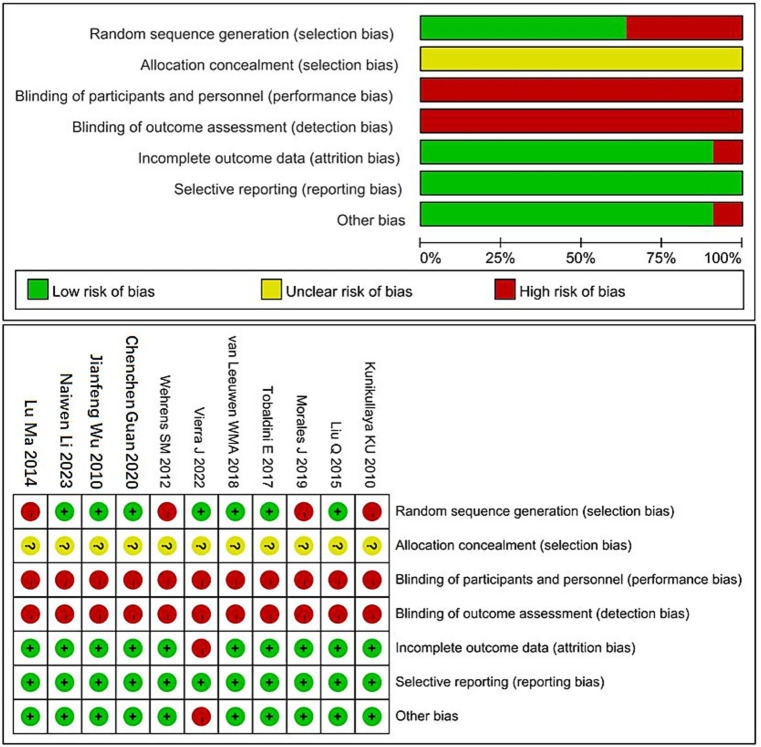
A systematic search was conducted in PubMed, Embase, CNKI, Wanfang, and VIP databases for RCTs investigating the effects of sleep deprivation on HRV, covering the period from January 2010 to May 2024. The Cochrane Risk of Bias tool was used for methodological quality assessment. Meta-analyses were performed using Review Manager 5.4 and Stata 17.0 software.
A total of 11 eligible studies involving 549 participants were included. The meta-analysis revealed that: (1) In the time domain, sleep deprivation was associated with a non-significant reduction in SDNN ( > 0.05), while RMSSD showed a significant decrease ( < 0.05). (2) In the frequency domain, both LF and LF/HF significantly increased after sleep deprivation ( < 0.05), whereas HF showed a decreasing trend that did not reach statistical significance ( > 0.05).
This meta-analysis indicates that sleep deprivation may impair cardiac autonomic function, as evidenced by decreased RMSSD and increased LF and LF/HF, suggesting sympathetic predominance and vagal suppression. However, changes in other HRV indices such as SDNN and HF were not statistically significant. These findings imply a potential disruption of the dynamic balance between sympathetic and parasympathetic activity following sleep deprivation. Future research should adopt standardized HRV measurement protocols to validate these findings and further explore the underlying physiological mechanisms. This study provides important evidence for understanding the dynamic changes in autonomic function associated with sleep deprivation.
https://inplasy.com/projects/, identifier INPLASY202560023.

睡眠剥夺在高压环境人群和轮班工作者中普遍存在,可能导致自主神经系统(ANS)失调,进而引发心血管疾病、情绪障碍和认知功能障碍。心率变异性(HRV)是ANS功能的一项重要指标,反映交感神经和副交感神经活动的波动情况,常用于评估睡眠剥夺对自主神经系统的影响。然而,由于HRV测量方法不一致、剥夺持续时间不同以及混杂因素控制不足,现有研究存在相当大的异质性。
本研究旨在通过对随机对照试验(RCT)进行系统评价和荟萃分析,全面评估睡眠剥夺对HRV的影响,阐明睡眠剥夺诱发心脏自主神经功能障碍的潜在机制,并为优化与睡眠相关的干预措施和预防心血管疾病提供见解。
在PubMed、Embase、中国知网、万方和维普数据库中进行系统检索,查找2010年1月至2024年5月期间研究睡眠剥夺对HRV影响的RCT。使用Cochrane偏倚风险工具进行方法学质量评估。采用Review Manager 5.4和Stata 17.0软件进行荟萃分析。
共纳入11项符合条件的研究,涉及549名参与者。荟萃分析结果显示:(1)在时域中,睡眠剥夺与SDNN无显著降低相关(>0.05),而RMSSD显著降低(<0.05)。(2)在频域中,睡眠剥夺后LF和LF/HF均显著增加(<0.05),而HF呈下降趋势,但未达到统计学显著性(>0.05)。
这项荟萃分析表明,睡眠剥夺可能损害心脏自主神经功能,表现为RMSSD降低以及LF和LF/HF增加,提示交感神经占优势和迷走神经受抑制。然而,其他HRV指标如SDNN和HF的变化无统计学显著性。这些发现意味着睡眠剥夺后交感神经和副交感神经活动之间的动态平衡可能受到潜在破坏。未来研究应采用标准化的HRV测量方案来验证这些发现,并进一步探索潜在的生理机制。本研究为理解与睡眠剥夺相关的自主神经功能动态变化提供了重要证据。
https://inplasy.com/projects/,标识符INPLASY20256 0 023。 (注:原文此处疑似多了个0,译文保留)