The First Endocrinology Department of Shengjing Hospital of China Medical University, Shenyang.
J Clin Endocrinol Metab. 2020 Sep 1;105(9):2950-63. doi: 10.1210/clinem/dgaa337.
To evaluate the efficacy of insulin sensitizers on menstrual frequency, sex hormone, and metabolic parameters in overweight women with polycystic ovary syndrome (PCOS).
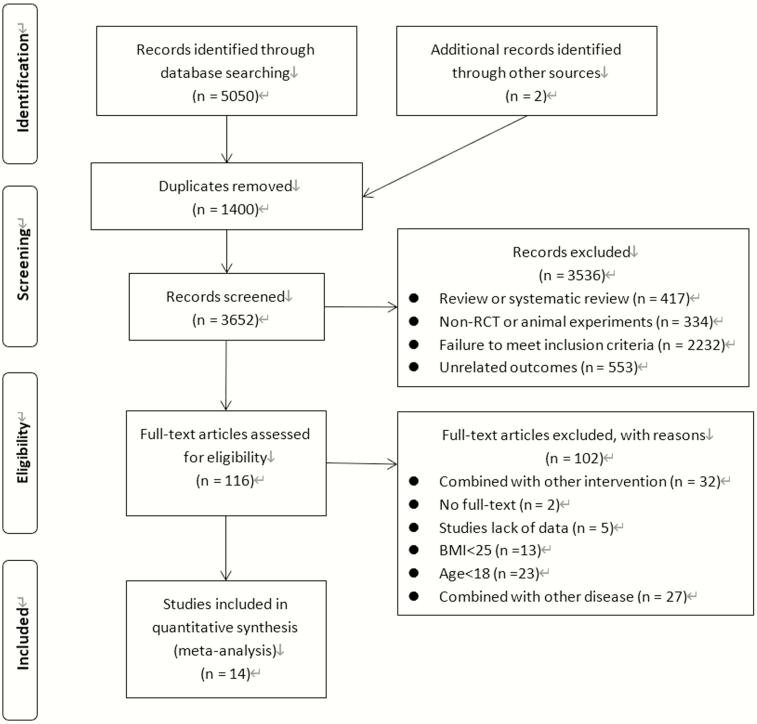
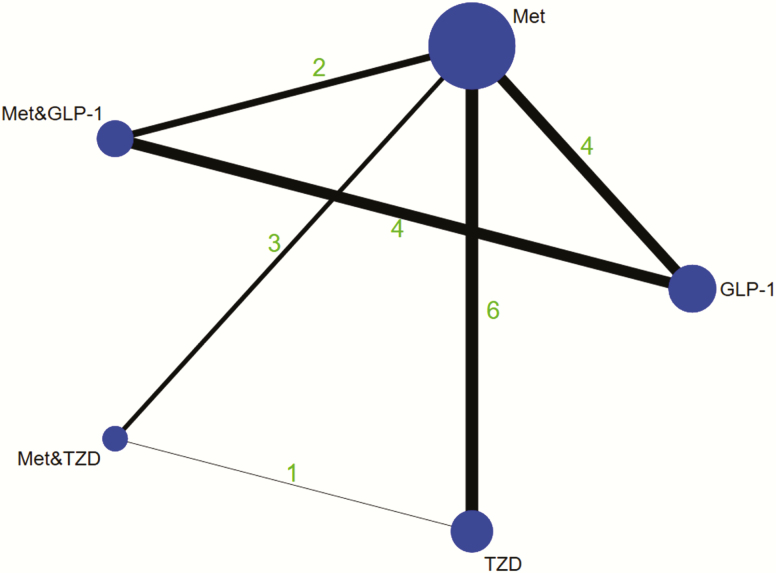
We searched multiple databases from inception to September 2019 for randomized controlled trials. Network meta-analysis was conducted using multivariate random effects method.
Fourteen trials reporting on 619 women were included. Compared with metformin, metformin + thiazolidinediones (TZDs) was more superior in menstrual recovery (weighted mean difference [WMD] 3.68; 95% credibility interval [CrI], 1.65 to 8.20), metformin + glucagon-like peptide-1 (GLP-1) receptor agonists was more effective in decreasing androstenedione (WMD -2.53; 95% CrI, -3.96 to -1.09), both metformin + GLP-1 receptor agonists (WMD 9.22; 95% CrI, 5.46 to 12.98) and metformin + TZDs (WMD 4.30; 95% CrI, 0.78 to 7.82) were more effective in increasing sex hormone-binding globulin (SHBG), while TZDs were less effective in decreasing body mass index (BMI) (WMD 1.69; 95% CrI, 0.72 to 2.66). Compared with GLP-1 receptor agonists, metformin + GLP-1 receptor agonists was associated with higher SHBG (WMD 7.80; 95% CrI, 4.75 to 10.85), lower free testosterone (WMD -1.77; 95% CrI, -3.25 to -0.29), lower androstenedione (WMD -2.70; 95% CrI, -3.91 to -1.50) and lower fasting blood glucose (WMD -0.41; 95% CrI, -0.73 to -0.08).
For overweight women with PCOS, both metformin combined with GLP-1 receptor agonists and metformin combined with TZDs appear superior to monotherapy in improving hyperandrogenemia. Metformin combined with TZDs could be particularly effective in promoting the recovery of menstruation. Metformin combined with GLP-1 receptor agonists has the additional advantage of improving fasting glucose when compared with GLP-1 receptor agonists alone. TZDs are inferior to metformin in decreasing BMI.
评估胰岛素增敏剂对超重多囊卵巢综合征(PCOS)妇女月经频率、性激素和代谢参数的疗效。
我们从建库到 2019 年 9 月在多个数据库中搜索了随机对照试验。使用多变量随机效应方法进行网络荟萃分析。
纳入了 14 项试验,共 619 名女性。与二甲双胍相比,二甲双胍联合噻唑烷二酮(TZD)在月经恢复方面更有效(加权均数差 [WMD] 3.68;95%置信区间 [CrI],1.65 至 8.20),二甲双胍联合胰高血糖素样肽-1(GLP-1)受体激动剂在降低雄烯二酮方面更有效(WMD -2.53;95% CrI,-3.96 至-1.09),二甲双胍联合 GLP-1 受体激动剂(WMD 9.22;95% CrI,5.46 至 12.98)和二甲双胍联合 TZD(WMD 4.30;95% CrI,0.78 至 7.82)在增加性激素结合球蛋白(SHBG)方面更有效,而 TZD 降低体重指数(BMI)的效果较差(WMD 1.69;95% CrI,0.72 至 2.66)。与 GLP-1 受体激动剂相比,二甲双胍联合 GLP-1 受体激动剂与更高的 SHBG 相关(WMD 7.80;95% CrI,4.75 至 10.85),更低的游离睾酮(WMD -1.77;95% CrI,-3.25 至-0.29),更低的雄烯二酮(WMD -2.70;95% CrI,-3.91 至-1.50)和更低的空腹血糖(WMD -0.41;95% CrI,-0.73 至-0.08)。
对于超重的多囊卵巢综合征妇女,二甲双胍联合 GLP-1 受体激动剂和二甲双胍联合 TZD 似乎比单药治疗更能改善高雄激素血症。二甲双胍联合 TZD 在促进月经恢复方面可能特别有效。与 GLP-1 受体激动剂单独使用相比,二甲双胍联合 GLP-1 受体激动剂具有改善空腹血糖的额外优势。与二甲双胍相比,TZD 降低 BMI 的效果较差。