Department of Radiology, University Medical Center Utrecht, Utrecht, The Netherlands.
Department of Clinical Sciences, Faculty of Veterinary Medicine, Utrecht University, Utrecht, The Netherlands.
J Orthop Res. 2020 Nov;38(11):2383-2389. doi: 10.1002/jor.24764. Epub 2020 Jun 10.
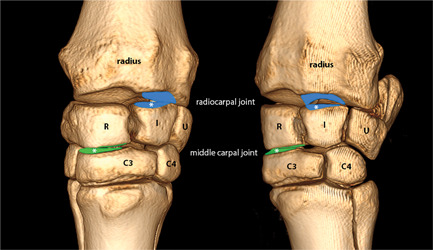
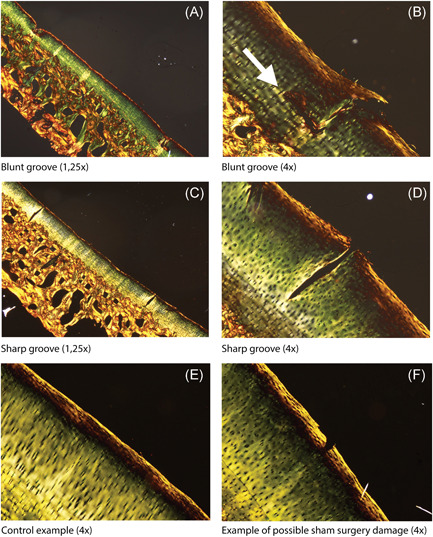
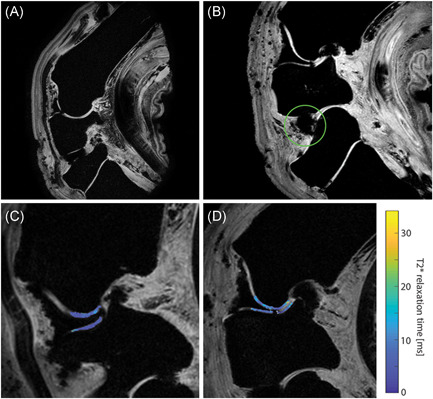
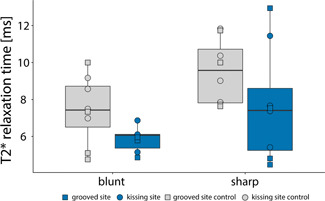
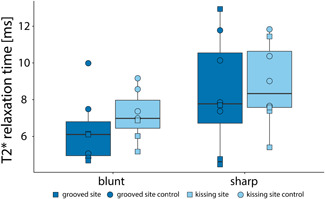
T2* mapping is promising for the evaluation of articular cartilage collagen. In this work, a groove model in a large animal is used as a model for posttraumatic arthritis. We hypothesized that T2* mapping could be employed to differentiate between healthy and (subtly) damaged cartilage. Eight carpal joints were obtained from four adult Shetland ponies that had been included in the groove study. In this model, grooves were surgically created on the proximal articular surface of the intermediate carpal bone (radiocarpal joint) and the radial facet of the third carpal bone (middle carpal joint) by either coarse disruption or sharp incision. After 9 months, T2* mapping of the entire carpal joint was carried out on a 7.0-T whole-body magnetic resonance imaging (MRI) scanner by means of a gradient echo multi-echo sequence. Afterwards, assessment of collagen orientation was carried out based on Picrosirius Red-stained histological sections, visualized by polarized light microscopy (PLM). The average T2* relaxation time in grooved samples was lower than in contralateral control sites. Opposite to the grooved areas, the "kissing sites" had a higher average T2* relaxation time than the grooved sites. PLM showed mild changes in orientation of the collagen fibers, particularly around blunt grooves. This work shows that T2* relaxation times are different in healthy cartilage vs (early) damaged cartilage, as induced by the equine groove model. Additionally, the average T2* relaxation times are different in kissing lesions vs the grooved sites.
T2* 映射有望用于评估关节软骨胶原。在这项工作中,使用大型动物的沟槽模型作为创伤后关节炎的模型。我们假设 T2* 映射可用于区分健康和(轻微)受损的软骨。从已纳入沟槽研究的四只成年设得兰矮种马中获得了八个腕关节。在该模型中,通过粗钝或锐切在中间腕骨(桡腕关节)的近侧关节面和第三腕骨(中间腕关节)的桡侧关节面上创建沟槽。9 个月后,在 7.0-T 全身磁共振成像(MRI)扫描仪上通过梯度回波多回波序列对整个腕关节进行 T2* 映射。之后,根据番红 O 染色的组织学切片,通过偏振光显微镜(PLM)进行胶原取向评估。有沟槽的样本的平均 T2* 弛豫时间低于对侧对照部位。与有沟槽的区域相反,“亲吻部位”的平均 T2* 弛豫时间高于有沟槽的部位。PLM 显示胶原纤维的取向有轻微变化,特别是在钝沟槽周围。这项工作表明,T2* 弛豫时间在健康软骨与(早期)受损软骨之间存在差异,这是由马的沟槽模型引起的。此外,亲吻病变与沟槽部位的平均 T2* 弛豫时间不同。