Department of Epidemiology and Biostatistics, Dornsife School of Public Health, Drexel University (AE Mudd, YL Michael, AV Diez-Roux, and F Lê-Scherban), Philadelphia, Pa.
Department of Epidemiology and Biostatistics, Dornsife School of Public Health, Drexel University (AE Mudd, YL Michael, AV Diez-Roux, and F Lê-Scherban), Philadelphia, Pa.
Acad Pediatr. 2020 Aug;20(6):871-878. doi: 10.1016/j.acap.2020.05.014. Epub 2020 May 31.
Evidence suggests that spatial accessibility to primary care is a contributing factor to appropriate health care utilization, with limited primary care access resulting in avoidable hospitalizations and emergency department visits which are burdensome on individuals and our health care system. Limited research, however, has examined the effects on children.
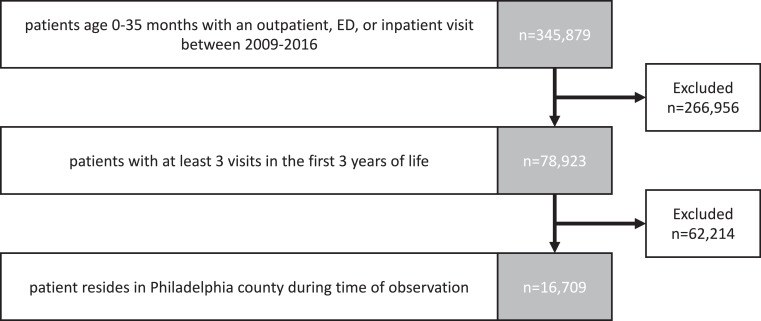
We evaluated associations of spatial accessibility to primary care on health care utilization among a sample of 16,709 children aged 0 to 3 years in Philadelphia who were primarily non-White and publicly insured. Log-Poisson models with generalized estimating equations were used to estimate incidence rate ratios (RR) and 95% confidence intervals (CI), while accounting for 3 levels of clustering (within individual, within primary care practice, within neighborhood).
In age-adjusted models, the lowest level of spatial accessibility was associated with 7% fewer primary care visits (RR 0.93, 95% CI 0.91, 0.95), 15% more emergency department visits (RR 1.15, 95% CI 1.09, 1.22), and 18% more avoidable hospitalizations (RR 1.18, 95% CI 1.01, 1.37). After adjustment for individual- (race/ethnicity, sex, number of chronic conditions, insurance status) and neighborhood-level (racial composition and proportion of housing units with no vehicle), spatial accessibility was not significantly associated with rate of health care utilization.
Individual-level predisposing factors, such as age, race, and need, attenuate the association between accessibility to primary care and use of primary care, emergency department visits, and avoidable hospitalization. Given the possibility of modifying access to primary care unlike immutable individual factors, a focus on spatial accessibility to primary care may promote appropriate health care utilization.
有证据表明,初级保健的空间可达性是适当医疗保健利用的一个促成因素,初级保健机会有限会导致可避免的住院和急诊就诊,这给个人和我们的医疗保健系统带来了负担。然而,有限的研究考察了对儿童的影响。
我们评估了初级保健空间可达性对费城 16709 名 0 至 3 岁儿童医疗保健利用的影响,这些儿童主要是非白人且有公共保险。使用广义估计方程的对数泊松模型来估计发病率比(RR)和 95%置信区间(CI),同时考虑到 3 个层次的聚类(个体内、初级保健实践内、邻里内)。
在年龄调整模型中,最低水平的空间可达性与初级保健就诊次数减少 7%相关(RR 0.93,95%CI 0.91,0.95)、急诊就诊次数增加 15%相关(RR 1.15,95%CI 1.09,1.22)和可避免住院次数增加 18%相关(RR 1.18,95%CI 1.01,1.37)。在调整个体层面(种族/民族、性别、慢性病数量、保险状况)和邻里层面(种族构成和无交通工具住房单元比例)的因素后,空间可达性与医疗保健利用率的比率不再显著相关。
个体层面的倾向因素,如年龄、种族和需求,削弱了初级保健可达性与初级保健、急诊就诊和可避免住院就诊利用率之间的关联。鉴于与不可改变的个体因素相比,初级保健的可达性具有改变的可能性,因此关注初级保健的空间可达性可能会促进适当的医疗保健利用。