Cardiovascular Epidemiology Unit Gertner Institute for Epidemiology and Health Policy Research Sheba Medical Center Ramat-Gan Israel.
Sackler Faculty of Medicine Tel Aviv University Tel Aviv Israel.
J Am Heart Assoc. 2021 Jan 19;10(2):e018037. doi: 10.1161/JAHA.120.018037. Epub 2021 Jan 12.
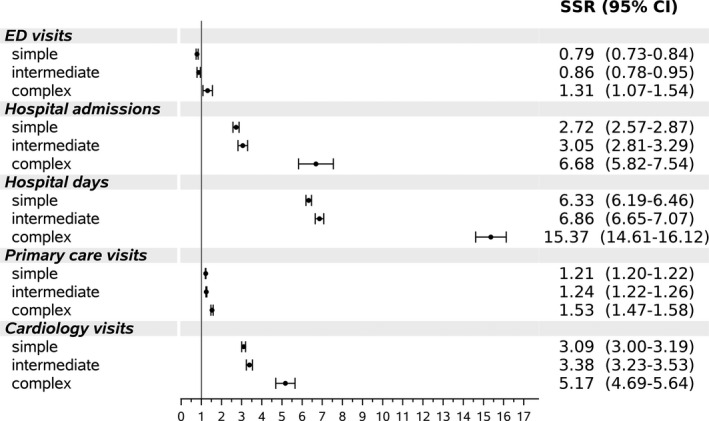
Background Several studies have examined hospitalizations among patients with adult congenital heart disease (ACHD). Few investigated other services or utilization patterns. Our aim was to study service utilization patterns and predictors among patients with ACHD. Methods and Results We identified 11 653 patients with ACHD aged ≥18 years (median, 47 years), through electronic records of 2 large Israeli healthcare providers (2007-2011). The association between patient, disease, and sociogeographic characteristics and healthcare resource utilization were modeled as recurrent events accounting for the competing death risk. Patients with ACHD had high healthcare utilization rates compared with the general population. The highest standardized service utilization ratios (SSRs) were found among patients with complex congenital heart disease including primary care visits (SSR, 1.53; 95% CI, 1.47-1.58), cardiology outpatient visits (SSR, 5.17; 95% CI, 4.69-5.64), hospitalizations (SSR, 6.68; 95% CI, 5.82-7.54), and days in hospital (SSR, 15.37; 95% CI, 14.61-16.12). Adjusted resource utilization hazard increased with increasing lesion complexity. Hazard ratios (HRs) for complex versus simple disease were: primary care (HR, 1.14; 95% CI, 1.06-1.23); cardiology outpatient visits (HR, 1.40; 95% CI, 1.24-1.59); emergency department visits (HR, 1.19; 95% CI, 1.02-1.39); and hospitalizations (HR, 1.75; 95% CI, 1.49-2.05). Effects attenuated with age for cardiology outpatient visits and hospitalizations and increased for emergency department visits. Female sex, geographic periphery, and ethnic minority were associated with more primary care visits, and female sex (HR versus men, 0.89 [95% CI, 0.84-0.94]) and periphery (HR, 0.72 [95% CI, 0.58-0.90] for very peripheral versus very central) were associated with fewer cardiology visits. Arab minority patients also had high hospitalization rates compared with the majority group of Jewish or other patients. Conclusions Healthcare utilization rates were high among patients with ACHD. Female sex, geographic periphery, and ethnicity were associated with less optimal service utilization patterns. Further research should examine strategies to optimize service utilization in these groups.
多项研究调查了成人先天性心脏病(ACHD)患者的住院情况。很少有研究调查其他服务或利用模式。我们的目的是研究 ACHD 患者的服务利用模式和预测因素。
我们通过两家大型以色列医疗保健提供者的电子记录,确定了 11653 名年龄≥18 岁(中位数 47 岁)的 ACHD 患者。通过反复事件建模,将患者、疾病和社会地理特征与医疗资源利用之间的关联作为竞争死亡风险进行建模。与一般人群相比,ACHD 患者的医疗保健利用率很高。最高的标准化服务利用率比(SSR)见于患有复杂先天性心脏病的患者,包括初级保健就诊(SSR,1.53;95%CI,1.47-1.58)、心脏病学门诊就诊(SSR,5.17;95%CI,4.69-5.64)、住院(SSR,6.68;95%CI,5.82-7.54)和住院天数(SSR,15.37;95%CI,14.61-16.12)。调整后的资源利用危害随着病变复杂性的增加而增加。与简单疾病相比,复杂疾病的危害比(HR)为:初级保健(HR,1.14;95%CI,1.06-1.23);心脏病学门诊就诊(HR,1.40;95%CI,1.24-1.59);急诊就诊(HR,1.19;95%CI,1.02-1.39);以及住院治疗(HR,1.75;95%CI,1.49-2.05)。心脏病学门诊就诊和住院治疗的 HR 随年龄的增长而减弱,而急诊就诊的 HR 则随年龄的增长而增加。女性、地理边缘和少数民族与更多的初级保健就诊相关,而女性(与男性相比,0.89 [95%CI,0.84-0.94])和边缘(对于非常边缘与非常中心,0.72 [95%CI,0.58-0.90])与较少的心脏病就诊相关。阿拉伯少数民族患者的住院率也高于犹太或其他多数族裔患者。
ACHD 患者的医疗保健利用率很高。女性、地理边缘和种族与不太理想的服务利用模式相关。进一步的研究应该检查在这些群体中优化服务利用的策略。