Xu Chun-Wei, Lei Lei, Wang Wen-Xian, Lin Li, Zhu You-Cai, Wang Hong, Miao Li-Yun, Wang Li-Ping, Zhuang Wu, Fang Mei-Yu, Lv Tang-Feng, Song Yong
Department of Respiratory Medicine, Affiliated Jinling Hospital, Medical School of Nanjing University, Nanjing, Jiangsu 210002, People's Republic of China.
Department of Chemotherapy, Institute of Cancer Research and Basic Medical Sciences of Chinese Academy of Sciences, Cancer Hospital of University of Chinese Academy of Sciences, Zhejiang Cancer Hospital, Hangzhou, Zhejiang 310022, People's Republic of China.
Transl Oncol. 2020 Sep;13(9):100791. doi: 10.1016/j.tranon.2020.100791. Epub 2020 May 31.
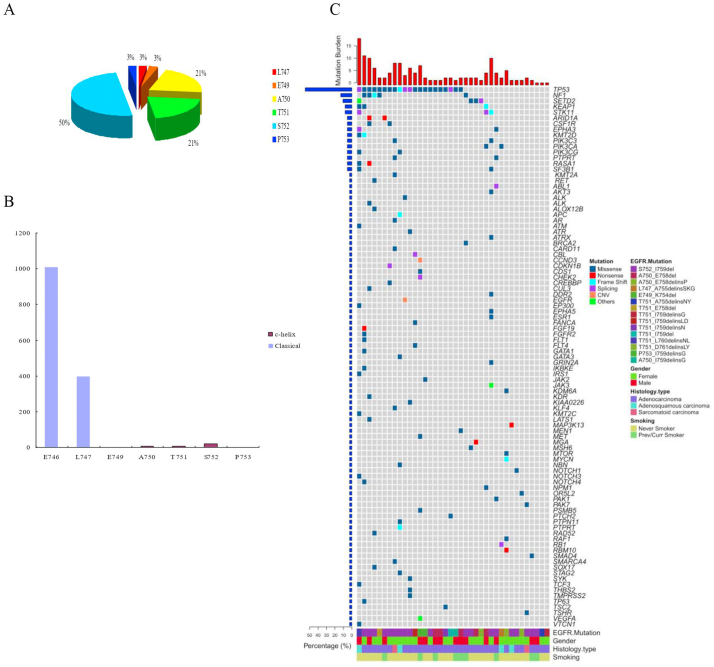
Epidermal growth factor receptor (EGFR) exon 19 deletion (E19del) is the most common activating mutation in advanced non-small cell lung cancer (NSCLC) and associates with the sensitivity of EGFR tyrosine kinase inhibitors (TKIs) treatment. However, not all mutant patterns of E19del have been well studied for the limited coverage of regular EGFR mutation testing. Here, we performed a retrospective cohort study of the C-helix E19del in advanced NSCLC patients based on the screening data by the next-generation sequencing (NGS) platform. From May 2012 to December 2019, clinical information and specimen from 7544 consecutive advanced (IIIB/IV) NSCLC patients were collected and screened for EGFR gene mutations by NGS from multicenters in China. The molecular characteristics and responsiveness to first-line EGFR TKIs therapy in NSCLC patients with C-helix E19del were analyzed. The clinical characteristics were also compared between patients with classical E19del and C-helix E19del. Thirty-eight (2.6%) patients with C-helix E19del and 1400 (97.4%) patients with classical E19dels were identified from 1438 patients with E19del. No significant difference in clinical characteristics was observed between the C-helix E19del and classical E19del groups (P > .05), except for histology (P < .001). All 22 patients with C-helix E19del as p.S752_I759del, p.A750_E758del, p.A750_E758delinsP, p.T751_A755delinsNY, p.T751_I759delinsG, p.T751_I759delinsLD, p.T751_I759delinsN, p.T751_L760delinsNL, and p.T751_D761delinsLY reached the best response as partial response rate (72.7%), and the progression-free survival (PFS) was 12.0 months. The PFS after EGFR TKIs in patients with C-helix E19del tended to be longer than patients with classical E19del but has no statistical significance (12.0 months vs 8.5 months, P = .06). The C-helix E19del could be a positive biomarker for predicting response to EGFR TKIs in advanced NSCLC patients. NGS should be the appropriate platform to identify this rare population, especially when patients harbor no actionable driver mutation initially and are reluctant to accept chemotherapy as first-line therapy.
表皮生长因子受体(EGFR)外显子19缺失(E19del)是晚期非小细胞肺癌(NSCLC)中最常见的激活突变,与EGFR酪氨酸激酶抑制剂(TKIs)治疗的敏感性相关。然而,由于常规EGFR突变检测覆盖范围有限,并非所有E19del的突变模式都得到了充分研究。在此,我们基于下一代测序(NGS)平台的筛查数据,对晚期NSCLC患者中的C螺旋E19del进行了一项回顾性队列研究。2012年5月至2019年12月,收集了7544例连续的晚期(IIIB/IV期)NSCLC患者的临床信息和标本,并通过NGS对来自中国多中心的患者进行EGFR基因突变筛查。分析了C螺旋E19del的NSCLC患者的分子特征及对一线EGFR TKIs治疗的反应性。还比较了经典E19del和C螺旋E19del患者的临床特征。在1438例E19del患者中,鉴定出38例(2.6%)C螺旋E19del患者和1400例(97.4%)经典E19del患者。除组织学外(P<0.001),C螺旋E19del组和经典E19del组在临床特征上未观察到显著差异(P>0.05)。所有22例C螺旋E19del为p.S752_I759del、p.A750_E758del、p.A750_E758delinsP、p.T751_A755delinsNY、p.T751_I759delinsG、p.T751_I759delinsLD、p.T751_I759delinsN、p.T751_L760delinsNL和p.T751_D761delinsLY的患者达到最佳反应,部分缓解率为72.7%,无进展生存期(PFS)为12.0个月。C螺旋E19del患者接受EGFR TKIs治疗后的PFS往往比经典E19del患者长,但无统计学意义(12.0个月对8.5个月,P = 0.06)。C螺旋E19del可能是预测晚期NSCLC患者对EGFR TKIs反应的阳性生物标志物。NGS应该是识别这一罕见人群的合适平台,尤其是当患者最初没有可操作的驱动基因突变且不愿接受化疗作为一线治疗时。