Department of Drug Addiction Pharmacology, Maj Institute of Pharmacology Polish Academy of Sciences, 31-343 Kraków, Poland.
Department of Neuroscience, Karolinska Institutet, 171 77 Stockholm, Sweden.
Cells. 2020 Jun 1;9(6):1372. doi: 10.3390/cells9061372.
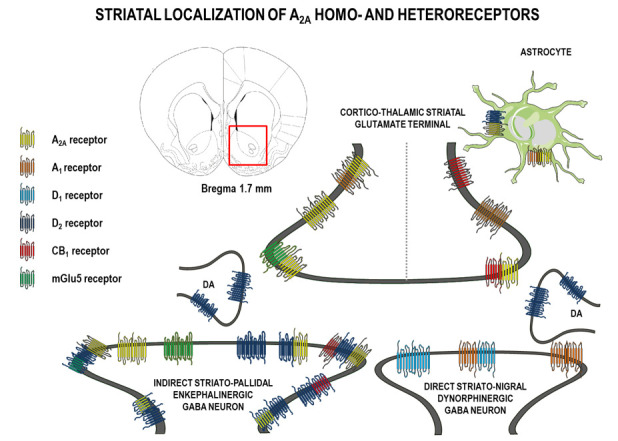
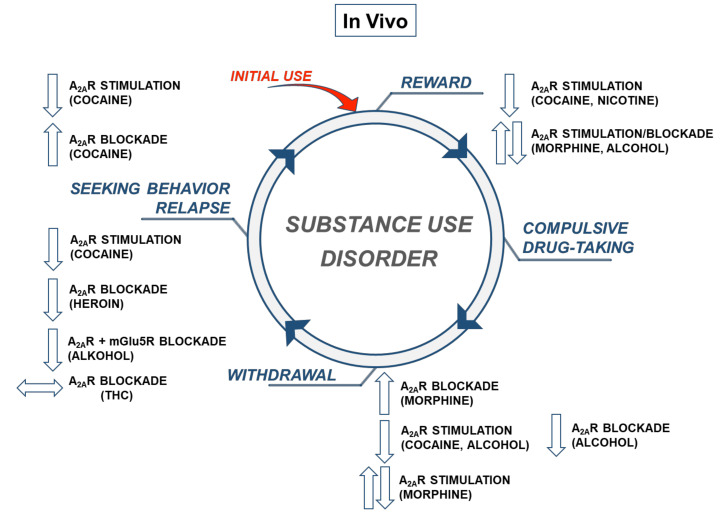
Several psychoactive drugs can evoke substance use disorders (SUD) in humans and animals, and these include psychostimulants, opioids, cannabinoids (CB), nicotine, and alcohol. The etiology, mechanistic processes, and the therapeutic options to deal with SUD are not well understood. The common feature of all abused drugs is that they increase dopamine (DA) neurotransmission within the mesocorticolimbic circuitry of the brain followed by the activation of DA receptors. D receptors were proposed as important molecular targets for SUD. The findings showed that D receptors formed heteromeric complexes with other GPCRs, which forced the addiction research area in new directions. In this review, we updated the view on the brain D receptor complexes with adenosine (A)2A receptors (AR) and discussed the role of AR in different aspects of addiction phenotypes in laboratory animal procedures that permit the highly complex syndrome of human drug addiction. We presented the current knowledge on the neurochemical in vivo and ex vivo mechanisms related to cocaine use disorder (CUD) and discussed future research directions for AR heteromeric complexes in SUD.
几种精神活性药物可在人类和动物中诱发物质使用障碍(SUD),其中包括精神兴奋剂、阿片类药物、大麻素(CB)、尼古丁和酒精。SUD 的病因、机制过程和治疗选择尚不完全清楚。所有滥用药物的共同特征是它们增加了大脑中中脑边缘多巴胺(DA)神经传递,随后激活了 DA 受体。D 受体被认为是 SUD 的重要分子靶点。研究结果表明,D 受体与其他 GPCR 形成异源二聚体复合物,这迫使成瘾研究领域朝着新的方向发展。在这篇综述中,我们更新了大脑 D 受体与腺苷(A)2A 受体(AR)复合物的观点,并讨论了 AR 在实验室动物程序中不同成瘾表型方面的作用,这些程序允许出现人类药物成瘾的高度复杂综合征。我们介绍了与可卡因使用障碍(CUD)相关的神经化学体内和体外机制的最新知识,并讨论了 SUD 中 AR 异源二聚体的未来研究方向。