Takeshita Akihiro, Asou Norio, Atsuta Yoshiko, Furumaki Hiroaki, Sakura Toru, Ueda Yasunori, Sawa Masashi, Dobashi Nobuaki, Taniguchi Yasuhiro, Suzuki Rikio, Nakagawa Masaru, Tamaki Shigehisa, Hagihara Maki, Fujimaki Katsumichi, Minamiguchi Hitoshi, Fujita Hiroyuki, Yanada Masamitsu, Maeda Yoshinobu, Usui Noriko, Kobayashi Yukio, Kiyoi Hitoshi, Ohtake Shigeki, Matsumura Itaru, Naoe Tomoki, Miyazaki Yasushi, Group The Japan Adult Leukemia Study
Transfusion and Cell Therapy, Hamamatsu University School of Medicine, 1-20-1 Handayama, Hamamatsu, Higashiku 431-3192, Japan.
International Medical Center, Saitama Medical University, 1397-1, Yamane, Hidaka 350-1298, Japan.
Cancers (Basel). 2020 Jun 1;12(6):1444. doi: 10.3390/cancers12061444.
After long-term analysis of the JALSG-APL204 study we recently reported that maintenance therapy with tamibarotene was more effective than all-trans retinoic acid (ATRA) by reducing relapse in APL patients. Here, the clinical significance of other important prognostic factors was evaluated with multivariate analyses.
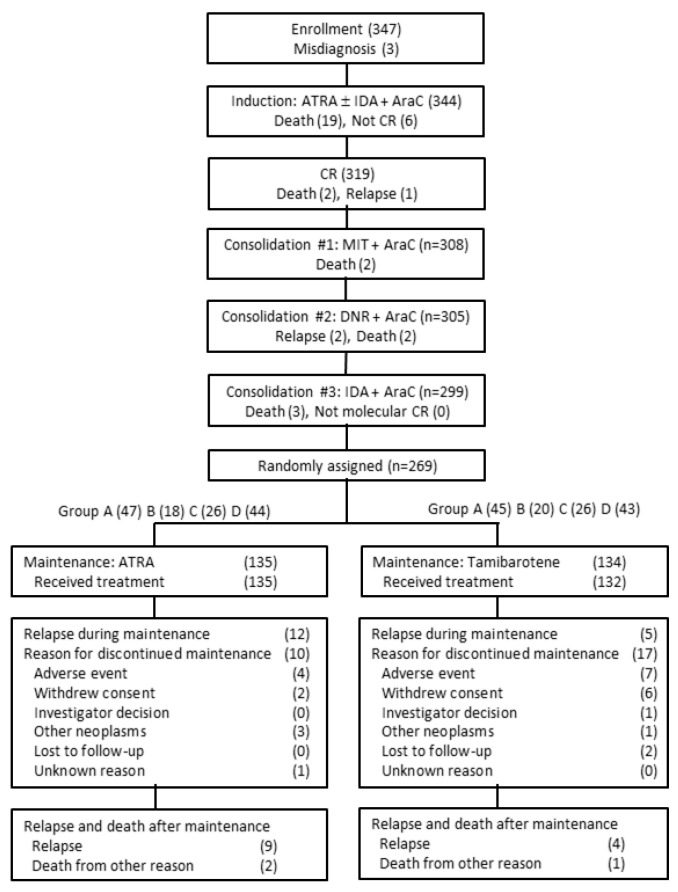
Newly diagnosed acute promyelocytic leukemia (APL) patients were registered with the study. Induction was composed of ATRA and chemotherapy. Patients who achieved molecular remission after consolidation were randomly assigned to maintenance with tamibarotene or ATRA.
Of the 344 eligible patients, 319 (93%) achieved complete remission (CR). After completing consolidation, 269 patients underwent maintenance random assignment-135 to ATRA, and 134 to tamibarotene. By multivariate analysis, overexpression of CD56 in blast was an independent unfavorable prognostic factor for relapse-free survival (RFS) ( = 0.006) together with more than 10.0 × 10/L WBC counts ( = 0.001) and the ATRA arm in maintenance ( = 0.028). Of all phenotypes, CD56 was related most clearly to an unfavorable prognosis. The CR rate, mortality rate during induction and overall survival of CD56 APL were not significantly different compared with CD56 APL. CD56 is continuously an independent unfavorable prognostic factor for RFS in APL patients treated with ATRA and chemotherapy followed by ATRA or tamibarotene maintenance therapy.
在对JALSG - APL204研究进行长期分析后,我们最近报告称,与全反式维甲酸(ATRA)相比,使用他米巴罗汀进行维持治疗在降低急性早幼粒细胞白血病(APL)患者复发率方面更有效。在此,通过多因素分析评估了其他重要预后因素的临床意义。
新诊断的急性早幼粒细胞白血病患者登记参加本研究。诱导治疗由ATRA和化疗组成。巩固治疗后达到分子缓解的患者被随机分配接受他米巴罗汀或ATRA维持治疗。
在344例符合条件的患者中,319例(93%)实现完全缓解(CR)。完成巩固治疗后,269例患者接受维持治疗随机分组,135例接受ATRA治疗,134例接受他米巴罗汀治疗。通过多因素分析,原始细胞中CD56过表达是无复发生存期(RFS)的独立不良预后因素(P = 0.006),白细胞计数超过10.0×10⁹/L(P = 0.001)以及维持治疗采用ATRA组(P = 0.028)也是不良预后因素。在所有表型中,CD56与不良预后的相关性最为明显。CD56⁺APL的CR率、诱导期死亡率和总生存率与CD56⁻APL相比无显著差异。在接受ATRA和化疗后采用ATRA或他米巴罗汀维持治疗的APL患者中,CD56持续是RFS的独立不良预后因素。