Department of International Health, Johns Hopkins Bloomberg School of Public Health, 615 N Wolfe St, Baltimore, MD, 21205, USA.
Department of Epidemiology, Johns Hopkins Bloomberg School of Public Health, Baltimore, MD, USA.
Int J Equity Health. 2020 Jun 3;19(1):82. doi: 10.1186/s12939-020-01199-z.
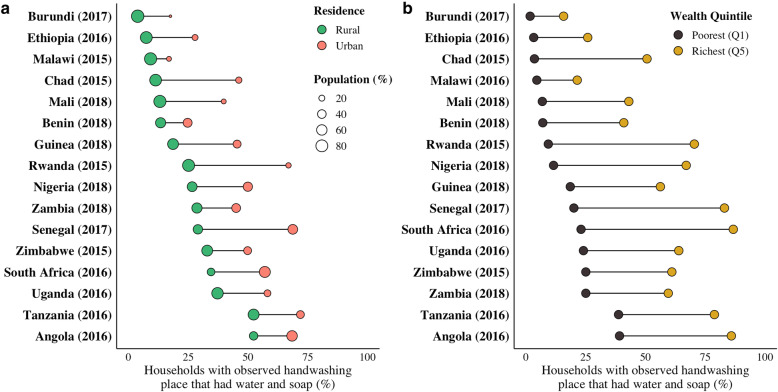
The COVID-19 pandemic has spread rapidly since the first case notification of the WHO in December 2019. Lacking an effective treatment, countries have implemented non-pharmaceutical interventions including social distancing measures and have encouraged maintaining adequate and frequent hand hygiene to slow down the disease transmission. Although access to clean water and soap is universal in high-income settings, it remains a basic need many do not have in low- and middle-income settings.We analyzed data from Demographic and Health Surveys (DHS) of 16 countries in sub-Saharan Africa, using the most recent survey since 2015. Differences in the percentage of households with an observed handwashing place with water and soap were estimated by place of residence and wealth quintiles. Equiplots showed wide within-country disparities, disproportionately affecting the poorest households and rural residents, who represent the majority of the population in most of the countries.Social inequalities in access to water and soap matter for the COVID-19 response in sub-Saharan Africa. Interventions such as mass distribution of soap and ensuring access to clean water, along with other preventive strategies should be scaled up to reach the most vulnerable populations.
自 2019 年世界卫生组织首次通报 COVID-19 病例以来,该疫情迅速蔓延。由于缺乏有效的治疗方法,各国已采取非药物干预措施,包括社交距离措施,并鼓励保持充足和频繁的手部卫生,以减缓疾病传播。尽管在高收入国家,清洁水和肥皂的供应是普遍的,但在中低收入国家,这仍然是许多人所缺乏的基本需求。我们分析了来自撒哈拉以南非洲 16 个国家的人口与健康调查(DHS)数据,使用了自 2015 年以来最新的调查数据。根据居住地和财富五分位数,估计了观察到有洗手用水和肥皂的家庭比例的差异。等距图显示了国内的巨大差异,对最贫困家庭和农村居民的影响不成比例,而这些人在大多数国家都占人口的大多数。在撒哈拉以南非洲,获得水和肥皂的社会不平等对 COVID-19 的应对措施至关重要。应该扩大肥皂的大规模分发和确保清洁水供应等干预措施,并结合其他预防策略,以覆盖最脆弱的人群。