General ICU, Henan Key Laboratory of Critical Care Medicine, The First Affiliated Hospital of Zhengzhou University, Zhengzhou Key Laboratory of Sepsis, Zhengzhou, 450052, China.
Stem Cell Res Ther. 2020 Jun 3;11(1):214. doi: 10.1186/s13287-020-01730-7.
Multiple studies have reported that mesenchymal stem cell (MSC) therapy has beneficial effects in experimental models of sepsis. However, this finding remains inconclusive. This study was performed to systematically determine the connection between MSC therapy and mortality in sepsis animal models by pooling and analyzing data from newly published studies.
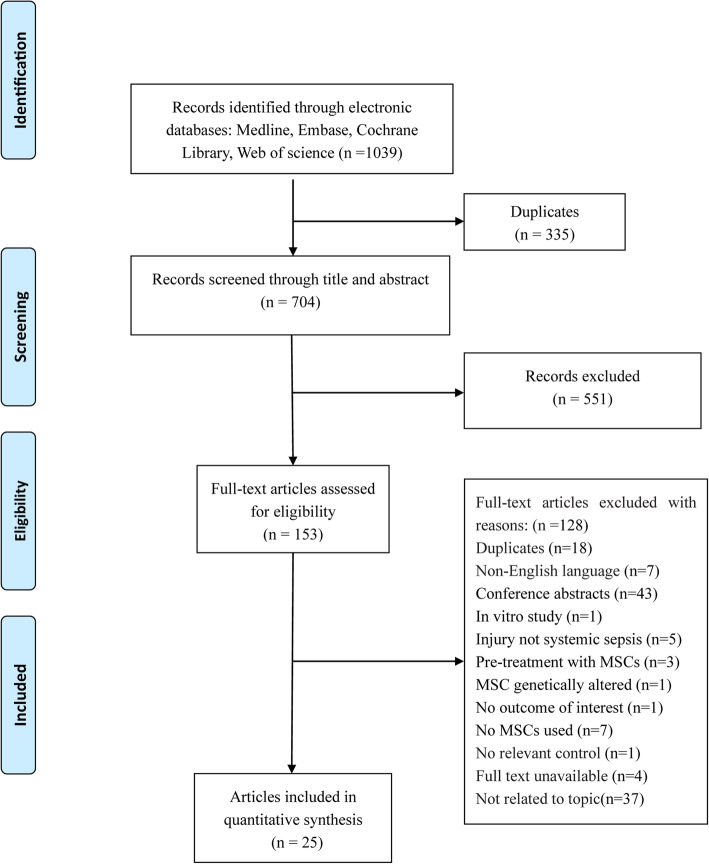
A detailed search of related studies from 2009 to 2019 was conducted in four databases, including MEDLINE, EMBASE, Cochrane Library, and Web of Science. After browsing and filtering out articles that met the inclusion criteria for statistical analysis, the inverse variance method of the fixed effects model was used to calculate the pooled odds ratios (ORs) and their 95% confidence intervals (CIs).
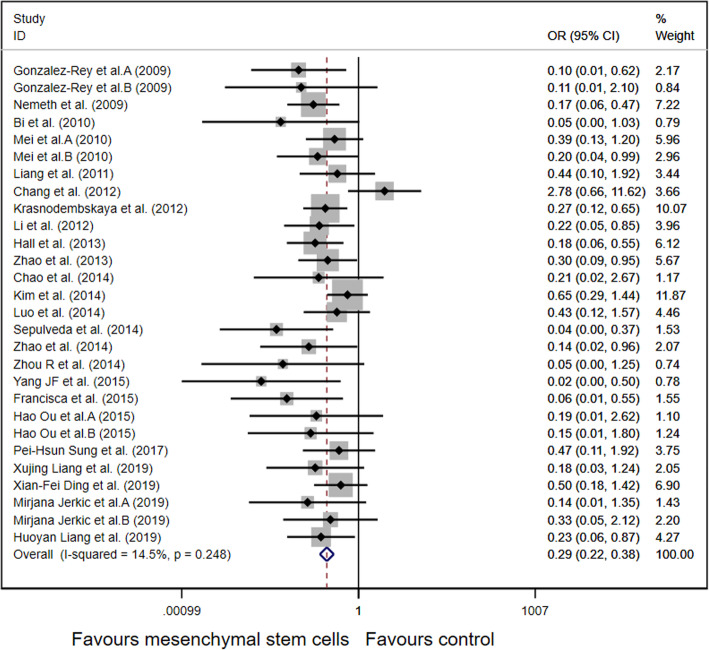
Twenty-nine animal studies, including 1266 animals, were identified. None of the studies was judged to have a low risk of bias. The meta-analysis demonstrated that MSC therapy was related to a significantly lower mortality rate (OR 0.29, 95% CI 0.22-0.38, P < 0.001). Subgroup analyses performed based on the MSC injection dose (< 1.0 × 10 cells, OR = 0.33, 95% CI 0.20-0.56, P < 0.001; 1.0 × 10 cells, OR = 0.24, 95% CI 0.16-0.35, P < 0.001) and injection time (< 1 h, OR = 0.24, 95% CI 0.13-0.45, P < 0.001; 1 h, OR = 0.28, 95% CI 0.17-0.46, P < 0.001) demonstrated that treatment with MSCs significantly reduced the mortality rate of animals with sepsis.
This up-to-date meta-analysis showed a connection between MSC therapy and lower mortality in sepsis animal models, supporting the potential therapeutic effect of MSC treatment in future clinical trials. The results in this study contradict a previous meta-analysis with regards to the ideal dose of MSC therapy. Thus, further research is required to support these findings.
多项研究报告称,间充质干细胞(MSC)治疗对脓毒症的实验模型具有有益作用。然而,这一发现仍不确定。本研究通过汇集和分析 2009 年至 2019 年新发表的研究数据,旨在系统地确定 MSC 治疗与脓毒症动物模型死亡率之间的关系。
在 MEDLINE、EMBASE、Cochrane 图书馆和 Web of Science 四个数据库中进行了详细的相关研究检索。在浏览和筛选出符合统计学分析纳入标准的文章后,采用固定效应模型的逆方差法计算合并优势比(OR)及其 95%置信区间(CI)。
确定了 29 项动物研究,共纳入 1266 只动物。没有一项研究被判定为低偏倚风险。荟萃分析表明,MSC 治疗与死亡率显著降低相关(OR 0.29,95%CI 0.22-0.38,P<0.001)。基于 MSC 注射剂量(<1.0×10 个细胞,OR=0.33,95%CI 0.20-0.56,P<0.001;1.0×10 个细胞,OR=0.24,95%CI 0.16-0.35,P<0.001)和注射时间(<1 小时,OR=0.24,95%CI 0.13-0.45,P<0.001;1 小时,OR=0.28,95%CI 0.17-0.46,P<0.001)的亚组分析表明,MSC 治疗可显著降低脓毒症动物的死亡率。
本最新荟萃分析显示,MSC 治疗与脓毒症动物模型死亡率降低之间存在关联,支持 MSC 治疗在未来临床试验中的潜在治疗效果。本研究的结果与之前关于 MSC 治疗理想剂量的荟萃分析结果相矛盾。因此,需要进一步的研究来支持这些发现。