Division of Rheumatology, Children's Hospital of Philadelphia, Philadelphia, PA, 19104, USA.
Center for Pediatric Clinical Effectiveness, Children's Hospital of Philadelphia Research Institute, Philadelphia, PA, 19146, USA.
Arthritis Res Ther. 2020 Jun 3;22(1):129. doi: 10.1186/s13075-020-02224-w.
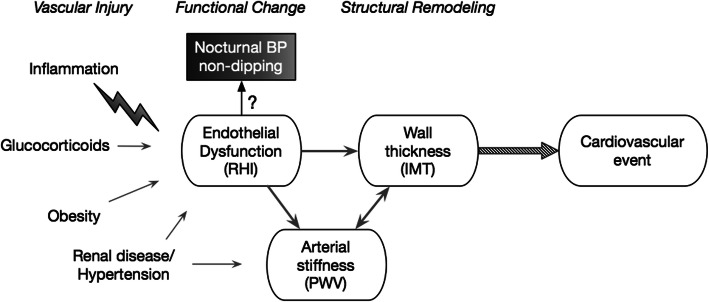
Loss of the normal nocturnal decline in blood pressure (BP), known as non-dipping, is a potential measure of cardiovascular risk identified by ambulatory blood pressure monitoring (ABPM). We sought to determine whether non-dipping is a useful marker of abnormal vascular function and subclinical atherosclerosis in pediatric-onset systemic lupus erythematosus (pSLE).
Twenty subjects 9-19 years of age with pSLE underwent ABPM, peripheral endothelial function testing, carotid-femoral pulse wave velocity/analysis for aortic stiffness, and carotid intima-media thickness. We assessed the prevalence of non-dipping and other ABPM abnormalities. Pearson or Spearman rank correlation tests were used to evaluate relationships between nocturnal BP dipping, BP load (% of abnormally elevated BPs over 24-h), and vascular outcome measures.
The majority (75%) of subjects had inactive disease, with mean disease duration of 3.2 years (± 2.1). The prevalence of non-dipping was 50%, which occurred even in the absence of nocturnal or daytime hypertension. Reduced diastolic BP dipping was associated with poorer endothelial function (r 0.5, p = 0.04). Intima-media thickness was significantly greater in subjects with non-dipping (mean standard deviation score of 3.0 vs 1.6, p = 0.02). In contrast, higher systolic and diastolic BP load were associated with increased aortic stiffness (ρ 0.6, p = 0.01 and ρ 0.7, p < 0.01, respectively), but not with endothelial function or intima-media thickness.
In a pSLE cohort with low disease activity, isolated nocturnal BP non-dipping is prevalent and associated with endothelial dysfunction and atherosclerotic changes. In addition to hypertension assessment, ABPM has a promising role in risk stratification and understanding heterogeneous mechanisms of cardiovascular disease in pSLE.
夜间血压(BP)正常下降的丧失,即非杓型,是通过动态血压监测(ABPM)确定的心血管风险的潜在指标。我们试图确定非杓型是否是儿童起病系统性红斑狼疮(pSLE)患者异常血管功能和亚临床动脉粥样硬化的有用标志物。
20 名年龄在 9-19 岁的 pSLE 患者接受 ABPM、外周内皮功能测试、颈动脉-股动脉脉搏波速度/主动脉僵硬度分析和颈动脉内膜中层厚度检查。我们评估了非杓型和其他 ABPM 异常的发生率。Pearson 或 Spearman 秩相关检验用于评估夜间 BP 下降与 BP 负荷(24 小时内异常升高的 BP 百分比)和血管结果测量之间的关系。
大多数(75%)患者患有活动性疾病,平均病程为 3.2±2.1 年。非杓型的发生率为 50%,即使在没有夜间或日间高血压的情况下也会发生。舒张压下降减少与内皮功能较差相关(r 0.5,p=0.04)。非杓型患者的内膜中层厚度明显更大(平均标准差值为 3.0 对 1.6,p=0.02)。相反,较高的收缩压和舒张压负荷与主动脉僵硬度增加相关(ρ 0.6,p=0.01 和 ρ 0.7,p<0.01),但与内皮功能或内膜中层厚度无关。
在疾病活动度低的 pSLE 队列中,孤立的夜间 BP 非杓型很常见,与内皮功能障碍和动脉粥样硬化变化有关。除了高血压评估外,ABPM 在风险分层和理解 pSLE 中心血管疾病的异质机制方面具有广阔的应用前景。