Lenahan Jennifer L, Nkwopara Evangelyn, Phiri Melda, Mvalo Tisungane, Couasnon Mari T, Turner Kali, Ndamala Chifundo, McCollum Eric D, May Susanne, Ginsburg Amy Sarah
International Programs, Save the Children Federation Inc., Westport, CT, USA.
Dept of Pediatrics, University of North Carolina Project, Lilongwe Medical Relief Fund Trust, Lilongwe, Malawi.
ERJ Open Res. 2020 May 26;6(2). doi: 10.1183/23120541.00275-2019. eCollection 2020 Apr.
As part of a randomised controlled trial of treatment with placebo 3 days of amoxicillin for nonsevere fast-breathing pneumonia among Malawian children aged 2-59 months, a subset of children was hospitalised for observation. We sought to characterise the progression of fast-breathing pneumonia among children undergoing repeat assessments to better understand which children do and do not deteriorate.
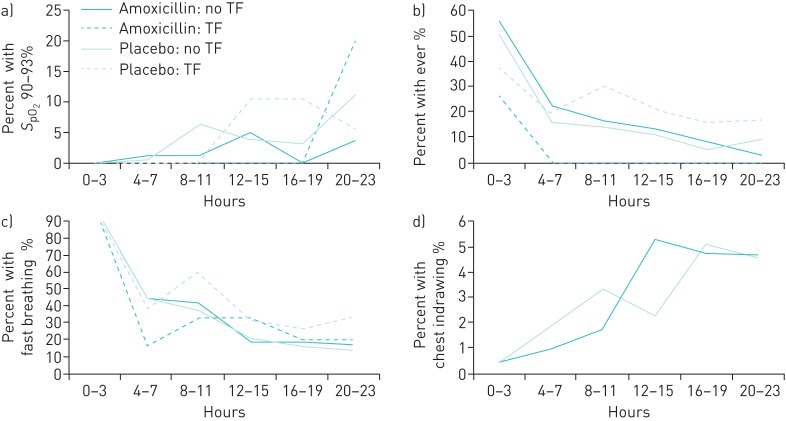
Vital signs and physical examination findings, including respiratory rate, arterial oxygen saturation measured by pulse oximetry ( ), chest indrawing and temperature were assessed every 3 h for the duration of hospitalisation. Children were assessed for treatment failure during study visits on days 1, 2, 3 and 4.
Hospital monitoring data from 436 children were included. While no children had 90-93% at baseline, 7.4% (16 of 215) of children receiving amoxicillin and 9.5% (21 of 221) receiving placebo developed 90-93% during monitoring. Similarly, no children had chest indrawing at enrolment, but 6.6% (14 of 215) in the amoxicillin group and 7.2% (16 of 221) in the placebo group went on to develop chest indrawing during hospitalisation.
Repeat monitoring of children with fast-breathing pneumonia identified vital and physical examination signs not present at baseline, including 90-93% and chest indrawing. This information may support providers and policymakers in developing guidance for care of children with nonsevere pneumonia.
作为一项针对马拉维2至59个月大儿童非重症快速呼吸性肺炎进行的为期3天的阿莫西林与安慰剂治疗随机对照试验的一部分,有一部分儿童被收治入院观察。我们试图描述接受重复评估的儿童快速呼吸性肺炎的病情进展,以更好地了解哪些儿童病情会恶化,哪些不会。
在住院期间,每3小时评估一次生命体征和体格检查结果,包括呼吸频率、通过脉搏血氧饱和度仪测量的动脉血氧饱和度( )、胸廓凹陷和体温。在第1、2、3和4天的研究访视期间评估儿童的治疗失败情况。
纳入了436名儿童的医院监测数据。虽然基线时没有儿童的 为90% - 93%,但在监测期间,接受阿莫西林治疗的儿童中有7.4%(215名中的16名)、接受安慰剂治疗的儿童中有9.5%(221名中的21名)的 降至90% - 93%。同样,入组时没有儿童出现胸廓凹陷,但阿莫西林组中有6.6%(215名中的14名)、安慰剂组中有7.2%(221名中的16名)在住院期间出现了胸廓凹陷。
对快速呼吸性肺炎儿童的重复监测发现了基线时不存在的生命体征和体格检查体征,包括 降至90% - 93%和胸廓凹陷。这些信息可能有助于医疗服务提供者和政策制定者制定非重症肺炎儿童的护理指南。