State Key Laboratory of Natural Medicines, School of Basic Medicine and Clinical Pharmacy, China Pharmaceutical University, Nanjing 211198, China.
State Key Laboratory of Natural Medicines, Laboratory of Molecular Design and Drug Discovery, School of Science, China Pharmaceutical University, Nanjing 211198, China.
Sci Adv. 2020 Apr 22;6(17):eaaw8500. doi: 10.1126/sciadv.aaw8500. eCollection 2020 Apr.
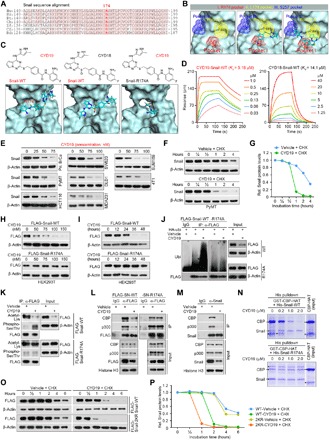
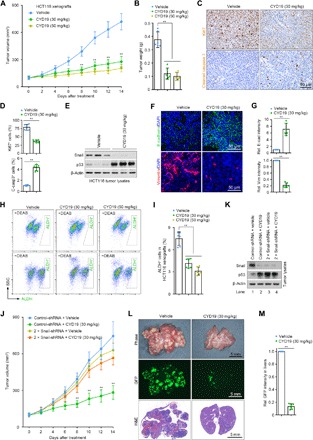
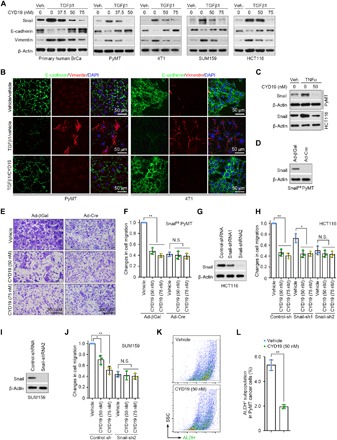
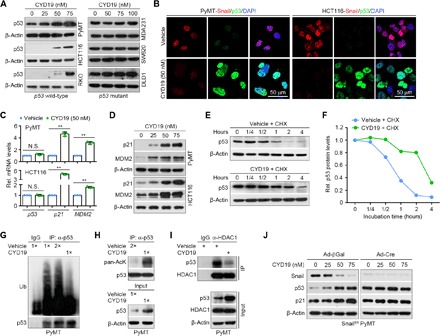
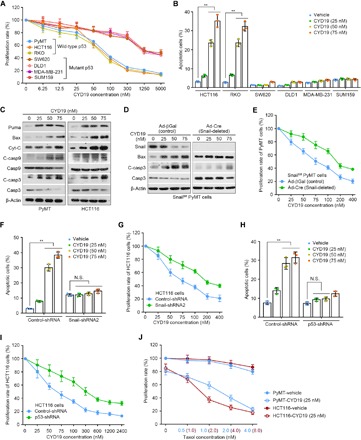
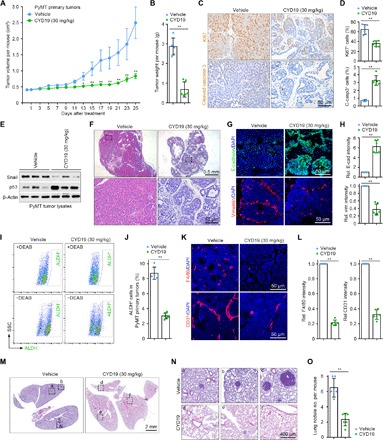
The zinc finger transcription factor Snail is aberrantly activated in many human cancers and associated with poor prognosis. Therefore, targeting Snail is expected to exert therapeutic benefit in patients with cancer. However, Snail has traditionally been considered "undruggable," and no effective pharmacological inhibitors have been identified. Here, we found a small-molecule compound CYD19 that forms a high-affinity interaction with the evolutionarily conserved arginine-174 pocket of Snail protein. In aggressive cancer cells, CYD19 binds to Snail and thus disrupts Snail's interaction with CREB-binding protein (CBP)/p300, which consequently impairs CBP/p300-mediated Snail acetylation and then promotes its degradation through the ubiquitin-proteasome pathway. Moreover, CYD19 restores Snail-dependent repression of wild-type p53, thus reducing tumor growth and survival in vitro and in vivo. In addition, CYD19 reverses Snail-mediated epithelial-mesenchymal transition (EMT) and impairs EMT-associated tumor invasion and metastasis. Our findings demonstrate that pharmacologically targeting Snail by CYD19 may exert potent therapeutic effects in patients with cancer.
锌指转录因子 SNAI1 在许多人类癌症中异常激活,并与预后不良相关。因此,针对 SNAI1 有望为癌症患者带来治疗益处。然而,SNAI1 传统上被认为是“不可成药的”,尚未发现有效的药理学抑制剂。在这里,我们发现了一种小分子化合物 CYD19,它与 SNAI1 蛋白进化上保守的精氨酸 174 口袋形成高亲和力相互作用。在侵袭性癌细胞中,CYD19 与 SNAI1 结合,从而破坏 SNAI1 与 CREB 结合蛋白(CBP)/p300 的相互作用,进而损害 CBP/p300 介导的 SNAI1 乙酰化,然后通过泛素-蛋白酶体途径促进其降解。此外,CYD19 恢复了 SNAI1 依赖性对野生型 p53 的抑制作用,从而减少了体外和体内的肿瘤生长和存活。此外,CYD19 逆转了 SNAI1 介导的上皮-间充质转化(EMT),并损害了 EMT 相关的肿瘤侵袭和转移。我们的研究结果表明,CYD19 通过药理学靶向 SNAI1 可能在癌症患者中发挥强大的治疗作用。