Zang X, Jian C, Ingersoll S, Li Huashan, Adams J J, Lu Z, Ferralis N, Grossman J C
Department of Materials Science and Engineering, Massachusetts Institute of Technology, Cambridge, MA 02139, USA.
Department of Mechanical Engineering, York University, 4700 Keele Street, Toronto, ON M3J 1P3, Canada.
Sci Adv. 2020 Apr 24;6(17):eaaz5231. doi: 10.1126/sciadv.aaz5231. eCollection 2020 Apr.
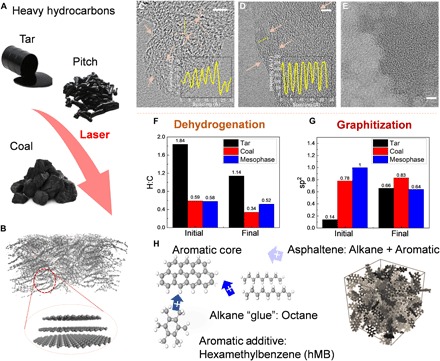
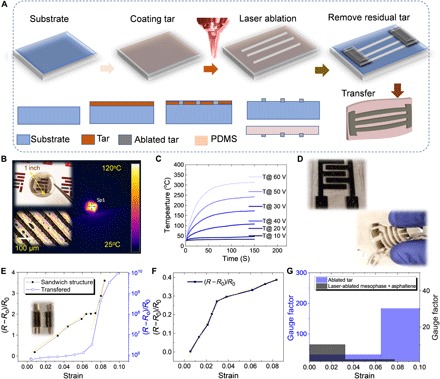
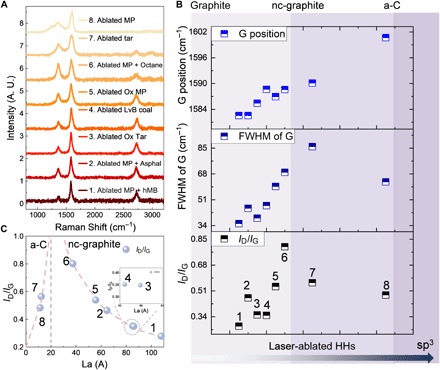
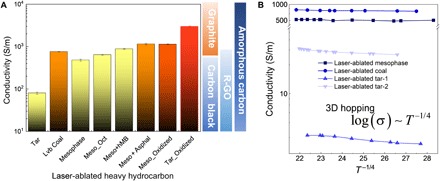
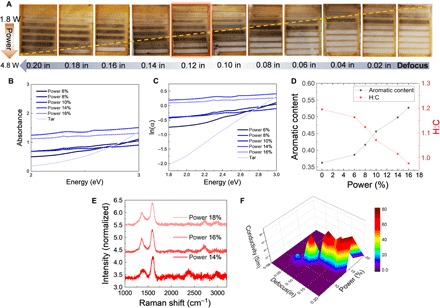
Polycyclic heavy hydrocarbons (HHs) such as coal, tar, and pitch are a family of materials with extremely rich and complex chemistry, representing a massive opportunity for their use in a range of potential applications. The present work shows that optimal selection of initial HHs based on molecular constituents is essential in tuning the material for a particular and targeted electronic application. Combining the selection of feedstock chemistry (H:C and aromatic content) and controlling variable laser treatment parameters (laser power, speed, and focus) lead to full control over the H:C ratio, sp concentration, and degree of graphitic stacking order of the products. The broad intertunability of these factors results from a wide distribution of carbon material crystallinity from amorphous to highly graphitic and a broad distribution of electrical conductivity up to 10 S/m.
多环重烃(HHs),如煤、焦油和沥青,是一类化学性质极其丰富和复杂的材料,在一系列潜在应用中具有巨大的使用潜力。目前的研究表明,基于分子成分对初始HHs进行优化选择对于针对特定电子应用调整材料至关重要。结合原料化学性质(H:C和芳烃含量)的选择以及控制可变激光处理参数(激光功率、速度和焦点),可以全面控制产物的H:C比、sp浓度和石墨堆积有序度。这些因素的广泛相互可调性源于从非晶态到高度石墨化的碳材料结晶度的广泛分布以及高达10 S/m的电导率的广泛分布。