Division of Neurology, Hospital for Sick Children, Toronto, ON, Canada.
Division of Clinical and Metabolic Genetics, Hospital for Sick Children, Toronto, ON, Canada.
Ann Clin Transl Neurol. 2020 Jul;7(7):1132-1140. doi: 10.1002/acn3.51076. Epub 2020 Jun 4.
The first-line use of specialized metabolic screening laboratories in the investigation of hypotonia and/or developmental delay remains a standard practice despite lack of supporting evidence. Our study aimed to address the utility of such testing by determining the proportion of patients whose diagnosis was directly supported by metabolic screening.
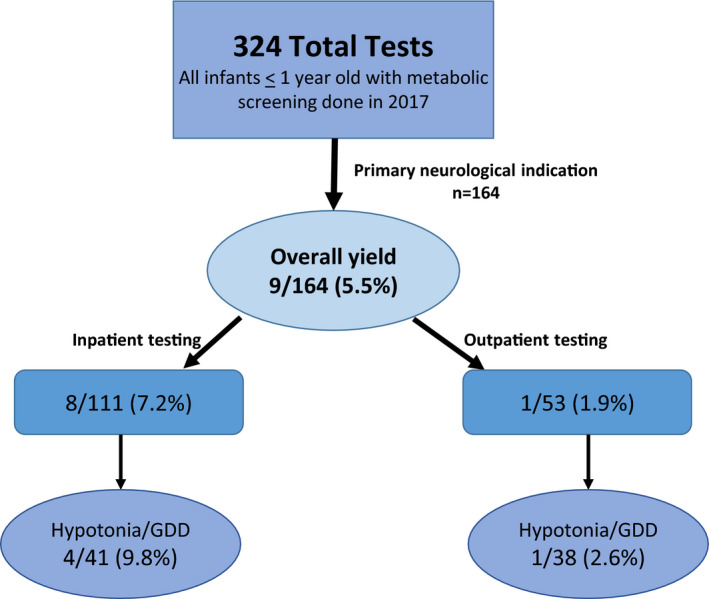
We performed a retrospective chart review study of 164 patients under age one who had screening metabolic laboratory testing done within the time period of one calendar year.
Of patients screened, 9/164 (5.5%) had diagnoses supported by metabolic testing (two with nonketotic hyperglycinemia, three with ornithine transcarbamylase deficiency, one with propionic acidemia, one with a congenital disorder of glycosylation, one with D-bifunctional protein deficiency, and one with GM1 Gangliosidosis). Of patients specifically evaluated for hypotonia and/or developmental delay, 5/79 (6.3%) were diagnosed with the aid of metabolic testing. All patients with positive screens presented with acute decompensation. Outside of this subgroup of high-risk patients, no patients were diagnosed using metabolic testing. Screening laboratories were also ineffective in an outpatient setting, identifying only one of the seven outpatients who was ultimately diagnosed with an inborn error of metabolism.
These findings demonstrate that the yield of specialized metabolic screening testing is extremely low in infants with hypotonia and/or developmental delay, approaching zero outside of the specific setting of clinical decompensation or multi-system involvement. Furthermore, many outpatient cases of IEM are not identified by screening studies. This information will help guide the diagnostic evaluation of hypotonia and/or global developmental delay.
尽管缺乏支持证据,在调查张力减退和/或发育迟缓时,一线使用专门的代谢筛查实验室仍然是一种标准做法。我们的研究旨在通过确定代谢筛查直接支持诊断的患者比例来解决此类检测的实用性。
我们对在一个日历年内进行了代谢筛查实验室检测的 164 名年龄在一岁以下的患者进行了回顾性图表审查研究。
在接受筛查的患者中,有 9/164(5.5%)的患者的诊断得到了代谢检测的支持(2 例为非酮症高甘氨酸血症,3 例为鸟氨酸转氨甲酰酶缺乏症,1 例为丙酸血症,1 例为先天性糖基化障碍,1 例为 D-双功能蛋白缺乏症,1 例为 GM1 神经节苷脂贮积症)。在专门评估张力减退和/或发育迟缓的 79 名患者中,有 5/79(6.3%)的患者借助代谢检测得到了诊断。所有阳性筛查患者均表现为急性失代偿。在这组高危患者之外,没有患者通过代谢检测得到诊断。筛查实验室在门诊环境中也没有效果,仅在最终被诊断为先天性代谢缺陷的 7 名门诊患者中发现了一名。
这些发现表明,在张力减退和/或发育迟缓的婴儿中,专门的代谢筛查检测的阳性率极低,在临床失代偿或多系统受累的特定情况下接近零。此外,许多先天性代谢缺陷的门诊病例无法通过筛查研究来识别。这些信息将有助于指导张力减退和/或全面发育迟缓的诊断评估。