Maternal and Child Health Hospital of Hubei Province, Tongji Medical College, Huazhong University of Science and Technology, Wuhan, Hubei, China.
Department of Epidemiology and Biostatistics, Ministry of Education Key Lab of Environment and Health, School of Public Health, Tongji Medical College, Huazhong University of Science and Technology, Wuhan, Hubei, China.
PLoS One. 2020 Jun 4;15(6):e0232800. doi: 10.1371/journal.pone.0232800. eCollection 2020.
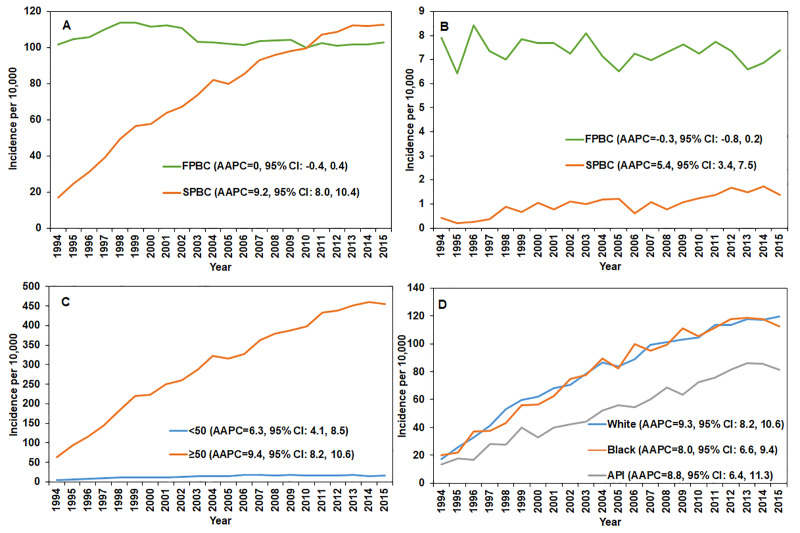
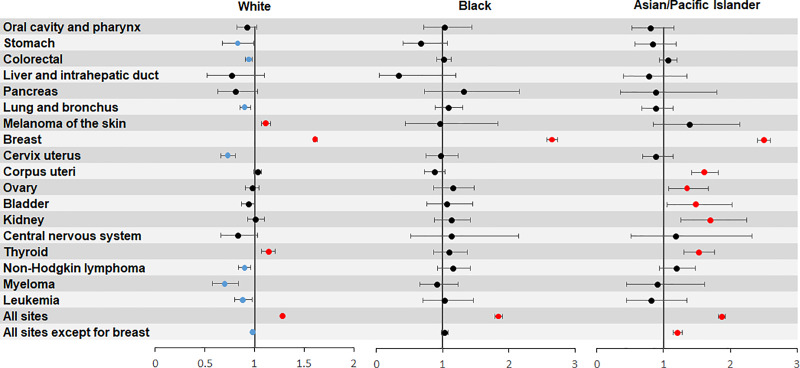
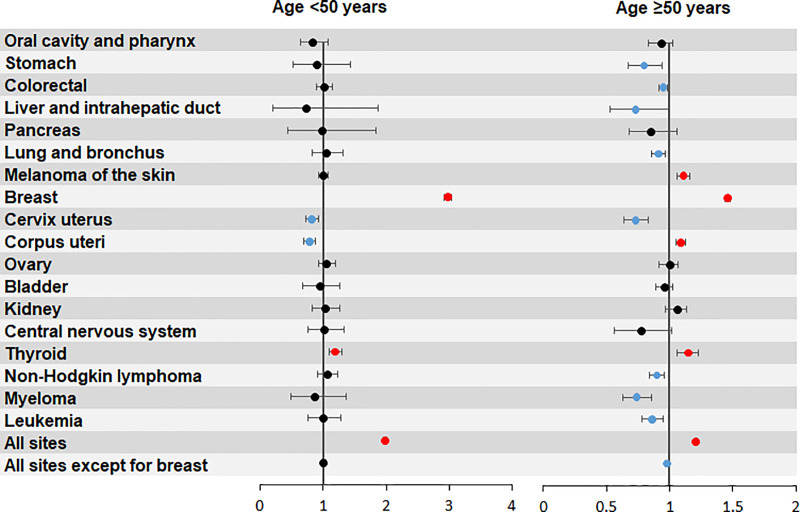
Second primary breast cancer (SPBC) is becoming one of the major obstacles to breast cancer (BC) control. This study was aimed to determine the trend of SPBC incidence over time and the risk of developing SPBC in site-specific primary cancer survivors in the United States. The Surveillance, Epidemiology, and End Results (SEER) 13 registry (1992-2015) was used to identify SPBC patients with previous malignancies. Standardized incidence ratio (SIR) was computed to compare the incidence rates of the observed cases of SPBC in cancer survivors over the expected cases in the general population. Elevated risk of SPBC was observed in women with previous BC (SIR = 1.74) or thyroid cancer (SIR = 1.17). Women with initial skin melanoma in older age (≥50 years) (SIR = 1.11), or White race (SIR = 1.11) presented an elevated incidence of SPBC than the general female population. Besides, Asian/Pacific Islander (API) women with cancer of corpus uteri, ovary, bladder, or kidney were prone to developing SPBC when compared with the general population, with SIRs of 1.61, 1.35, 1.48, and 1.70, respectively. Male BC patients showed profound risk of developing SPBC (SIR = 34.86). Male leukemia patients also presented elevated risk of developing SPBC (SIR = 2.06). Our study suggests significant increase of SPBC in both sexes in the United States. Elevated risk of SPBC exists in survivors with primary BC, female thyroid cancer, male leukemia, and API female cancer patients with primary genitourinary cancer. Our study is helpful in developing strategies for BC control and prevention on specific first primary cancer survivors with an elevated risk of SPBC.
第二原发乳腺癌(SPBC)正成为乳腺癌(BC)控制的主要障碍之一。本研究旨在确定美国 SPBC 发病率随时间的变化趋势以及特定部位原发性癌症幸存者发生 SPBC 的风险。使用监测、流行病学和最终结果(SEER)13 登记处(1992-2015 年)来识别先前患有恶性肿瘤的 SPBC 患者。计算标准化发病比(SIR)以比较癌症幸存者中观察到的 SPBC 病例的发病率与一般人群中的预期病例。先前患有 BC(SIR=1.74)或甲状腺癌(SIR=1.17)的女性 SPBC 风险增加。年龄较大(≥50 岁)(SIR=1.11)或白人种族(SIR=1.11)的初始皮肤黑色素瘤女性 SPBC 发病率高于一般女性人群。此外,与一般人群相比,患有子宫体癌、卵巢癌、膀胱癌或肾癌的亚裔/太平洋岛民(API)女性发生 SPBC 的风险更高,SIR 分别为 1.61、1.35、1.48 和 1.70。男性 BC 患者发生 SPBC 的风险显著增加(SIR=34.86)。男性白血病患者发生 SPBC 的风险也升高(SIR=2.06)。我们的研究表明,美国男女 SPBC 的发病率均显著增加。原发性 BC、女性甲状腺癌、男性白血病幸存者以及原发性泌尿生殖系统癌症的 API 女性幸存者存在 SPBC 风险增加。我们的研究有助于为特定的高风险 SPBC 第一原发性癌症幸存者制定 BC 控制和预防策略。