Bletsis Patrick P, Janssen Laura E, Visser Otto, Offerman Saskia R, Tellier Michiel A, Laterveer Laurens, Houpt Peter
Faculty of Medical Sciences, University of Groningen, Groningen, the Netherlands; Department of Plastic and Reconstructive Surgery, Isala Clinics, Zwolle, the Netherlands.
Department of Plastic and Reconstructive Surgery, Isala Clinics, Zwolle, the Netherlands.
Int J Surg Case Rep. 2020;71:341-345. doi: 10.1016/j.ijscr.2020.05.039. Epub 2020 May 29.
An estimated 30.000 breast implants are placed in the Netherlands annually. An increasing amount of reports have linked implants to the rare anaplastic large cell lymphoma (ALCL). Other implant-related lymphomas, such as those of B-cell lineage, are much rarer.
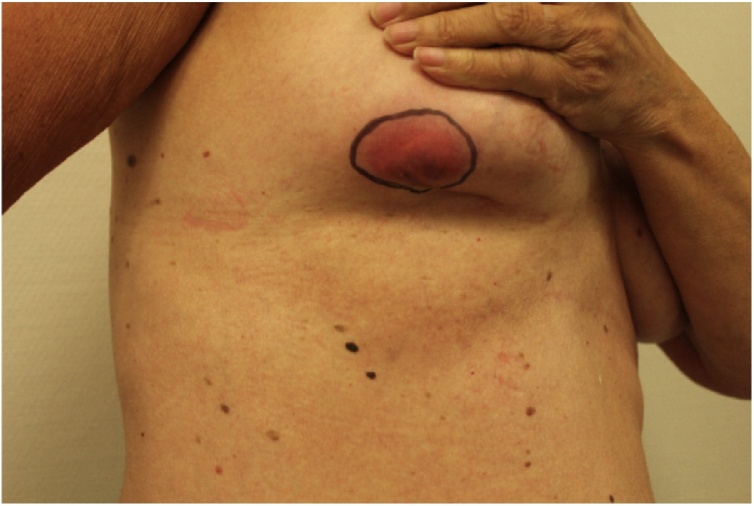
A 62-year-old female presented with pain and Baker grade III capsular contraction of the right breast. Subpectorally placed textured anatomical implants had been in situ for 26 years after cosmetic augmentation. Magnetic Resonance Imaging (MRI) showed bilateral implant leakage. Explantation of both implants confirmed bilateral leakage after which symptoms went into remission. Three months later our patient noticed an erythematous area, scar swelling and serous fluid leakage on the lateral side of the inframammary fold of the right breast. Siliconomas were excised bilaterally together with a partial capsulectomy on the left. Histopathology and immunohistochemical analysis showed monotonous small cell B-lymphocytic infiltration (CD20+, CD5+, CD23+, ALK-) in both capsules, highly suggestive for chronic lymphocytic leukemia (CLL)/small lymphocytic lymphoma (SLL).
CLL/SLL are classified as nearly the same disease. The primary difference is the localization; CLL is found the bone marrow and blood whereas SLL is predominantly in the lymph nodes and spleen. There are no previous descriptions of bilateral CLL/SLL found in periprosthetic capsules.
Breast implants are increasingly linked to various malignancies. In most cases, including our patient, implant explantation together with long-term follow-up suffices. MRI yields additional value in early stage diagnosis. More research is required to further optimize multidisciplinary care and improve patient outcomes.
荷兰每年估计有30000例乳房植入手术。越来越多的报告将植入物与罕见的间变性大细胞淋巴瘤(ALCL)联系起来。其他与植入物相关的淋巴瘤,如B细胞谱系的淋巴瘤,则更为罕见。
一名62岁女性因右乳疼痛和贝克三级包膜挛缩就诊。在进行美容隆胸手术后,置于胸大肌下的纹理解剖型植入物已在位26年。磁共振成像(MRI)显示双侧植入物渗漏。取出双侧植入物证实存在双侧渗漏,之后症状缓解。三个月后,我们的患者注意到右乳房下皱襞外侧有一个红斑区域、瘢痕肿胀和浆液性液体渗漏。双侧切除硅瘤,并对左侧进行部分包膜切除术。组织病理学和免疫组化分析显示,两个包膜中均有单调的小细胞B淋巴细胞浸润(CD20 +、CD5 +、CD23 +、ALK -),高度提示慢性淋巴细胞白血病(CLL)/小淋巴细胞淋巴瘤(SLL)。
CLL/SLL被归类为几乎相同的疾病。主要区别在于定位;CLL见于骨髓和血液,而SLL主要位于淋巴结和脾脏。此前没有关于在假体周围包膜中发现双侧CLL/SLL的描述。
乳房植入物与各种恶性肿瘤的关联日益增加。在大多数情况下,包括我们的患者,取出植入物并进行长期随访就足够了。MRI在早期诊断中具有额外价值。需要更多研究来进一步优化多学科护理并改善患者预后。