Yang Pil-Sung, Sung Jung-Hoon, Jang Eunsun, Yu Hee Tae, Kim Tae-Hoon, Uhm Jae-Sun, Kim Jong-Youn, Pak Hui-Nam, Lee Moon-Hyoung, Lip Gregory Y H, Joung Boyoung
Department of Cardiology, CHA Bundang Medical Centre, CHA University, Seongnam 13496, Korea.
Division of Cardiology, Department of Internal Medicine, Severance Cardiovascular Hospital, Yonsei University College of Medicine, Seoul 03722, Korea.
J Clin Med. 2020 Jun 2;9(6):1696. doi: 10.3390/jcm9061696.
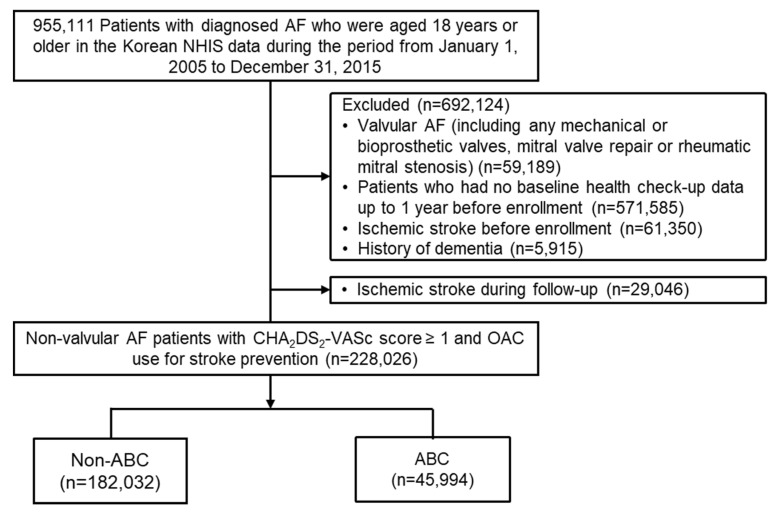
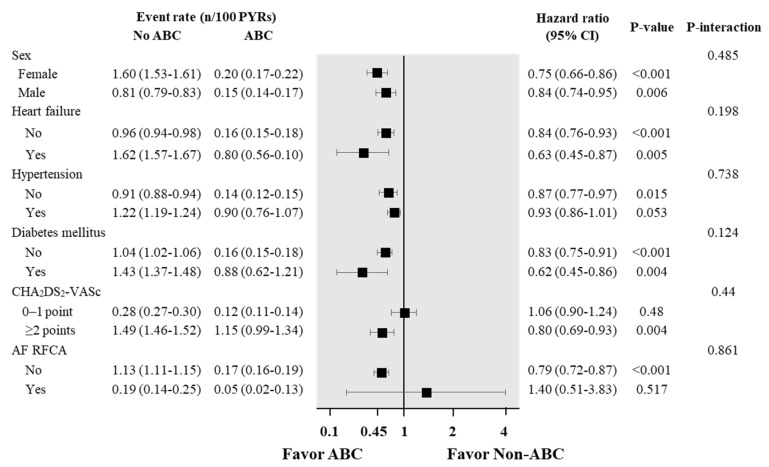
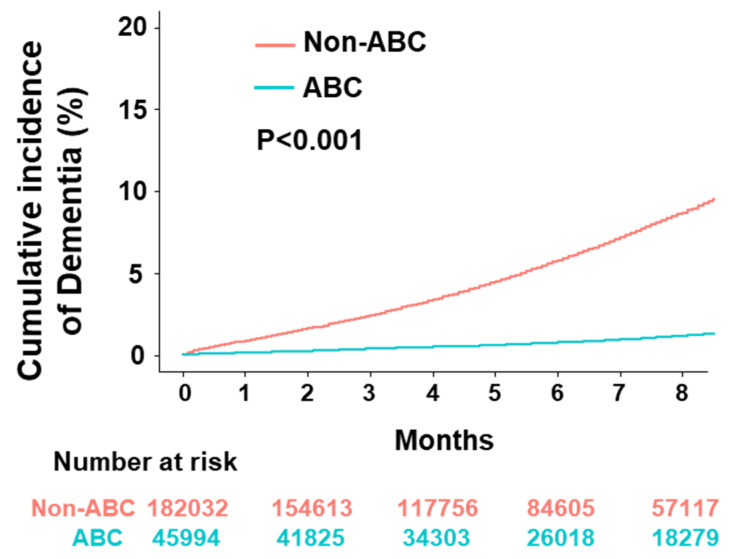
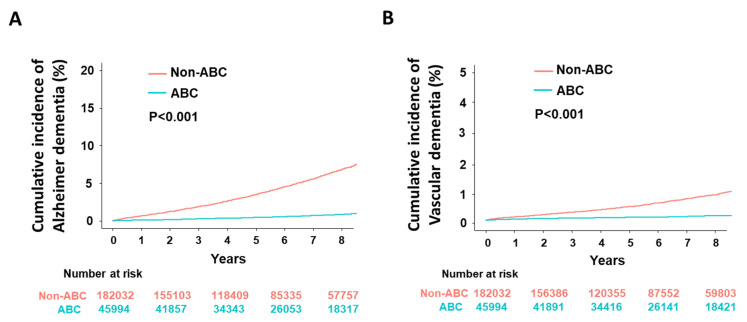
Clinical outcomes of patients with atrial fibrillation (AF) can be improved by an integrated care approach. We analyzed whether adherence with the AF Better Care (ABC) pathway for integrated care management would reduce the risk of dementia in a nationwide AF cohort. Using the National Health Insurance Service database of Korea, 228,026 non-valvular AF patients were retrospectively evaluated between 2005 and 2015. Patients meeting all criteria of the ABC pathway were classified as the "ABC" group and those not classified as the "non-ABC" group. During a median (25th, 75th percentiles) follow-up of 6.0 (3.3, 9.5) years, the ABC group had lower rates and risk of overall dementia (0.17 vs. 1.11 per 100 person-years, < 0.001; hazard ratio (HR) 0.80; 95% CI 0.73-0.87) and both Alzheimer's (HR 0.79, 95% CI 0.71-0.88) and vascular dementia (HR 0.76, 95% CI 0.59-0.98) than the non-ABC group. The stratified analysis showed that the ABC pathway reduced the risk of dementia regardless of sex, comorbidities, and in patients with high stroke risk. Adherence with the ABC pathway is associated with a reduced risk of dementia in AF patients. Due to the high medical burden of AF, it is necessary to implement integrated AF management to reduce the risk of dementia.
综合护理方法可改善房颤(AF)患者的临床结局。我们分析了遵循房颤优化护理(ABC)综合护理管理路径是否会降低全国房颤队列中痴呆症的风险。利用韩国国民健康保险服务数据库,对2005年至2015年间的228,026例非瓣膜性房颤患者进行了回顾性评估。符合ABC路径所有标准的患者被分类为“ABC”组,未分类的患者为“非ABC”组。在中位(第25、75百分位数)随访6.0(3.3,9.5)年期间,ABC组的总体痴呆症发生率和风险较低(每100人年0.17例 vs. 1.11例,<0.001;风险比(HR)0.80;95%置信区间0.73 - 0.87),阿尔茨海默病(HR 0.79,95%置信区间0.71 - 0.88)和血管性痴呆(HR 0.76,95%置信区间0.59 - 0.98)的发生率和风险均低于非ABC组。分层分析表明,无论性别、合并症以及中风风险高的患者,ABC路径均可降低痴呆症风险。遵循ABC路径与房颤患者痴呆症风险降低相关。由于房颤的医疗负担较重,有必要实施房颤综合管理以降低痴呆症风险。