Escola Bahiana de Medicina e Saúde Pública, Salvador 41150-100, Brazil.
Fima Lifshitz Metabolic Unit, Hospital Universitário Professor Edgard Santos, Universidade Federal da Bahia, Salvador 40170-110, Brazil.
Nutrients. 2020 Jun 2;12(6):1650. doi: 10.3390/nu12061650.
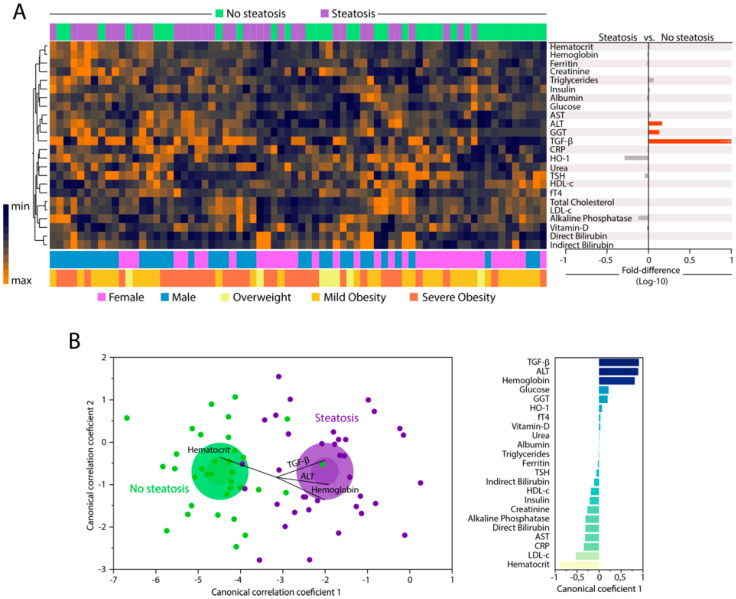
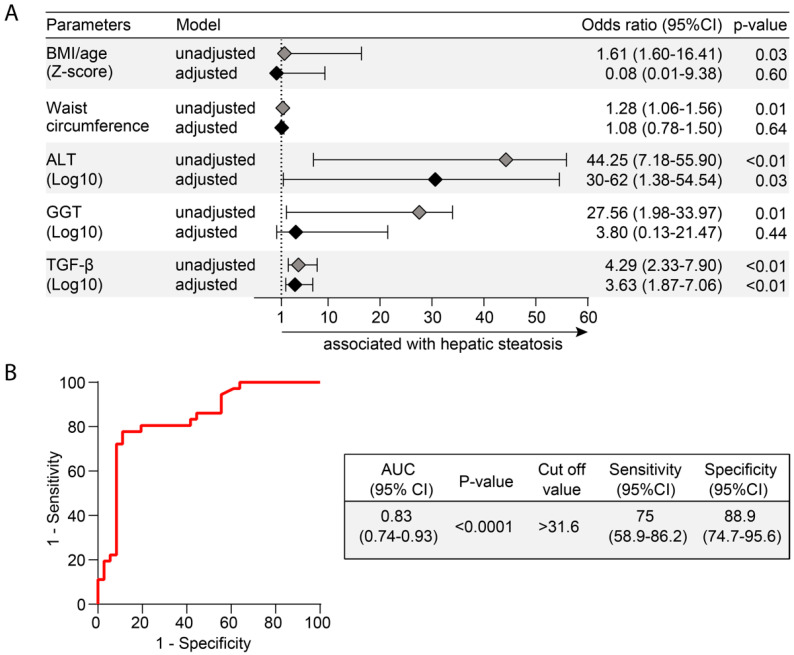
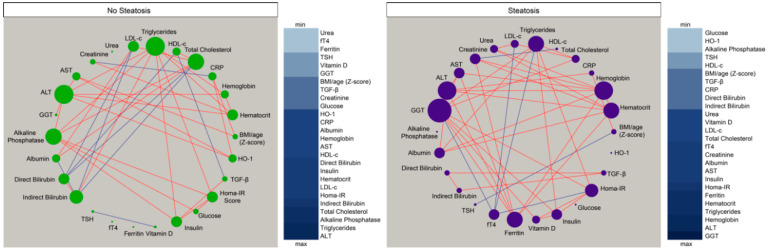
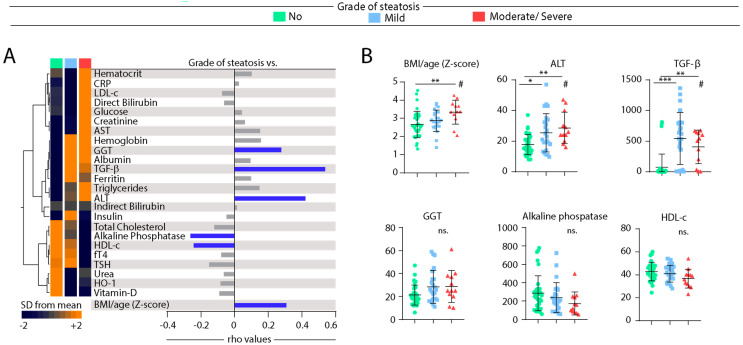
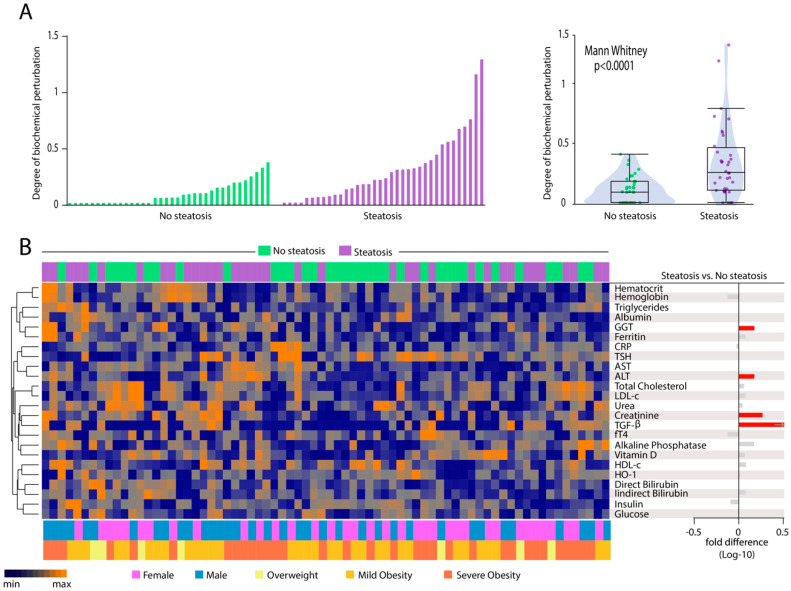
Nonalcoholic Fatty Liver Disease (NAFLD) is a common cause of chronic liver disease in childhood and strongly associated with obesity. Routine biochemical non-invasive tests remain with low accuracy for diagnosis of NAFLD. We performed a cross-sectional study to examine potential associations between anthropometric and biochemical parameters, specially TGF-β, a prognosis marker for hepatic steatosis (HS). Between May and October 2019, seventy-two overweight adolescents were enrolled, of which 36 had hepatic steatosis. Hepatic, lipidic and glycemic profiles, and levels of vitamin D, ferritin and TGF-β were analyzed. Hierarchical cluster and a discriminant model using canonical correlations were employed to depict the overall expression profile of biochemical markers and the biochemical degree of perturbation. Median values of alanine aminotransferase (ALT), gamma glutamyl transpeptidase (GGT), and TGF-β were higher in the adolescents with HS. Values of body mass index (BMI)/age and ALT, but not of TGF-β, were gradually increased proportionally to augmentation of steatosis severity. In a multivariate analysis, TGF-β plasma concentrations were associated with occurrence of hepatic steatosis independent of other covariates. Discriminant analysis confirmed that TGF-β concentrations can identify HS cases. Our data reveal that HS patients exhibit a distinct biosignature of biochemical parameters and imply TGF-β as an important biomarker to evaluate risk of steatosis development.
非酒精性脂肪性肝病(NAFLD)是儿童慢性肝病的常见病因,与肥胖密切相关。常规生化非侵入性检测对 NAFLD 的诊断准确性仍然较低。我们进行了一项横断面研究,以检查人体测量学和生化参数之间的潜在关联,特别是 TGF-β,这是肝脂肪变性(HS)的预后标志物。2019 年 5 月至 10 月期间,共纳入 72 名超重青少年,其中 36 名患有肝脂肪变性。分析了肝脏、脂质和血糖谱以及维生素 D、铁蛋白和 TGF-β 的水平。使用典范相关进行层次聚类和判别模型,以描绘生化标志物的整体表达谱和生化扰动程度。HS 青少年的丙氨酸氨基转移酶(ALT)、γ-谷氨酰转肽酶(GGT)和 TGF-β的中位数较高。BMI/年龄和 ALT 的值,但不是 TGF-β的值,随着脂肪变性严重程度的增加而呈比例逐渐增加。在多变量分析中,TGF-β 血浆浓度与肝脏脂肪变性的发生相关,与其他协变量无关。判别分析证实 TGF-β 浓度可以识别 HS 病例。我们的数据显示,HS 患者表现出生化参数的独特生物特征,并暗示 TGF-β 作为评估脂肪变性发展风险的重要生物标志物。