Borkent Jos W, Keller Heather, Wham Carol, Wijers Fleur, de van der Schueren Marian A E
Department of Nutrition and Health, School of Allied Health, HAN University of Applied Sciences, 6525 EN Nijmegen, The Netherlands.
Schlegel-University of Waterloo Research institute for aging, Department of Kinesiology, University of Waterloo, Waterloo, ON ON N2G 0E2, Canada.
Healthcare (Basel). 2020 Jun 2;8(2):151. doi: 10.3390/healthcare8020151.
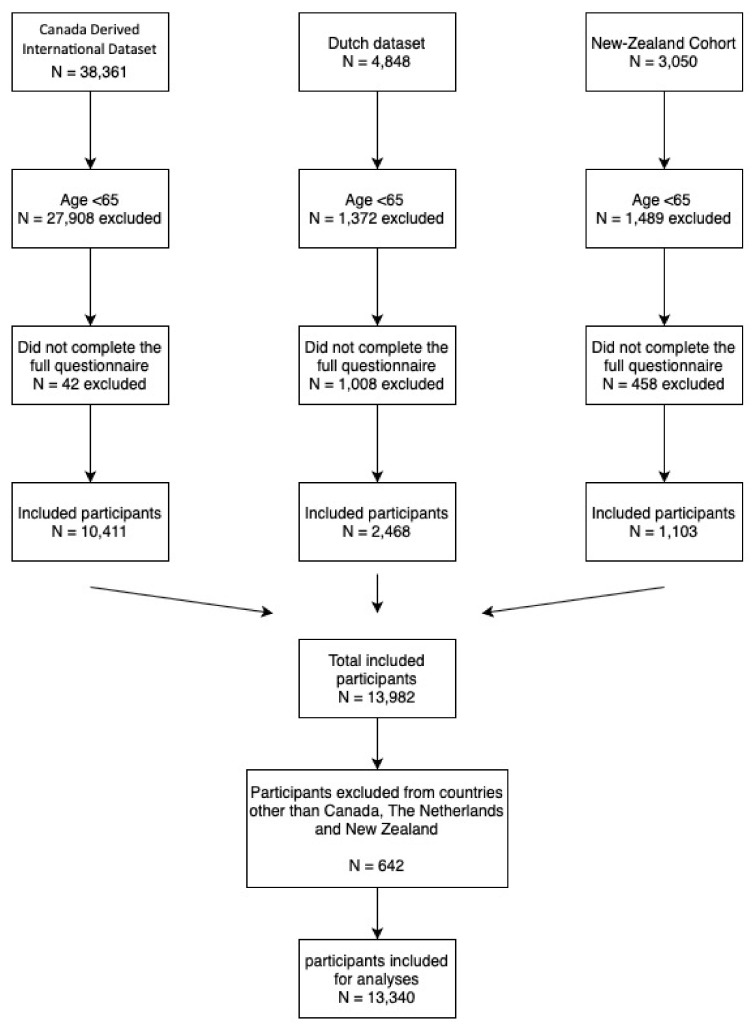
Undernutrition is highly prevalent among community-dwelling older adults. Early identification of nutrition risk is important to prevent or treat undernutrition. This study describes the prevalence rates of nutrition risk in community-dwelling older adults (aged ≥ 65) using the same validated tool across different countries and aims to identify differences in nutritional risk factors. Cross-sectional data was obtained from three datasets including participants from the Netherlands (NL), Canada (CA) and New Zealand (NZ). Seniors in the Community Risk Evaluation for Eating and Nutrition II (SCREEN II) was used to assess nutritional risk factors and prevalence of risk. Differences between countries were tested with logistic and linear regression. Sensitivity analyses were conducted to test the influence of sampling strategy. A total of 13,340 participants were included, and 66.3% were found to be at high nutrition risk. After stratifying the data for method of data sampling, prevalence rates showed some differences across countries (NL: 61.5%, NZ: 68.2%, CA: 70.1%). Risk factor items that contributed to nutrition risk also differed among countries: NZ and CA participants scored higher for weight change, skipping meals, problems with meal preparation, use of meal replacements, problems with biting and chewing, low fluid intake and problems with doing groceries, as compared to participants in NL. Low intake of fruits and vegetables and meat were more prevalent in NL. In conclusion: nutrition risk is a worldwide, highly prevalent problem among community-dwelling older adults, but risk factors contributing to nutrition risk differ by country.
营养不良在社区居住的老年人中极为普遍。早期识别营养风险对于预防或治疗营养不良至关重要。本研究使用同一经过验证的工具描述了不同国家社区居住的老年人(年龄≥65岁)的营养风险患病率,并旨在确定营养风险因素的差异。横断面数据来自三个数据集,包括来自荷兰(NL)、加拿大(CA)和新西兰(NZ)的参与者。使用社区饮食与营养风险评估II(SCREEN II)来评估营养风险因素和风险患病率。通过逻辑回归和线性回归检验国家之间的差异。进行敏感性分析以检验抽样策略的影响。总共纳入了13340名参与者,发现66.3%的人处于高营养风险。在对数据抽样方法进行分层后,各国的患病率显示出一些差异(荷兰:61.5%,新西兰:68.2%,加拿大:70.1%)。导致营养风险的风险因素项目在各国之间也有所不同:与荷兰的参与者相比,新西兰和加拿大的参与者在体重变化、不吃饭、做饭问题、使用代餐、咬合和咀嚼问题、液体摄入量低以及购物问题上得分更高。水果、蔬菜和肉类摄入量低在荷兰更为普遍。总之:营养风险是社区居住的老年人中一个全球性的、极为普遍的问题,但导致营养风险的风险因素因国家而异。