Max Planck Institute of Psychiatry, Kraepelinstraße 2-10, 80804, Munich, Germany.
International Max Planck Research School for Translational Psychiatry (IMPRS-TP), Munich, Germany.
BMC Med. 2020 Jun 5;18(1):170. doi: 10.1186/s12916-020-01623-9.
Antidepressant medication (ADM) and psychotherapy are effective treatments for major depressive disorder (MDD). It is unclear, however, if treatments differ in their effectiveness at the symptom level and whether symptom information can be utilised to inform treatment allocation. The present study synthesises comparative effectiveness information from randomised controlled trials (RCTs) of ADM versus psychotherapy for MDD at the symptom level and develops and tests the Symptom-Oriented Therapy (SOrT) metric for precision treatment allocation.
First, we conducted systematic review and meta-analyses of RCTs comparing ADM and psychotherapy at the individual symptom level. We searched PubMed Medline, PsycINFO, and the Cochrane Central Register of Controlled Trials databases, a database specific for psychotherapy RCTs, and looked for unpublished RCTs. Random-effects meta-analyses were applied on sum-scores and for individual symptoms for the Hamilton Rating Scale for Depression (HAM-D) and Beck Depression Inventory (BDI) measures. Second, we computed the SOrT metric, which combines meta-analytic effect sizes with patients' symptom profiles. The SOrT metric was evaluated using data from the Munich Antidepressant Response Signature (MARS) study (n = 407) and the Emory Predictors of Remission in Depression to Individual and Combined Treatments (PReDICT) study (n = 234).
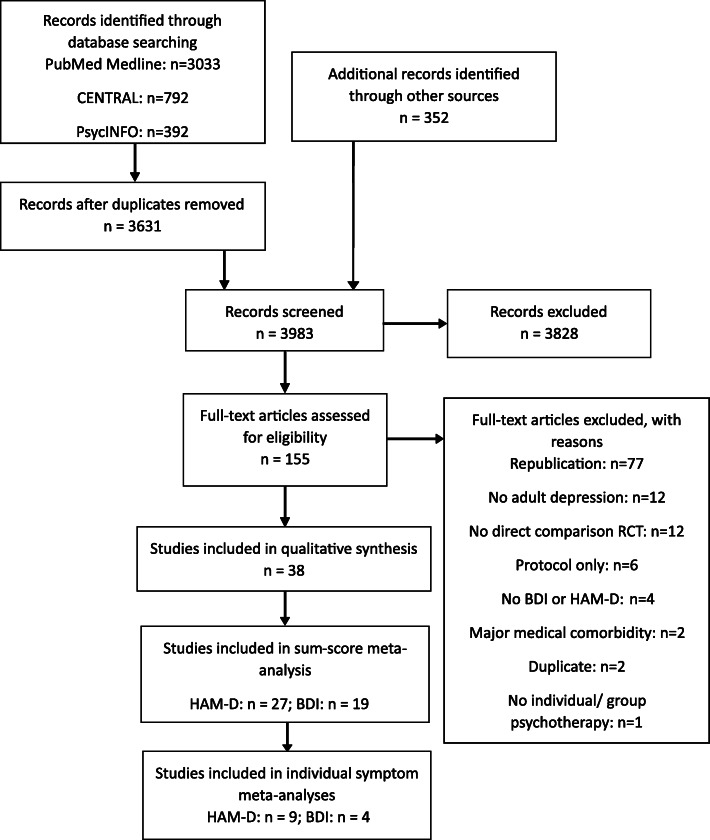
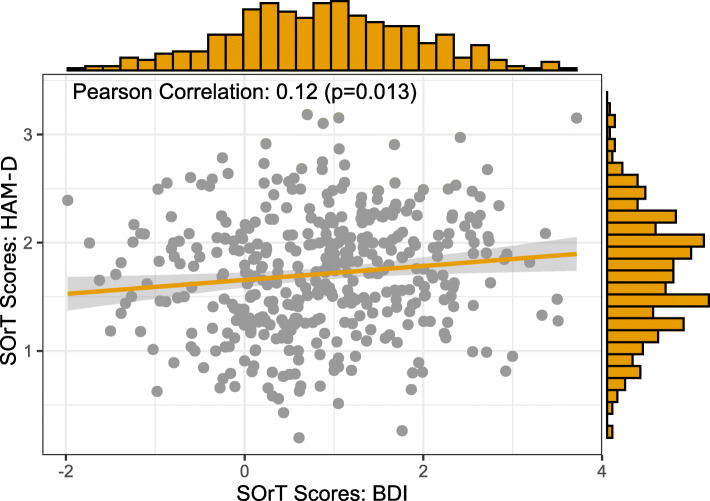
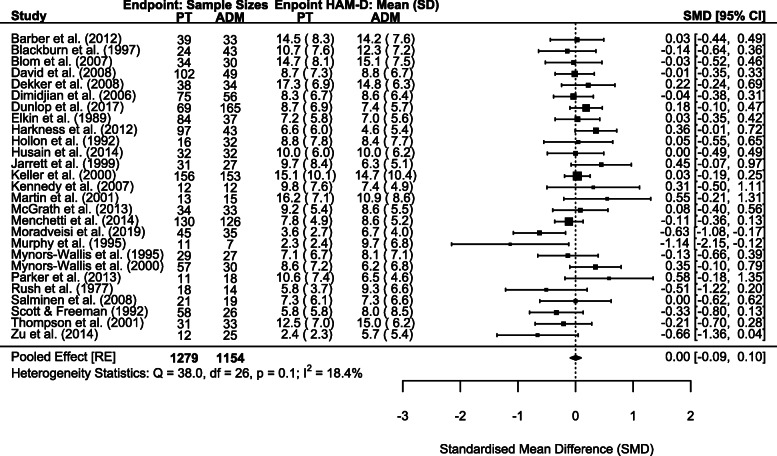
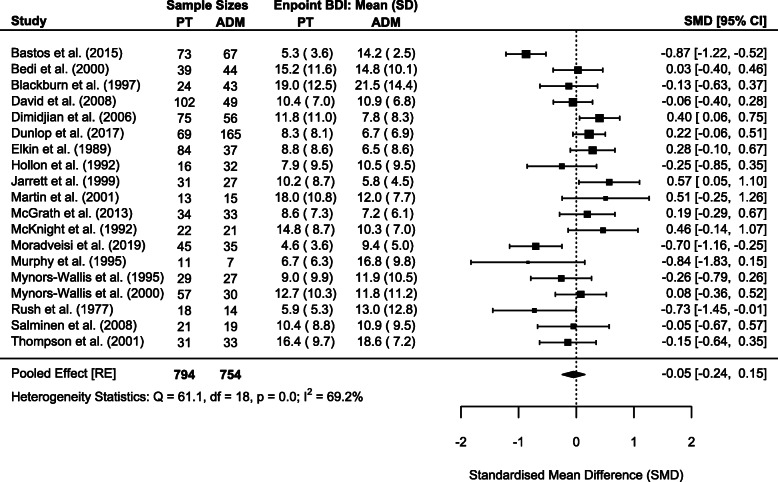
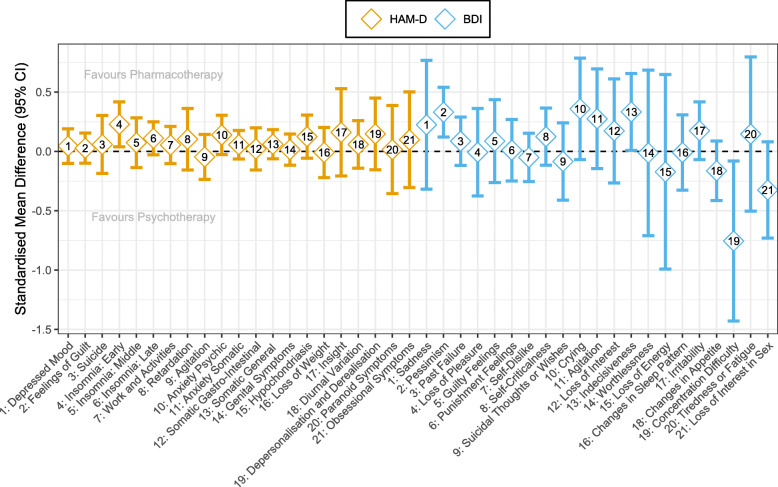
The systematic review identified 38 RCTs for qualitative inclusion, 27 and 19 for quantitative inclusion at the sum-score level, and 9 and 4 for quantitative inclusion on individual symptom level for the HAM-D and BDI, respectively. Neither meta-analytic strategy revealed significant differences in the effectiveness of ADM and psychotherapy across the two depression measures. The SOrT metric did not show meaningful associations with other clinical variables in the MARS sample, and there was no indication of utility of the metric for better treatment allocation from PReDICT data.
This registered report showed no differences of ADM and psychotherapy for the treatment of MDD at sum-score and symptom levels. Symptom-based metrics such as the proposed SOrT metric do not inform allocation to these treatments, but predictive value of symptom information requires further testing for other treatment comparisons.
抗抑郁药物(ADM)和心理治疗是治疗重度抑郁症(MDD)的有效方法。然而,尚不清楚这些治疗方法在症状层面上的有效性是否存在差异,以及症状信息是否可以用于指导治疗分配。本研究综合了 ADM 与心理治疗治疗 MDD 症状层面的随机对照试验(RCT)的比较有效性信息,并开发和测试了用于精确治疗分配的症状导向治疗(SOrT)指标。
首先,我们对 ADM 与心理治疗治疗 MDD 个体症状层面的 RCT 进行了系统回顾和荟萃分析。我们检索了 PubMed Medline、PsycINFO 和 Cochrane 中央对照试验注册库、专门针对心理治疗 RCT 的数据库,并寻找了未发表的 RCT。对 Hamilton 抑郁评定量表(HAM-D)和贝克抑郁量表(BDI)的总分和单项症状进行了随机效应荟萃分析。其次,我们计算了 SOrT 指标,该指标将荟萃分析效应大小与患者的症状特征相结合。SOrT 指标是使用慕尼黑抗抑郁反应特征(MARS)研究(n=407)和埃默里抑郁症缓解的个体和联合治疗预测因子(PReDICT)研究(n=234)的数据进行评估的。
系统综述确定了 38 项 RCT 进行定性纳入,27 项和 19 项定量纳入总分水平,9 项和 4 项定量纳入 HAM-D 和 BDI 的单项症状水平。两种荟萃分析策略都没有发现 ADM 和心理治疗在两种抑郁测量方法上的有效性存在显著差异。在 MARS 样本中,SOrT 指标与其他临床变量没有明显的关联,而且从 PReDICT 数据来看,该指标没有指示更好的治疗分配的作用。
本注册报告显示,ADM 和心理治疗在 MDD 的总分和症状层面上没有差异。基于症状的指标,如建议的 SOrT 指标,并不能为这些治疗方法的分配提供信息,但症状信息的预测价值需要进一步测试,以用于其他治疗比较。