Ramachandran Prashanth, Augstein Frauke, Nguyen Van, Carlsbecker Annelie
Department of Organismal Biology, Physiological Botany, Evolutionary Biology Centre and Linnean Centre for Plant Biology, Uppsala University, Uppsala, Sweden.
Front Plant Sci. 2020 May 15;11:570. doi: 10.3389/fpls.2020.00570. eCollection 2020.
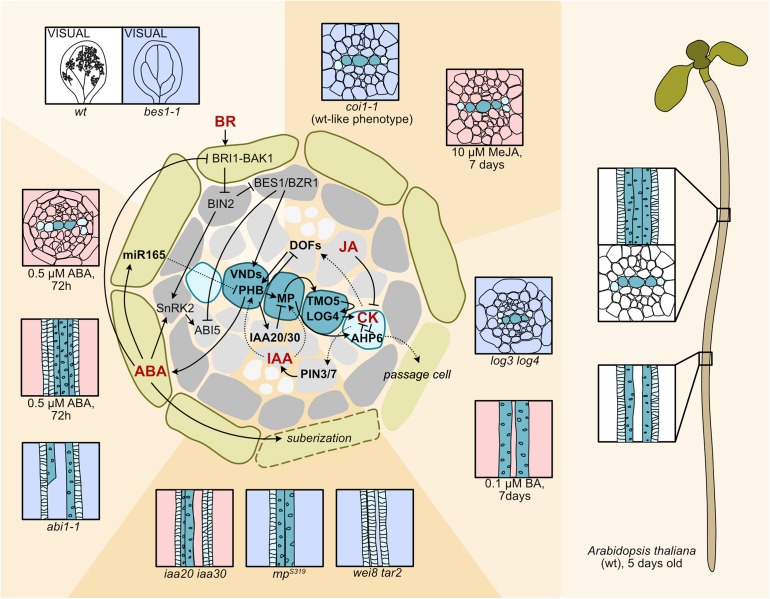
Periods of drought, that threaten crop production, are expected to become more prominent in large parts of the world, making it necessary to explore all aspects of plant growth and development, to breed, modify and select crops adapted to such conditions. One such aspect is the xylem, where influencing the size and number of the water-transporting xylem vessels, may impact on hydraulic conductance and drought tolerance. Here, we focus on how plants adjust their root xylem as a response to reduced water availability. While xylem response has been observed in a wide array of species, most of our knowledge on the molecular mechanisms underlying xylem plasticity comes from studies on the model plant . When grown under water limiting conditions, Arabidopsis rapidly adjusts its development to produce more xylem strands with altered identity in an abscisic acid (ABA) dependent manner. Other hormones such as auxin and cytokinin are essential for vascular patterning and differentiation. Their balance can be perturbed by stress, as evidenced by the effects of enhanced jasmonic acid signaling, which results in similar xylem developmental alterations as enhanced ABA signaling. Furthermore, brassinosteroids and other signaling molecules involved in drought tolerance can also impact xylem development. Hence, a multitude of signals affect root xylem properties and, potentially, influence survival under water limiting conditions. Here, we review the likely entangled signals that govern root vascular development, and discuss the importance of taking root anatomical traits into account when breeding crops for enhanced resilience toward changes in water availability.
干旱时期会威胁作物产量,预计在世界大部分地区将变得更加突出,因此有必要探索植物生长和发育的各个方面,以培育、改良和选择适应这种条件的作物。其中一个方面是木质部,影响输水木质部导管的大小和数量可能会影响水力传导率和耐旱性。在这里,我们关注植物如何调整其根木质部以应对水分供应减少的情况。虽然在众多物种中都观察到了木质部的反应,但我们对木质部可塑性背后分子机制的了解大多来自对模式植物的研究。在水分限制条件下生长时,拟南芥会迅速调整其发育,以脱落酸(ABA)依赖的方式产生更多具有改变特征的木质部束。其他激素如生长素和细胞分裂素对于维管模式形成和分化至关重要。它们的平衡会受到胁迫的干扰,茉莉酸信号增强的影响就证明了这一点,这会导致与ABA信号增强类似的木质部发育改变。此外,油菜素内酯和其他参与耐旱性的信号分子也会影响木质部发育。因此,多种信号会影响根木质部特性,并可能影响在水分限制条件下的存活。在这里,我们综述了可能控制根维管发育的相互交织的信号,并讨论了在培育具有更强水分适应性恢复力的作物时考虑根解剖学特征的重要性。