Deng Chenhui, Li Xiaosong, Pan Jay
West China School of Public Health, Sichuan University, No. 17, Section 3, Ren Min Nan Road, Chengdu 610041, China.
West China Research Center for Rural Health Development, Sichuan University, No. 17, Section 3, Ren Min Nan Road, Chengdu 610041, China.
Glob Health J. 2018 Jun;2(2):33-46. doi: 10.1016/S2414-6447(19)30138-1. Epub 2019 Sep 25.
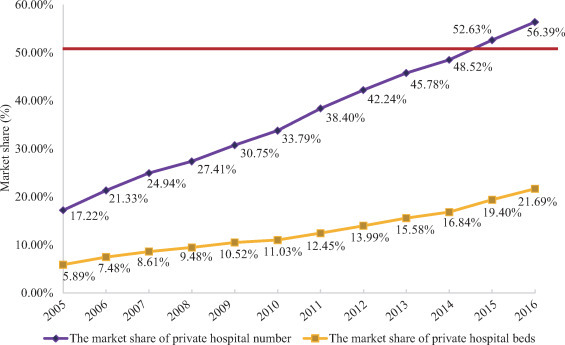
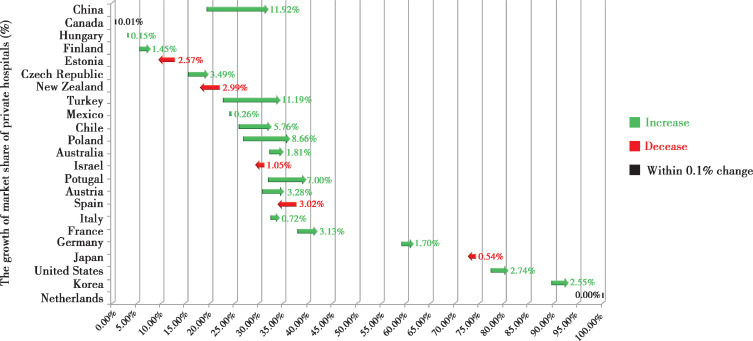
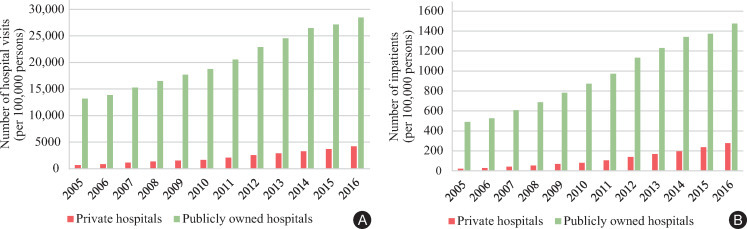
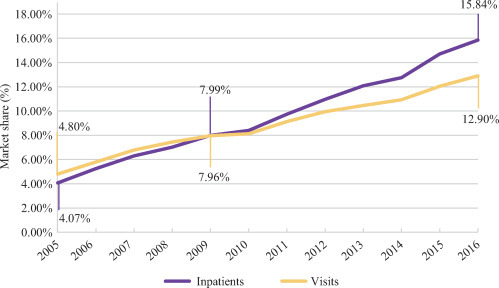
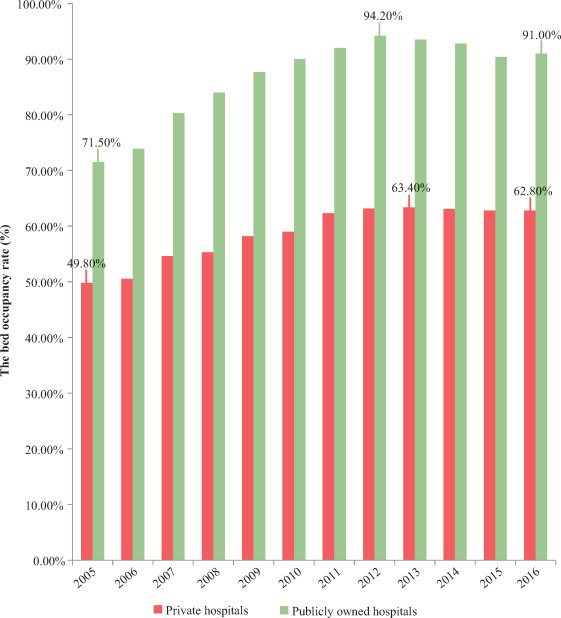
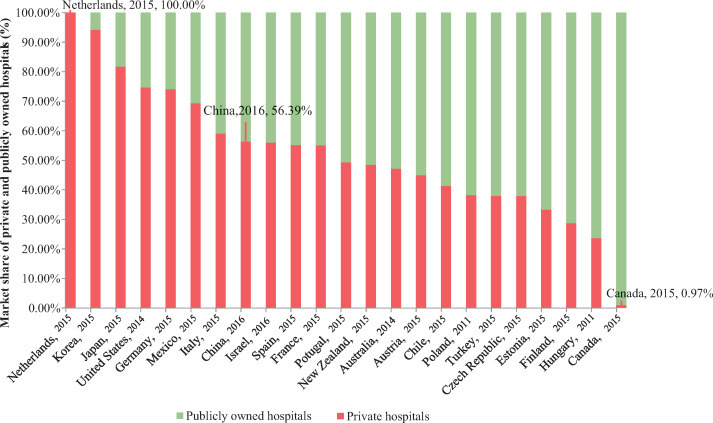
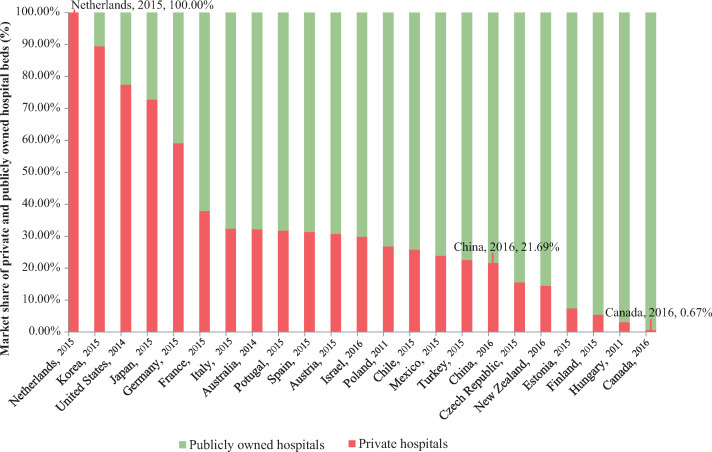
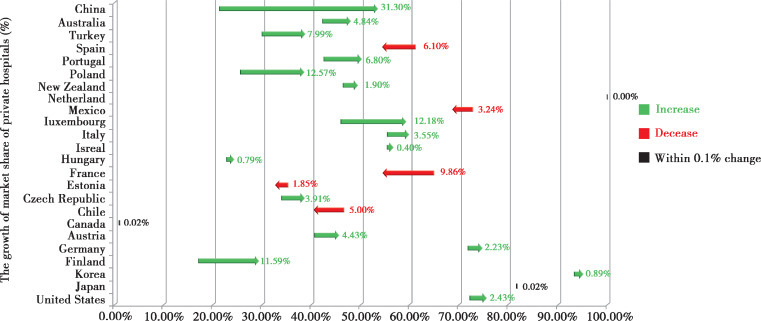
To assess the private hospital development in China during 2005-2016 from a global perspective. We searched the English and Chinese literature in PubMed, CNKI and Google Scholar databases with the keywords including "private hospitals in China", "hospital ownership", "public and private hospital", "private hospital development". Descriptive statistical analysis was used to assess the trend of the private hospital development in China and worldwide. Both the change of private hospitals in supply capacity and health care delivery were studied in this paper. The number of hospitals, number of hospital beds and the average number of hospital beds per hospital were employed to measure the supply capacity. The visit number, inpatients number, and bed occupancy rate (BOR) were used to measure the healthcare delivery. The data was collected from the and the "Organisation for Economic and Co-operation and Development (OECD) Statistics" website. The private sector rapidly expanded in China's hospital market in recent years. The number of private hospitals exceeded the public in 2015. There has also been a significant rise for the indicators of both the supply capacity (including number of hospitals, number of hospital beds and the average number of hospital beds per hospital) and the health care delivery (inpatients number and BOR) of the private hospitals. However, the growth rates of them were relatively lower than the public. The expansion trend of China's private sector in the hospital market accorded with most the OECD countries around the world. In 2016, China was above the medium level of the share of the private hospitals' number with the OECD countries, but below the medium for the supply capacity, in terms of the hospital beds. As a result of the economic growth and supporting policy, the private sector has experienced a vast expansion in China's hospital market in the past decade. The rising gap in average size between private and publicly owned hospitals, and the inconsistent development between the private hospitals' supply capacity and their market share, have become the two main challenges. Meanwhile, the future policy in supporting the private sector should be carefully introduced to advance the whole healthcare delivery system development in China.
从全球视角评估2005 - 2016年中国民营医院的发展情况。我们在PubMed、中国知网和谷歌学术数据库中检索了英文和中文文献,关键词包括“中国民营医院”“医院所有制”“公立和民营医院”“民营医院发展”。采用描述性统计分析来评估中国和全球民营医院的发展趋势。本文研究了民营医院在供给能力和医疗服务提供方面的变化。用医院数量、医院床位数和平均每家医院的床位数来衡量供给能力。用就诊人数、住院人数和床位使用率(BOR)来衡量医疗服务提供情况。数据来自 和“经济合作与发展组织(OECD)统计”网站。近年来,中国医院市场中的民营部门迅速扩张。2015年民营医院数量超过了公立医院。民营医院在供给能力指标(包括医院数量、医院床位数和平均每家医院的床位数)和医疗服务提供指标(住院人数和BOR)方面也都有显著增长。然而,它们的增长率相对低于公立医院。中国民营部门在医院市场的扩张趋势与世界上大多数经合组织国家相符。2016年,就民营医院数量占比而言,中国高于经合组织国家的中等水平,但就医院床位的供给能力而言低于中等水平。由于经济增长和扶持政策,在过去十年中,中国医院市场的民营部门经历了大规模扩张。民营医院与公立医院平均规模差距的不断扩大,以及民营医院供给能力与其市场份额之间发展的不一致,已成为两大主要挑战。与此同时,应谨慎出台支持民营部门的未来政策,以推动中国整个医疗服务体系的发展。