Federation University, Ballarat, Australia.
Victoria University, Melbourne, Australia.
PLoS One. 2020 Jun 5;15(6):e0233998. doi: 10.1371/journal.pone.0233998. eCollection 2020.
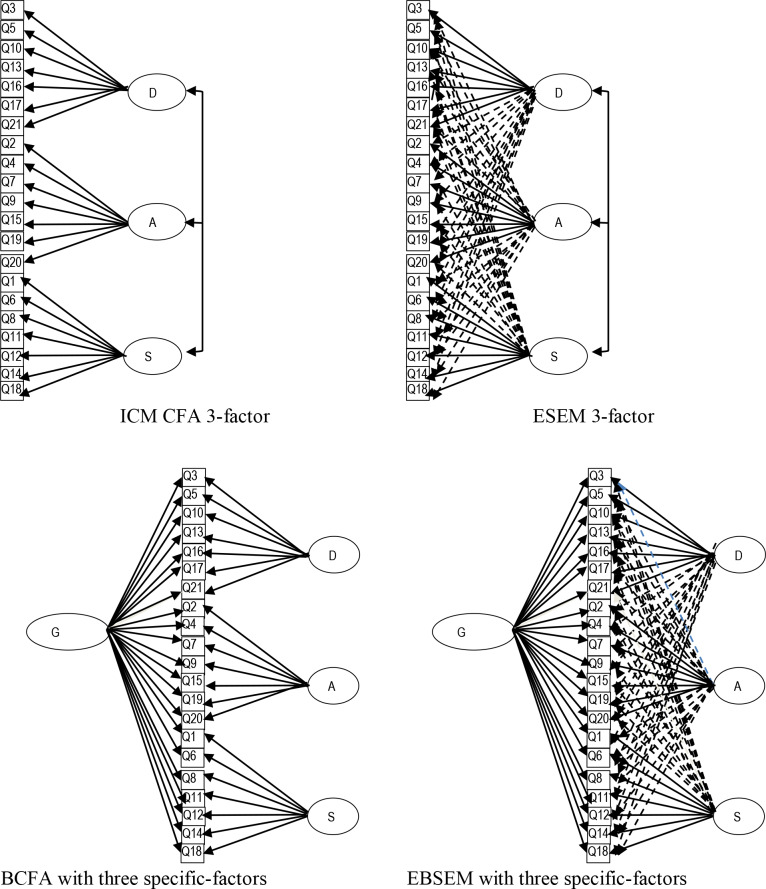
The Depression Anxiety and Stress Scales-21 (DASS-21) involves a simple structure first-order three-factor oblique model, with factors for depression, anxiety, and stress. Recently, concerns have been raised over the value of using confirmatory factor analysis (CFA) for studying the factor structure of scales in general. However, such concerns can be circumvented using exploratory structural equation modeling (ESEM). Consequently, the present study used CFA and ESEM with target rotation to examine the factor structure of the DASS-21 among an adult community. It compared first-order CFA, ESEM with target rotation, bi-factor CFA (BCFA), and bi-factor BESEM with target rotation models with group/specific factors for depression, anxiety, and stress. A total of 738 adults (males = 374, and females = 364; M = 25.29 years; SD = 7.61 years) completed the DASS-21. While all models examined showed good global fit values, one or more of the group/specific factors in the BCFA, ESEM with target rotation and BESEM with target rotation models were poorly defined. As the first-order CFA model was most parsimonious, with well-defined factors that were also supported in terms of their reliabilities and validities, this model was selected as the preferred DASS-21 model. The implications of the findings for use and revision of the DASS-21 are discussed.
抑郁-焦虑-压力量表 21 项(DASS-21)采用简单的一阶三因素斜交模型,包含抑郁、焦虑和压力三个因子。最近,人们对使用验证性因子分析(CFA)研究量表的因子结构的价值提出了担忧。然而,使用探索性结构方程模型(ESEM)可以避免这些担忧。因此,本研究使用 CFA 和具有目标旋转的 ESEM 来检验 DASS-21 在成人社区中的因子结构。它比较了一阶 CFA、具有目标旋转的 ESEM、双因子 CFA(BCFA)和具有目标旋转的双因子 ESEM 模型,这些模型都具有抑郁、焦虑和压力的分组/特定因子。共有 738 名成年人(男性=374 名,女性=364 名;M=25.29 岁;SD=7.61 岁)完成了 DASS-21。虽然所有检查的模型都显示出良好的整体拟合值,但在 BCFA、具有目标旋转的 ESEM 和具有目标旋转的 BESEM 模型中,一个或多个分组/特定因子的定义较差。由于一阶 CFA 模型最简约,其因子定义明确,并且在可靠性和有效性方面也得到了支持,因此该模型被选为首选的 DASS-21 模型。讨论了这些发现对 DASS-21 的使用和修订的意义。