Department of Anesthesiology, Weill Cornell Medicine, New York, New York, United States of America.
Department of Healthcare Policy and Research, Weill Cornell Medicine, New York, New York, United States of America.
PLoS Med. 2020 Jun 5;17(6):e1003108. doi: 10.1371/journal.pmed.1003108. eCollection 2020 Jun.
An estimated 87% of torture survivors experience chronic pain such as brachial plexopathy from upper extremity suspension or lumbosacral plexus injury from leg hyperextension. However, a vast majority of pain is undetected by evaluators due to a lack of diagnostic tools and confounding psychiatric illness. This diagnostic gap results in exclusive psychological treatment rather than multimodal therapies, substantially limiting rehabilitation. We hypothesized that the United Nations Istanbul Protocol (UNIP) would have a sensitivity of approximately 15% for pain detection, and that the use of a validated pain screen would improve its sensitivity by at least 29%, as compared to the reference standard (pain specialist evaluation).
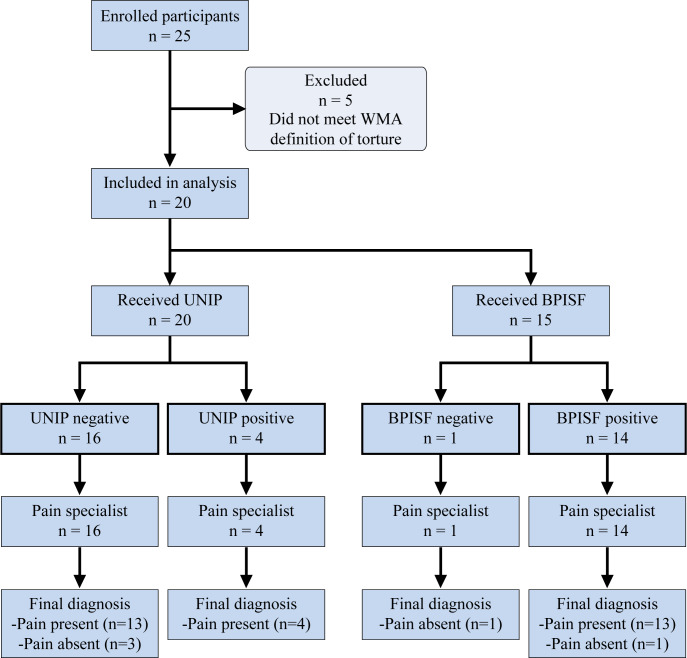
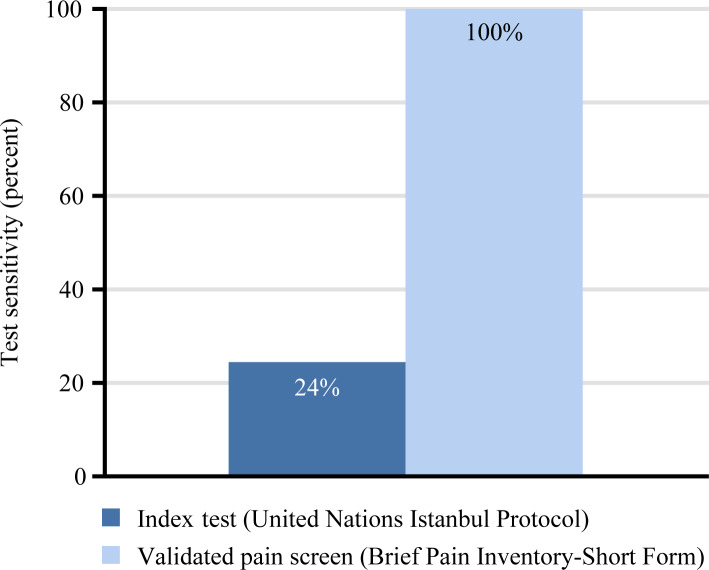
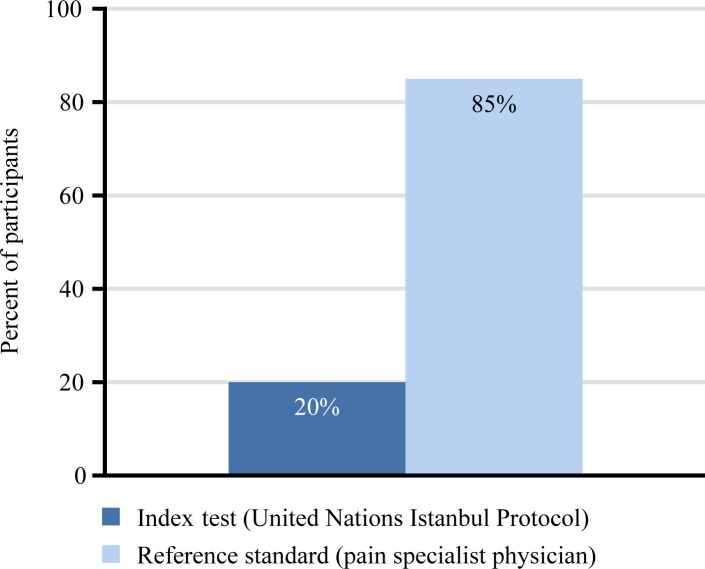
This prospective blind-comparison-to-gold-standard study of survivors of torture, as defined by the World Medical Association, took place at Weill Cornell Medicine between February 1, 2017, and June 21, 2019. 11 women and 9 men, for a total of 20 participants, were included in the analysis. Five participants received 2 UNIP evaluations, for a total of 25 unique evaluations included in the analysis. Participants were representative of a global population, with home countries in Africa, Central America, South Asia, the Caribbean, and the Middle East. Methods of torture experienced were homogeneous, following the predictable pattern of systematic torture. Participants first received the standard evaluation protocol for torture survivors (UNIP) by a trained evaluator, and subsequently received a validated pain screen (Brief Pain Inventory-Short Form [BPISF]) followed by a noninvasive examination by a pain specialist physician (reference standard). The primary outcome was the diagnostic and treatment capability of the standard protocol (index test) versus the validated pain screen (BPISF), as compared to the reference standard. Trained evaluators performing the initial assessment with the UNIP (index test) were blinded to the study, and the pain specialist physician (reference standard) was blinded to the outcome of the initial UNIP evaluation and the BPISF; data from the initial UNIP assessment were not gathered by the principal investigator until all other study procedures were completed. Providers using only the UNIP captured pain in a maximum of 16% of evaluations, as compared to 85% of participants being diagnosed with pain by the reference standard. When employed, the validated pain screen had a sensitivity of 100% (95% CI 72%-100%) and a negative predictive value of 100%, as compared to a sensitivity of 24% (95% CI 8%-50%) and a negative predictive value of 19% (95% CI 5%-46%) for the index test. The difference in the sensitivity of the UNIP as compared to the BPISF was significant, with p < 0.001. No adverse events owing to participation in the study were reported by participants. Limitations of the study include small sample size, its single-site nature, and the exclusion of individuals who did not speak 1 of the 5 study languages.
These data indicate that a validated pain screen can supplement the current global standard assessment of torture survivors, the UNIP, to increase the accuracy of pain diagnosis.
ClinicalTrials.gov NCT03018782.
据估计,87%的酷刑幸存者会经历慢性疼痛,如上肢悬吊引起的臂丛神经病或下肢过度伸展引起的腰骶丛损伤。然而,由于缺乏诊断工具和混杂的精神疾病,绝大多数疼痛未被评估者发现。这种诊断差距导致仅采用心理治疗,而不是多模式治疗,从而极大地限制了康复。我们假设,联合国伊斯坦布尔议定书(UNIP)的疼痛检测灵敏度约为 15%,而使用经过验证的疼痛筛查将至少提高 29%的灵敏度,作为参考标准(疼痛专家评估)。
这项对酷刑幸存者的前瞻性盲法比较金标准研究,由世界医学协会定义,于 2017 年 2 月 1 日至 2019 年 6 月 21 日在威尔康奈尔医学院进行。共纳入 20 名参与者,包括 11 名女性和 9 名男性。其中 5 名参与者接受了 2 次 UNIP 评估,共有 25 次独特的评估纳入分析。参与者代表了来自非洲、中美洲、南亚、加勒比和中东的全球人群。他们经历的酷刑方法是同质的,遵循系统酷刑的可预测模式。参与者首先接受由经过培训的评估员进行的标准酷刑幸存者评估(UNIP),随后接受经过验证的疼痛筛查(简短疼痛量表[BPISF]),随后由疼痛专科医生(参考标准)进行非侵入性检查。主要结局是标准方案(指数试验)与经过验证的疼痛筛查(BPISF)的诊断和治疗能力,与参考标准相比。进行初始 UNIP 评估的经过培训的评估员(指数试验)对研究结果保持盲态,而疼痛专科医生(参考标准)对初始 UNIP 评估和 BPISF 的结果保持盲态;直到完成所有其他研究程序,主研究员才收集初始 UNIP 评估的数据。仅使用 UNIP 的提供者最多可捕捉到 16%的评估中的疼痛,而参考标准则可诊断出 85%的参与者存在疼痛。当使用时,经过验证的疼痛筛查的灵敏度为 100%(95%CI 72%-100%),阴性预测值为 100%,而指数试验的灵敏度为 24%(95%CI 8%-50%),阴性预测值为 19%(95%CI 5%-46%)。UNIP 的灵敏度与 BPISF 的差异具有统计学意义,p<0.001。没有参与者报告因参与研究而发生任何不良事件。该研究的局限性包括样本量小、研究地点单一以及排除了不会说 5 种研究语言之一的人。
这些数据表明,经过验证的疼痛筛查可以补充当前全球酷刑幸存者评估的标准,即 UNIP,以提高疼痛诊断的准确性。
ClinicalTrials.gov NCT03018782。