Epi-Centre for Healthy Ageing, Deakin University, PO Box 281, Geelong, Victoria, 3220, Australia.
Faculty of Health, Biostatistics Unit, Deakin University, Geelong, VIC, Australia.
BMC Geriatr. 2020 Jun 5;20(1):196. doi: 10.1186/s12877-020-01595-8.
Frailty is characterised by age-related declines in physical, psychological and social functioning. Features of frailty overlap with risk factors for fragility fractures. The aim of this study was to investigate the association between the fracture risk assessment tool (FRAX®) and frailty.
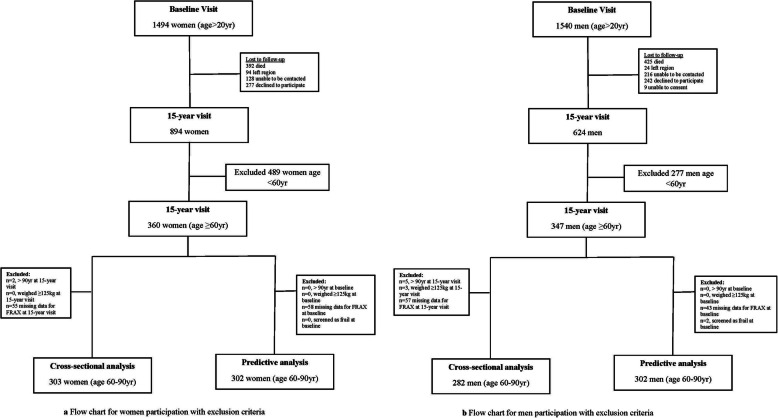
In cross-sectional analysis, frailty status was determined for participants aged 60-90 yr at 15-year follow-up of the Geelong Osteoporosis Study, using a modified Fried frailty phenotype. Using the FRAX on-line tool, scores for hip and major osteoporotic fracture (MOF) were calculated with and without bone mineral density (BMD). Using the area under Receiver Operating Characteristic (AUROC) curves, and FRAX scores calculated at the baseline visit for these participants, we investigated the association of FRAX and frailty 15 years later.
Forty-seven of 303 women (15.5%) and 41 of 282 men (14.5%) were frail at the 15-year visit. There was a gradient of increasing median FRAX scores from robust to frail. For example, for women, median MOF-FRAX without BMD increased from 5.9 for the robust to 7.5 for the pre-frail and 14.0 for the frail (p < 0.001). In secondary analyses, an association was observed between FRAX and frailty over 15 years, with the highest AUROC for women being 0.72 for MOF-FRAX with BMD, and for men, 0.76 hip-FRAX without BMD.
An association was observed between FRAX and frailty where frail men and women had higher FRAX-scores compared to the other groups. Preliminary data suggest that FRAX, with or without BMD, may be useful in enhancing the information on frailty. Further research using larger datasets will be required to explore this.
衰弱的特点是与年龄相关的身体、心理和社会功能下降。衰弱的特征与脆性骨折的危险因素重叠。本研究的目的是探讨骨折风险评估工具(FRAX®)与衰弱之间的关系。
在横断面分析中,使用改良的 Fried 衰弱表型,对 Geelong 骨质疏松研究随访 15 年时年龄在 60-90 岁的参与者的衰弱状况进行了评估。使用 FRAX 在线工具,计算了有和没有骨密度(BMD)的髋部和主要骨质疏松性骨折(MOF)的分数。使用接收器操作特征(ROC)曲线下面积(AUROC)和这些参与者基线时的 FRAX 评分,我们调查了 FRAX 与 15 年后的衰弱之间的关联。
在 15 年的随访中,303 名女性中有 47 名(15.5%)和 282 名男性中有 41 名(14.5%)衰弱。从强壮到衰弱,FRAX 评分中位数呈梯度升高。例如,对于女性,无 BMD 的 MOF-FRAX 中位数从强壮组的 5.9 增加到虚弱前期组的 7.5 和衰弱组的 14.0(p<0.001)。在二次分析中,在 15 年内观察到 FRAX 与衰弱之间存在关联,女性的 MOF-FRAX 与 BMD 的 AUROC 最高为 0.72,男性的髋部 FRAX 无 BMD 的 AUROC 最高为 0.76。
FRAX 与衰弱之间存在关联,虚弱的男性和女性的 FRAX 评分高于其他组。初步数据表明,FRAX,无论是否有 BMD,都可能有助于增强对衰弱的了解。需要使用更大的数据集进行进一步研究以探讨这一问题。