Technical University of Munich, School of Medicine, Institute of Medical Informatics, Statistics and Epidemiology, Ismaninger Str. 22, 81675, Munich, Germany.
Institute for Community Medicine, Department Epidemiology of Health Care and Community Health, University Medicine Greifswald, Ellernholzstr 1-2, 17487, Greifswald, Germany.
BMC Med Inform Decis Mak. 2020 Jun 5;20(1):103. doi: 10.1186/s12911-020-01138-6.
The aim of the German Medical Informatics Initiative is to establish a national infrastructure for integrating and sharing health data. To this, Data Integration Centers are set up at university medical centers, which address data harmonization, information security and data protection. To capture patient consent, a common informed consent template has been developed. It consists of different modules addressing permissions for using data and biosamples. On the technical level, a common digital representation of information from signed consent templates is needed. As the partners in the initiative are free to adopt different solutions for managing consent information (e.g. IHE BPPC or HL7 FHIR Consent Resources), we had to develop an interoperability layer.
First, we compiled an overview of data items required to reflect the information from the MII consent template as well as patient preferences and derived permissions. Next, we created entity-relationship diagrams to formally describe the conceptual data model underlying relevant items. We then compared this data model to conceptual models describing representations of consent information using different interoperability standards. We used the result of this comparison to derive an interoperable representation that can be mapped to common standards.
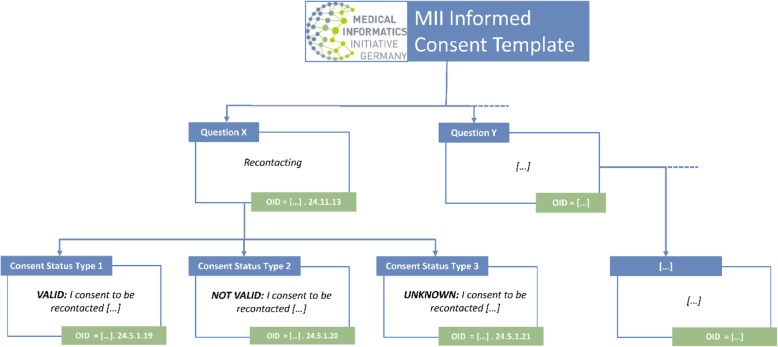
The digital representation needs to capture the following information: (1) version of the consent, (2) consent status for each module, and (3) period of validity of the status. We found that there is no generally accepted solution to represent status information in a manner interoperable with all relevant standards. Hence, we developed a pragmatic solution, comprising codes which describe combinations of modules with a basic set of status labels. We propose to maintain these codes in a public registry called ART-DECOR. We present concrete technical implementations of our approach using HL7 FHIR and IHE BPPC which are also compatible with the open-source consent management software gICS.
The proposed digital representation is (1) generic enough to capture relevant information from a wide range of consent documents and data use regulations and (2) interoperable with common technical standards. We plan to extend our model to include more fine-grained status codes and rules for automated access control.
德国医学信息学倡议的目的是建立一个整合和共享健康数据的国家基础设施。为此,在大学医学中心设立了数据集成中心,负责数据协调、信息安全和数据保护。为了获取患者同意,开发了一个通用的知情同意模板。它由不同的模块组成,涉及使用数据和生物样本的权限。在技术层面上,需要对签名同意模板中的信息进行通用的数字表示。由于倡议的合作伙伴可以自由采用不同的解决方案来管理同意信息(例如 IHE BPPC 或 HL7 FHIR 同意资源),因此我们必须开发一个互操作性层。
首先,我们编制了一份需要反映 MII 同意模板信息以及患者偏好和派生权限的数据项概述。接下来,我们创建了实体关系图,以正式描述相关项背后的概念数据模型。然后,我们将此数据模型与使用不同互操作性标准描述同意信息表示的概念模型进行比较。我们使用比较的结果推导出一种可映射到通用标准的互操作表示。
数字表示需要捕获以下信息:(1)同意的版本,(2)每个模块的同意状态,以及(3)状态有效期。我们发现,没有一种普遍接受的解决方案可以以与所有相关标准互操作的方式表示状态信息。因此,我们开发了一种实用的解决方案,包括描述具有基本状态标签的模块组合的代码。我们建议在一个名为 ART-DECOR 的公共注册中心维护这些代码。我们使用 HL7 FHIR 和 IHE BPPC 展示了我们方法的具体技术实现,这些实现也与开源同意管理软件 gICS 兼容。
所提出的数字表示(1)足够通用,可以捕获来自广泛同意文件和数据使用法规的相关信息,(2)与常见技术标准互操作。我们计划扩展我们的模型,以包括更细粒度的状态代码和用于自动访问控制的规则。