Children's Clinic, St. Olavs Hospital, Trondheim, Norway.
Department of Clinical and Molecular Medicine, Norwegian University of Science and Technology, N-7489, Trondheim, Norway.
Health Qual Life Outcomes. 2020 Jun 5;18(1):170. doi: 10.1186/s12955-020-01430-z.
The primary aim was to measure health related quality of life (HRQoL) in a Norwegian cohort of adolescents with Chronic Fatigue Syndrome (CFS/ME). A secondary aim was to identify factors before diagnosis, at time of diagnosis and after diagnosis that were associated with HRQoL.
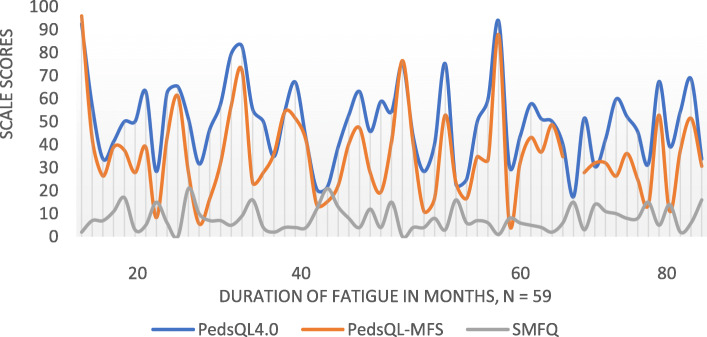
In this cross-sectional population-based study, HRQoL was measured by Pediatric Quality of Life Inventory™ Generic Core scale version 4.0 (PedsQL4.0) in 63 adolescents with CFS/ME. In addition, fatigue was measured by PedsQL Multidimensional Fatigue scale (PedsQL-MFS), depressive symptoms were measured by the Short Mood and Feelings Questionnaire (SMFQ), and disruption in school activities was measured by The De Paul Pediatric Health Questionnaire (DPHQ-N). Data were also collected from medical records and patient interviews.
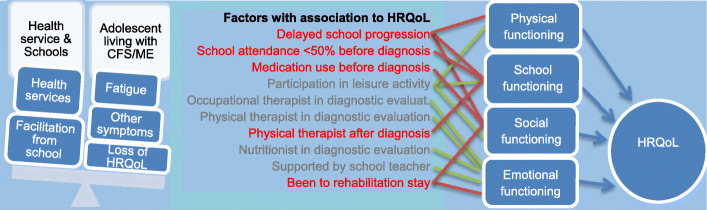
Age at diagnosis was 15 (2) years (mean (SD)), and four out of five participants were female. Time from diagnosis to reply was 39 (22) months. Adolescents with CFS/ME reported PedsQL4.0 score 50 (17), and boys reported a better score than girls (64 vs 47, 95% Confidence Interval (CI) for difference (- 27; - 6)). There were positive associations between overall HRQoL and support from a schoolteacher, school attendance or participation in leisure activities. There were negative associations between overall HRQoL and delayed school progression, having been to rehabilitation stay and depressive symptoms.
HRQoL in adolescents diagnosed with CFS/ME was low. The associations between reported HRQoL, healthcare previously provided, support from a schoolteacher, school attendance and participation in leisure activity may provide information of value when developing refined strategies for healthcare among adolescents with CFS/ME. Possible causal relationships must however be explored in future studies.
本研究旨在测量挪威慢性疲劳综合征(CFS/ME)青少年患者的健康相关生活质量(HRQoL)。次要目的是确定诊断前、诊断时和诊断后与 HRQoL 相关的因素。
在这项基于人群的横断面研究中,使用儿童生活质量量表通用核心量表第 4.0 版(PedsQL4.0)测量 63 名 CFS/ME 青少年的 HRQoL。此外,疲劳程度通过多维疲劳量表(PedsQL-MFS)进行测量,抑郁症状通过短情绪和感觉问卷(SMFQ)进行测量,学校活动中断通过德保罗儿科健康问卷(DPHQ-N)进行测量。数据还来自医疗记录和患者访谈。
诊断时的年龄为 15(2)岁(均值(SD)),五分之四的参与者为女性。从诊断到回复的时间为 39(22)个月。CFS/ME 青少年报告的 PedsQL4.0 评分为 50(17),男孩的得分高于女孩(64 比 47,95%置信区间(CI)差值为-27;-6)。总体 HRQoL 与得到学校教师的支持、上学或参加休闲活动呈正相关。总体 HRQoL 与学业进度延迟、接受康复治疗和抑郁症状呈负相关。
被诊断患有 CFS/ME 的青少年的 HRQoL 较低。报告的 HRQoL 与先前提供的医疗保健、得到学校教师的支持、上学和参加休闲活动之间的关联可能为制定针对 CFS/ME 青少年的精细医疗保健策略提供有价值的信息。然而,在未来的研究中必须探讨可能的因果关系。