Department of General Surgery and Medical-Surgical Specialties, Section of Orthodontics, School of Dentistry, University of Catania, Policlinico Universitario "Vittorio Emanuele", Via Santa Sofia 78, 95123, Catania, Italy.
Department of General Surgery and Medical-Surgical Specialties, Section of Prosthodontist, School of Dentistry, University of Catania, Policlinico Universitario "Vittorio Emanuele", Via Santa Sofia 78, Catania, 98123, Italy.
BMC Oral Health. 2020 Jun 5;20(1):165. doi: 10.1186/s12903-020-01145-z.
Mock-up based approach allows the preview of the aesthetic rehabilitation, however, it is crucial that the mock-up does not differ from the expected aesthetic outcomes. With CAD-CAM technologies, it is possible to directly create mock-ups from virtual planned smile project, with greater accuracy and efficiency compared to the conventional moulded mock-ups. In this study, we investigated the trueness of mock-ups obtained with milling and 3D printing technology and a full digital work-flow system.
Ten adults subjects were included and digital smile design/digital wax-up were performed to enhance the aesthetic of maxillary anterior region. Ten milled mock-ups and 10 prototyped mock-ups were obtained from the original .stl file and a digital analysis of trueness was carried out by superimposing the scanned-milled mock-ups and the scanned-prototyped mock-ups to the digital wax-up, according to the surface-to-surface matching technique. Specific linear measurements were performed to investigate and compare the dimensional characteristics of the physical manufactures, the 3D project and the scanned mock-ups. All data were statistically analyzed. A clinical test was also performed to assess the fitting of the final manufacture.
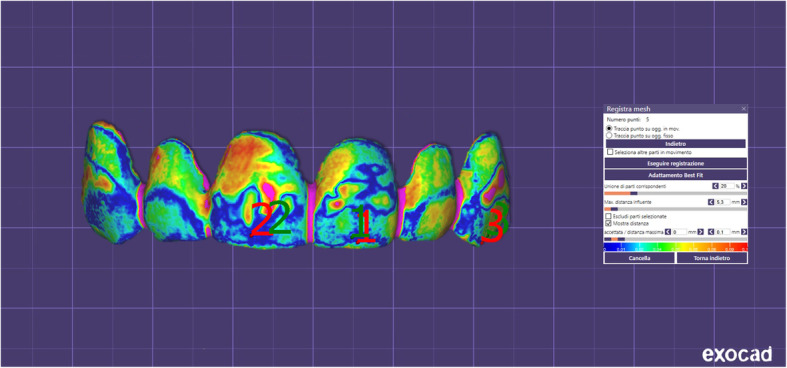
The prototyped mock-ups showed a significant increment of the transversal measurements (p < 0.001) while the milled mock-ups showed a significant increment of all vertical and transversal measurements (p < 0.001). The prototyped mock-ups showed good fitting after clinical tests while none of the milled mock-ups showed good adaptation (no fitting or significant clinical compensation required). Deviation analysis from the original 3D project reported a greater matching percentage for the scanned-milled mock-ups (80,31% ± 2.50) compared to the scanned-prototyped mock-ups (69,17% ± 2.64) (p < 0.001). This was in contrast with the findings from linear measurements as well as from the clinical test and may have been affected by a reductive algorithmic computation after digitization of physical mock-ups.
Both prototype and milled mock-ups showed a slight dimensional increment comparing to the original 3D project, with milled-mock-ups showing less fitting after clinical tests. Caution must be taken when assessing the trueness of scanned manufacture since an intrinsic error in the system can underestimate the dimensions of the real object.
基于模型的方法可以预览美学修复效果,但模型与预期美学效果之间不应存在差异。借助 CAD-CAM 技术,可以直接从虚拟的微笑设计项目中创建模型,与传统的注塑模型相比,其准确性和效率更高。本研究旨在探讨铣削和 3D 打印技术以及全数字化工作流程系统获得的模型的逼真度。
纳入 10 名成年人,对上颌前牙区进行数字化微笑设计/数字化蜡型,以增强美学效果。从原始.stl 文件中获得 10 个铣削模型和 10 个原型模型,然后根据表面到表面匹配技术,将扫描铣削模型和扫描原型模型叠加到数字化蜡型上,进行逼真度的数字分析。进行特定的线性测量,以研究和比较物理制造、3D 项目和扫描模型的尺寸特征。所有数据均进行统计学分析。还进行了临床测试,以评估最终制品的适配性。
原型模型的横向测量值显著增加(p<0.001),而铣削模型的所有垂直和横向测量值均显著增加(p<0.001)。临床测试后,原型模型适配良好,而铣削模型无一适配(需要适配或显著的临床补偿)。与原始 3D 项目的偏差分析显示,扫描铣削模型的匹配百分比(80.31%±2.50)高于扫描原型模型(69.17%±2.64)(p<0.001)。这与线性测量值以及临床测试的结果相反,可能是由于物理模型数字化后的还原算法计算造成的。
与原始 3D 项目相比,原型和铣削模型的尺寸均略有增加,临床测试后铣削模型的适配性较差。在评估扫描制品的逼真度时应谨慎,因为系统中的固有误差可能会低估真实物体的尺寸。