Zhang Guodong, Zhao Zhou, Chen Yu, Chen Shenglong, Liu Gang
Cardiac Surgery Department, Peking University People's Hospital, BeiJing, 100044, China.
J Cardiothorac Surg. 2020 Jun 5;15(1):126. doi: 10.1186/s13019-020-01172-5.
Owing to the high patency, the use of the left internal mammary artery (LIMA) for left anterior descending artery (LAD) grafting has been a cornerstone of coronary artery bypass grafting surgery (CABG). However, for some patients whose LIMA cannot be used, surgeons have to choose other conduit materials to revascularize the LAD. The purpose of this study was to explore the differences in different conduit materials used for LAD in terms of parameters measured by transit-time flow measurement (TTFM) and the early graft patency detected by computed tomography angiography.
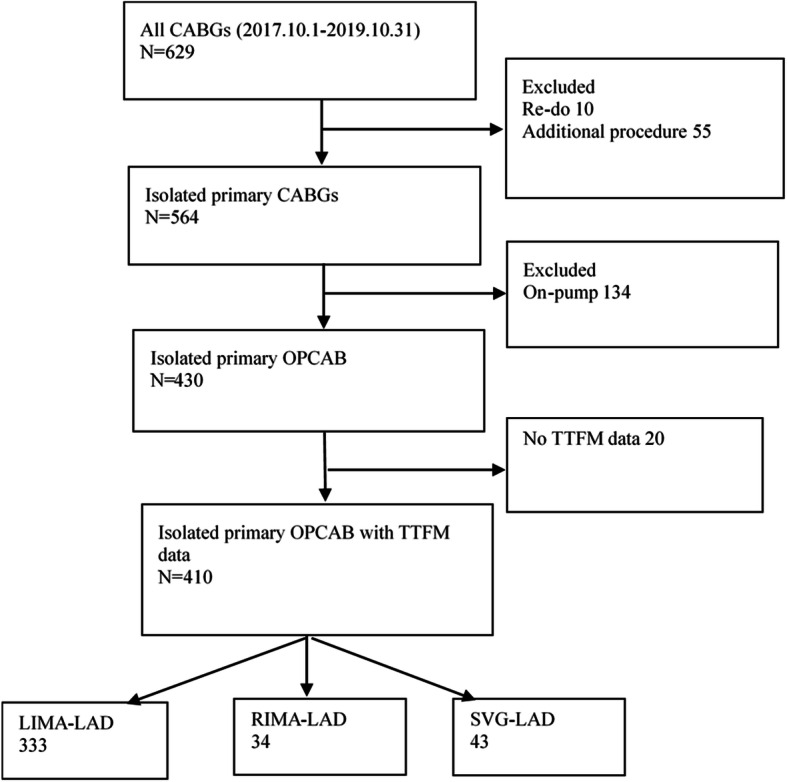
We retrospectively collected the data of 410 patients who underwent isolated primary OPCAB with intraoperative TTFM data. According to the strategy of the LAD revascularization, 410 patients were assigned to three groups: a left internal mammal artery (LIMA) group (n = 333), a right IMA (RIMA) group (n = 34) and a great saphenous vein (SVG) group (n = 43). The baseline and perioperative blood parameters were compared for the three groups, as well as the early graft patency rates.
Compared with the LIMA-LAD group, the SVG-LAD group had a significantly higher mean graft flow volume (MGF) (37.15 ± 23.29 vs 29.71 ± 20.94 ml/min, P = 0.036), however, had a lower value of pulse index (PI) (2.07 ± 0.62 vs 2.65 ± 1.01, P<0.001). There was no significant difference between the two groups in terms of DF (P>0.05). Compared with the RIMA-LAD group, the SVG-LAD group just had a lower value of PI (2.07 ± 0.62 vs 2.56 ± 0.96, P = 0.029). However, there was no significant difference between the two groups in terms of MGF and DF (P>0.05). Compared with the LIMA-LAD group, the RIMA-LAD group had a slightly lower value of DF (70.76 ± 11.87 vs 74.06 ± 7.09, P = 0.018), while there was no difference in terms of MGF and PI between the two groups (P>0.05). The patency rate of the LIMA-LAD group was 98.72% (309/313), that of RIMA-LAD group was 97.06% (33/34), and that of SVG-LAD group was 100%. There was no difference among the three groups in patency rate (P = 0.405).
SVG-LAD has a higher intraoperative MGF and a lower value of the PI than both LIMA-LAD and RIMA-LAD. RIMA has a higher preoperative blood flow and a lower value of the PI than LIMA; however, there were no significant difference between RIMA grafted to LAD and LIMA grafted to LAD in terms of MGF, PI and DF. In situ skeletonized RIMA did not increase blood flow compared to pedicled LIMA.
由于通畅率高,左乳内动脉(LIMA)用于左前降支动脉(LAD)搭桥一直是冠状动脉搭桥手术(CABG)的基石。然而,对于一些无法使用LIMA的患者,外科医生不得不选择其他管道材料来实现LAD血管重建。本研究的目的是探讨用于LAD的不同管道材料在通过渡越时间血流测量(TTFM)测量的参数以及通过计算机断层血管造影检测的早期移植物通畅率方面的差异。
我们回顾性收集了410例行孤立性初次非体外循环冠状动脉搭桥术且有术中TTFM数据的患者资料。根据LAD血管重建策略,将410例患者分为三组:左乳内动脉(LIMA)组(n = 333)、右乳内动脉(RIMA)组(n = 34)和大隐静脉(SVG)组(n = 43)。比较三组的基线和围手术期血液参数以及早期移植物通畅率。
与LIMA-LAD组相比,SVG-LAD组的平均移植物血流量(MGF)显著更高(37.15±23.29 vs 29.71±20.94 ml/min,P = 0.036),然而,搏动指数(PI)值更低(2.07±0.62 vs 2.65±1.01,P<0.001)。两组间舒张期血流分数(DF)无显著差异(P>0.05)。与RIMA-LAD组相比,SVG-LAD组仅PI值更低(2.07±0.62 vs 2.56±0.96,P = 0.029)。然而,两组间MGF和DF无显著差异(P>0.05)。与LIMA-LAD组相比,RIMA-LAD组的DF值略低(70.76±11.87 vs 74.06±7.09,P = 0.018),而两组间MGF和PI无差异(P>0.05)。LIMA-LAD组的通畅率为98.72%(309/313),RIMA-LAD组为97.06%(33/34),SVG-LAD组为100%。三组间通畅率无差异(P = 0.405)。
SVG-LAD在术中具有比LIMA-LAD和RIMA-LAD更高的MGF以及更低的PI值。RIMA术前血流量比LIMA更高且PI值更低;然而,RIMA移植至LAD与LIMA移植至LAD在MGF、PI和DF方面无显著差异。与带蒂LIMA相比,原位骨骼化RIMA并未增加血流量。