Jiangsu Key Laboratory of Atmospheric Environment Monitoring and Pollution Control, School of Environmental Science and Engineering, Nanjing University of Information Science and Technology, Nanjing, 210044, China.
John A. Paulson School of Engineering and Applied Sciences, Harvard University, Cambridge, MA, 02138, USA.
Nat Commun. 2020 Jun 5;11(1):2844. doi: 10.1038/s41467-020-16683-x.
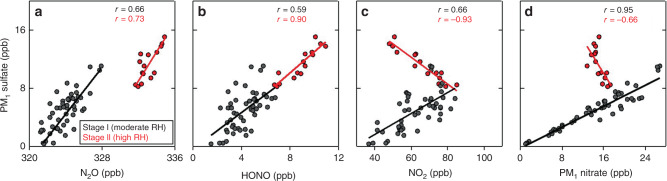
Severe events of wintertime particulate air pollution in Beijing (winter haze) are associated with high relative humidity (RH) and fast production of particulate sulfate from the oxidation of sulfur dioxide (SO) emitted by coal combustion. There has been considerable debate regarding the mechanism for SO oxidation. Here we show evidence from field observations of a haze event that rapid oxidation of SO by nitrogen dioxide (NO) and nitrous acid (HONO) takes place, the latter producing nitrous oxide (NO). Sulfate shifts to larger particle sizes during the event, indicative of fog/cloud processing. Fog and cloud readily form under winter haze conditions, leading to high liquid water contents with high pH (>5.5) from elevated ammonia. Such conditions enable fast aqueous-phase oxidation of SO by NO, producing HONO which can in turn oxidize SO to yield NO.This mechanism could provide an explanation for sulfate formation under some winter haze conditions.
北京市冬季颗粒物空气污染的严重事件(冬季雾霾)与相对湿度高(RH)和燃煤排放的二氧化硫(SO)快速氧化生成硫酸盐颗粒物有关。关于 SO 氧化的机制一直存在很大的争议。在这里,我们从雾霾事件的实地观测结果中提供了证据,表明二氧化氮(NO)和亚硝酸(HONO)会迅速氧化 SO,后者会产生一氧化二氮(NO)。硫酸盐在事件过程中转移到更大的颗粒尺寸,表明存在雾/云处理。在冬季雾霾条件下,雾和云很容易形成,导致高 pH 值(>5.5)的高液态水含量来自氨的升高。这种条件使得 NO 可以快速进行 SO 的水相氧化,产生可以将 SO 氧化生成 NO 的 HONO。这种机制可以为某些冬季雾霾条件下的硫酸盐形成提供解释。