Munroe-Meyer Institute for Genetics and Rehabilitation, University of Nebraska Medical Center, Omaha, NE, 68105, USA.
Department of Pediatrics, College of Medicine, University of Nebraska Medical Center, Omaha, NE, 68198, USA.
Mol Psychiatry. 2020 Nov;25(11):2685-2694. doi: 10.1038/s41380-020-0801-x. Epub 2020 Jun 5.
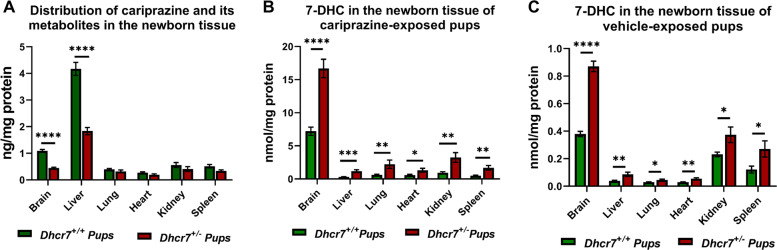
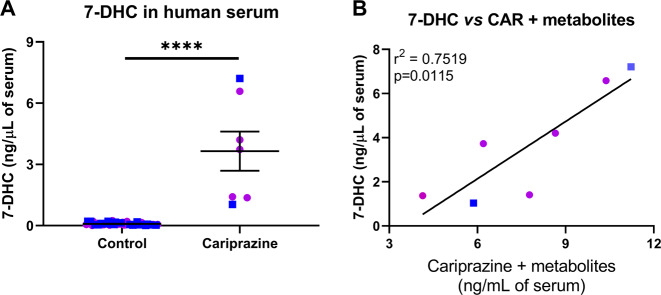
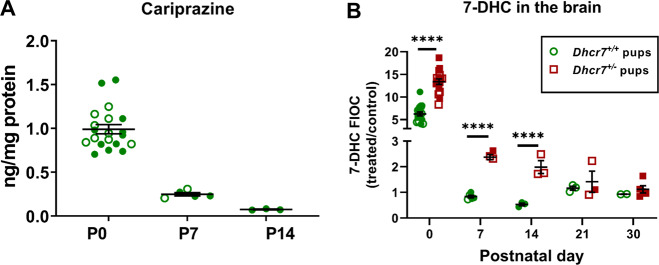
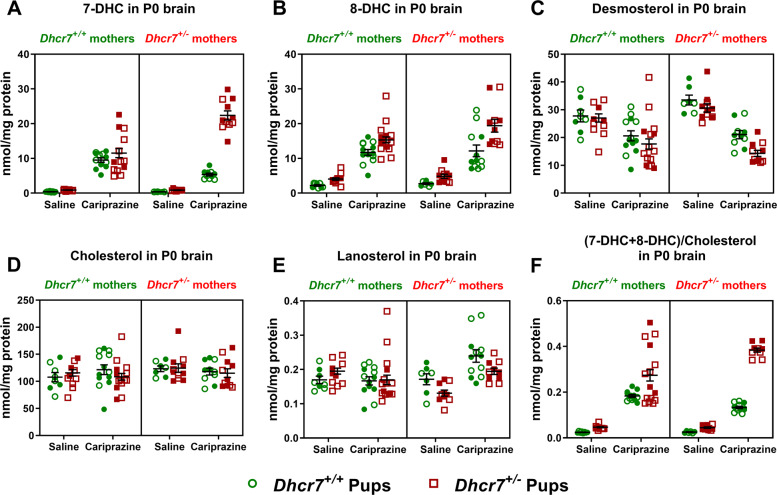
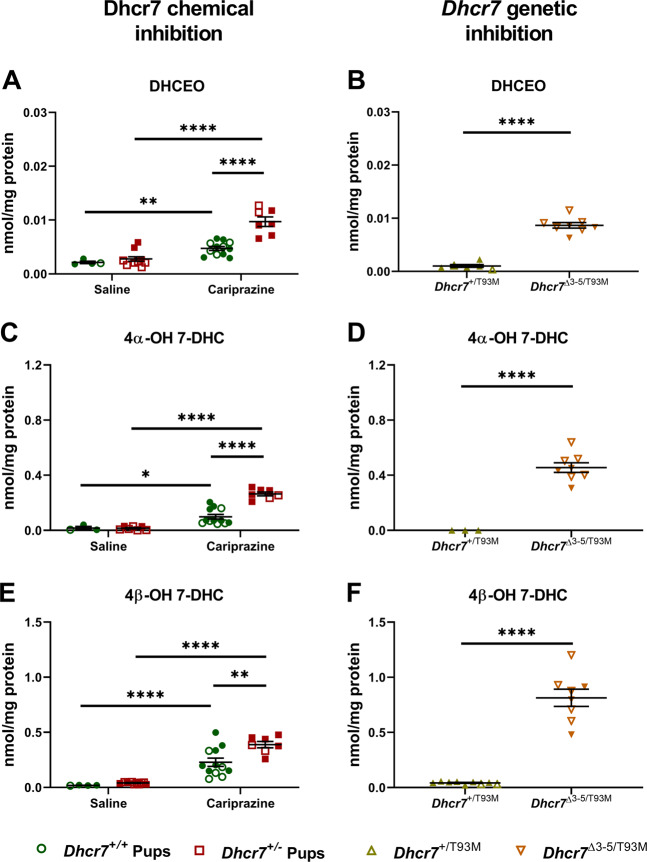
Cariprazine (CAR) is a strong inhibitor of the Dhcr7 enzyme, the last enzyme in the cholesterol biosynthesis pathway. We assessed the effects of CAR on maternally exposed Dhcr7 and wild-type mouse offspring, and tested the biochemical effects of CAR in human serum samples. Dhcr7 and wild-type time-pregnant mice were exposed to vehicle or 0.2 mg/kg CAR from E12 to E19. Levels of CAR, CAR metabolites, sterols, and oxysterols were measured in the brain of maternally exposed offspring at various time points using LC-MS/MS. Embryonic exposure to CAR significantly increased levels of 7-DHC in all organs of exposed embryos, with a particularly strong effect in the brain. Detectable levels of CAR and elevated 7-DHC were observed in the brain of newborn pups 14 days after drug exposure. In addition, CAR altered sterol metabolism in all animals analyzed, with the strongest effect on the brain of Dhcr7 pups born to Dhcr7 dams. Furthermore, CAR elevated toxic oxysterols in the brain of maternally exposed Dhcr7 offspring to levels approaching those seen in a mouse model of Smith-Lemli-Opitz syndrome. Finally, we observed that patients taking CAR have elevated 7-DHC in their serum. In summary, maternal DHCR7 heterozygosity, combined with offspring DHCR7 heterozygosity might represent a vulnerability factor to medications that interfere with sterol biosynthesis. Due to the conserved sterol biosynthesis between mice and humans, we suggest that the 1-3% of patient population with single-allele DHCR7 mutations might not be ideal candidates for CAR use, especially if they are nursing, pregnant or plan to become pregnant.
卡里匹嗪(CAR)是胆固醇生物合成途径中最后一种酶 Dhcr7 的强抑制剂。我们评估了 CAR 对母体暴露的 Dhcr7 和野生型小鼠后代的影响,并测试了 CAR 在人血清样本中的生化作用。Dhcr7 和野生型时间怀孕的小鼠从 E12 到 E19 接受载体或 0.2mg/kg CAR 暴露。使用 LC-MS/MS 在不同时间点测量母体暴露后代大脑中的 CAR、CAR 代谢物、甾醇和氧化甾醇水平。胚胎暴露于 CAR 显著增加了暴露胚胎所有器官中的 7-DHC 水平,在大脑中具有特别强烈的作用。在药物暴露 14 天后,新生幼仔的大脑中可检测到 CAR 和升高的 7-DHC。此外,CAR 改变了所有动物分析中的甾醇代谢,对 Dhcr7 母体后代大脑的影响最大,Dhcr7 母鼠出生的 Dhcr7 幼仔。此外,CAR 使母体暴露的 Dhcr7 后代的大脑中的毒性氧化甾醇升高,达到接近 Smith-Lemli-Opitz 综合征小鼠模型的水平。最后,我们观察到服用 CAR 的患者其血清中的 7-DHC 升高。总之,母体 DHCR7 杂合性,加上后代 DHCR7 杂合性,可能代表一种易感性因素,使那些干扰固醇生物合成的药物。由于小鼠和人类之间的固醇生物合成具有保守性,我们建议,具有单等位基因 DHCR7 突变的患者人群中,1-3%可能不是 CAR 使用的理想候选者,特别是如果他们正在哺乳、怀孕或计划怀孕。