Institute of Pathology, University Hospital Erlangen, Erlangen, Germany.
Departments of Human Genetics, McGill University, Montreal, Quebec, Canada.
Virchows Arch. 2020 Dec;477(6):787-798. doi: 10.1007/s00428-020-02853-1. Epub 2020 Jun 7.
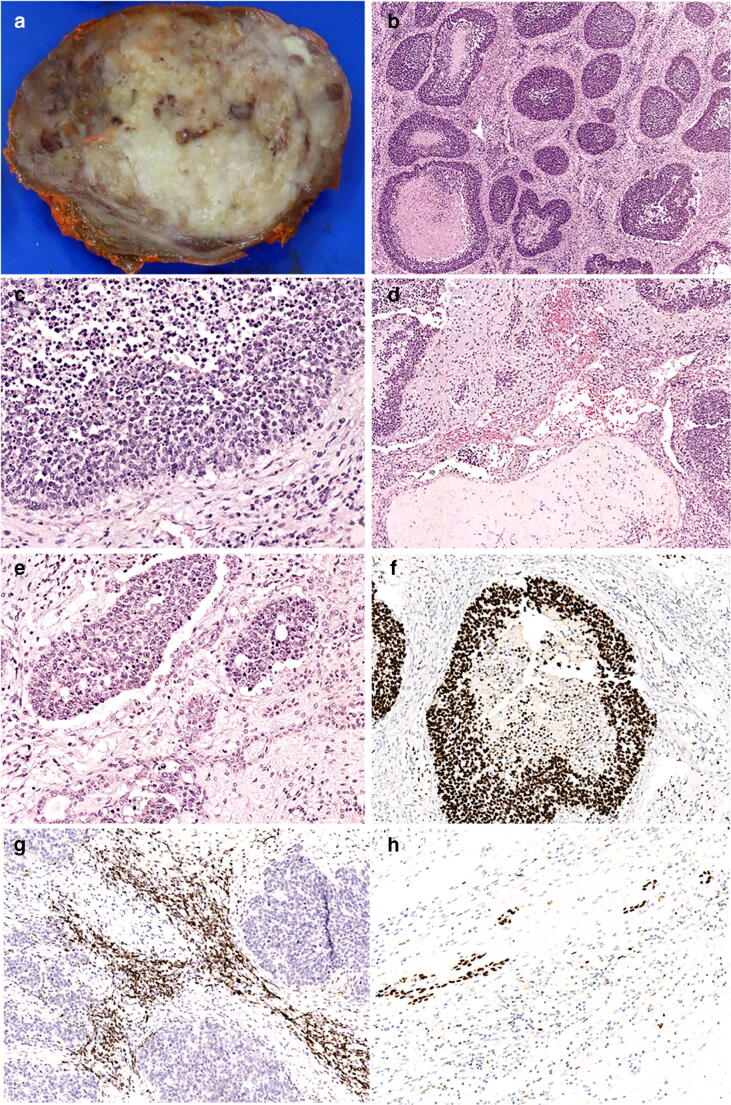
Primary thyroid teratomas are exceedingly rare. Mature and immature variants recapitulate their gonadal counterparts (predilection for infants/children, triphasic germ layer differentiation, and favorable outcome). On the other hand, the so-called malignant teratomas affect predominantly adults and elderly, are highly aggressive, and, according to a few published cases, harbor DICER1 mutations. We describe three highly aggressive sporadic malignant teratoid thyroid tumors in 2 females (17 and 45 years) and one male (17 years). Histology showed triphasic neoplasms composed of solid nests of small primitive monomorphic cells embedded in a cellular stroma with primitive immature rhabdomyosarcoma-like (2) or pleomorphic sarcoma-like (1) phenotype. The third component was represented by TTF1+/PAX8+ primitive teratoid epithelial tubules reminiscent of primitive thyroid follicles and/or Wilms tumor, admixed with scattered respiratory- or enteric-type tubules, neuroepithelial rosettes, and fetal-type squamoid nests. Foci of cartilage were seen in two cases, but none contained mature organoid adult-type tissue or skin adnexa. SALL4 was expressed in the small cell (2) and stromal (1) component. Other germ cell markers were negative. Molecular testing revealed a known "hotspot" pathogenic DICER1 mutation in two cases. In addition, case 1 had a missense TP53 variant. This type of thyroid malignancy is distinct from genuine teratomas. The immunoprofile suggests primitive thyroid- or branchial cleft-like differentiation. Given that "blastoma" is a well-accepted terminology in the spectrum of DICER1-associated malignancies, the term "thyroblastoma" might be more convenient for these malignant teratoid tumors of the thyroid gland. Relationship of thyroblastoma to the DICER1 syndrome remains to be addressed.
原发性甲状腺畸胎瘤极为罕见。成熟和不成熟的变体重现其性腺对应物(婴儿/儿童的偏好、三胚层分化和良好的结果)。另一方面,所谓的恶性畸胎瘤主要影响成年人和老年人,具有高度侵袭性,并且根据少数已发表的病例,存在 DICER1 突变。我们描述了 3 例在 2 名女性(17 岁和 45 岁)和 1 名男性(17 岁)中发生的高度侵袭性散发性恶性畸胎瘤甲状腺肿瘤。组织学显示三胚层肿瘤,由小原始单形细胞的实性巢组成,嵌入具有原始幼稚横纹肌肉瘤样(2)或多形性肉瘤样(1)表型的细胞基质中。第三个成分是由 TTF1+/PAX8+原始畸胎上皮小管组成,类似于原始甲状腺滤泡和/或维尔姆斯瘤,混合有散在的呼吸或肠型小管、神经上皮玫瑰花结和胎儿型鳞状巢。在 2 例中可见软骨灶,但均无成熟器官样成人型组织或皮肤附属物。SALL4 在小细胞(2)和基质(1)成分中表达。其他生殖细胞标志物均为阴性。分子检测显示 2 例存在已知的“热点”致病性 DICER1 突变。此外,病例 1 存在错义 TP53 变体。这种类型的甲状腺恶性肿瘤与真正的畸胎瘤不同。免疫组化提示原始甲状腺或鳃裂样分化。鉴于“胚细胞瘤”是 DICER1 相关恶性肿瘤谱中被广泛接受的术语,“甲状腺胚细胞瘤”可能更适合这些甲状腺的恶性畸胎瘤。甲状腺胚细胞瘤与 DICER1 综合征的关系仍有待解决。