Faculty of Engineering Technology, University of Twente, P.O. Box 217, 7500AE, Enschede, The Netherlands.
Med Biol Eng Comput. 2020 Aug;58(8):1817-1830. doi: 10.1007/s11517-020-02188-8. Epub 2020 Jun 7.
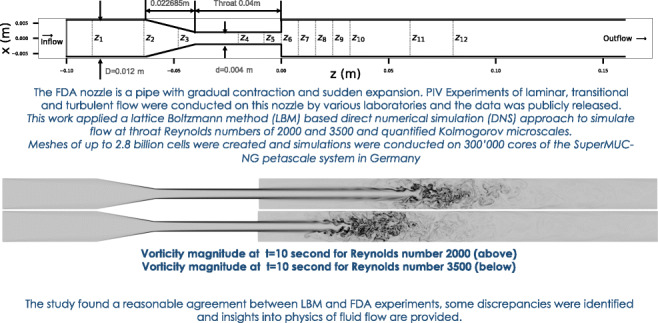
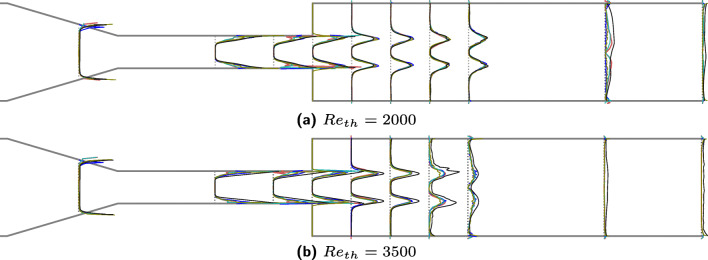
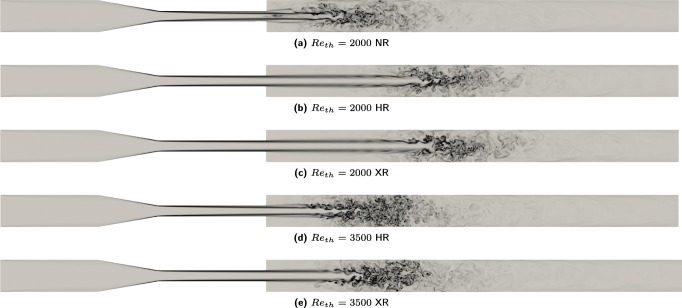
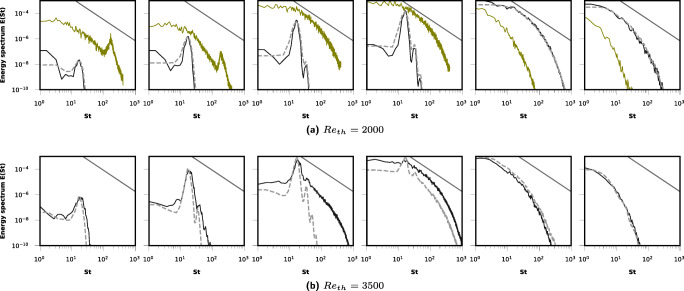
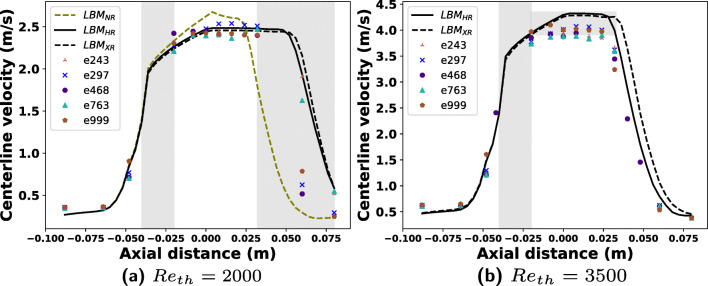
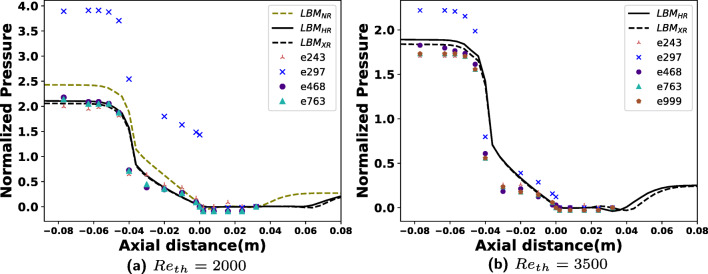
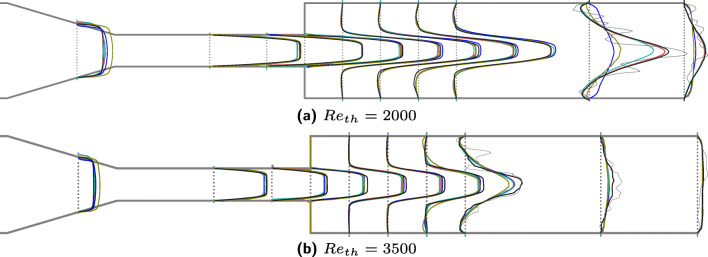
Flows through medical devices as well as in anatomical vessels despite being at moderate Reynolds number may exhibit transitional or even turbulent character. In order to validate numerical methods and codes used for biomedical flow computations, the US Food and Drug Administration (FDA) established an experimental benchmark, which was a pipe with gradual contraction and sudden expansion representing a nozzle. The experimental results for various Reynolds numbers ranging from 500 to 6500 were publicly released. Previous and recent computational investigations of flow in the FDA nozzle found limitations in various CFD approaches and some even questioned the adequacy of the benchmark itself. This communication reports the results of a lattice Boltzmann method (LBM) - based direct numerical simulation (DNS) approach applied to the FDA nozzle benchmark for transitional cases of Reynolds numbers 2000 and 3500. The goal is to evaluate if a simple off the shelf LBM would predict the experimental results without the use of complex models or synthetic turbulence at the inflow. LBM computations with various spatial and temporal resolutions are performed-in the extremities of 45 million to 2.88 billion lattice cells-executed respectively on 32 CPU cores of a desktop to more than 300,000 cores of a modern supercomputer to explore and characterize miniscule flow details and quantify Kolmogorov scales. The LBM simulations transition to turbulence at a Reynolds number 2000 like the FDA's experiments and acceptable agreement in jet breakdown locations, average velocity, shear stress, and pressure is found for both the Reynolds numbers. Graphical Abstract A bisecting plane showing the FDA nozzle and vorticity magnitude at t = 10 s for throat Reynolds numbers of 2000 and 3500.
尽管在中等雷诺数下,血流会流经医疗器械和解剖血管,但可能会表现出过渡流甚至湍流特征。为了验证用于生物医学流动计算的数值方法和代码,美国食品和药物管理局(FDA)建立了一个实验基准,该基准是一个具有逐渐收缩和突然扩张的管道,代表了一个喷嘴。各种雷诺数(范围从 500 到 6500)的实验结果已公开发布。先前和最近对 FDA 喷嘴内流动的计算研究发现,各种 CFD 方法存在局限性,甚至有人质疑基准本身的充分性。本通讯报告了应用于 FDA 喷嘴基准的格子玻尔兹曼方法(LBM)直接数值模拟(DNS)方法的结果,用于模拟雷诺数为 2000 和 3500 的过渡流情况。目的是评估简单的现成 LBM 是否可以在不使用复杂模型或合成湍流的情况下预测实验结果。在桌面的 32 个 CPU 内核上执行,最高可达现代超级计算机的 300,000 多个内核,执行各种空间和时间分辨率的 LBM 计算,以探索和描述微小的流动细节,并量化柯尔莫哥洛夫尺度。LBM 模拟在雷诺数为 2000 时过渡到湍流,就像 FDA 的实验一样,在射流破裂位置、平均速度、剪切应力和压力方面都找到了可接受的一致性。对于这两个雷诺数,都发现了 LBM 模拟在 2000 时过渡到湍流,以及在喉部雷诺数为 2000 和 3500 时的 bisecting 平面和涡量大小的展示。