Andersen Helle G, Raghava Jayachandra M, Svarer Claus, Wulff Sanne, Johansen Louise B, Antonsen Patrick K, Nielsen Mette Ø, Rostrup Egill, Vernon Anthony C, Jensen Lars T, Pinborg Lars H, Glenthøj Birte Y, Ebdrup Bjørn H
Center for Clinical Intervention and Neuropsychiatric Schizophrenia Research and Center for Neuropsychiatric Schizophrenia Research, Mental Health Centre Glostrup, University of Copenhagen, Glostrup, Denmark.
Department of Clinical Medicine, Faculty of Health and Medical Sciences, University of Copenhagen, Copenhagen, Denmark.
Front Neurosci. 2020 May 20;14:484. doi: 10.3389/fnins.2020.00484. eCollection 2020.
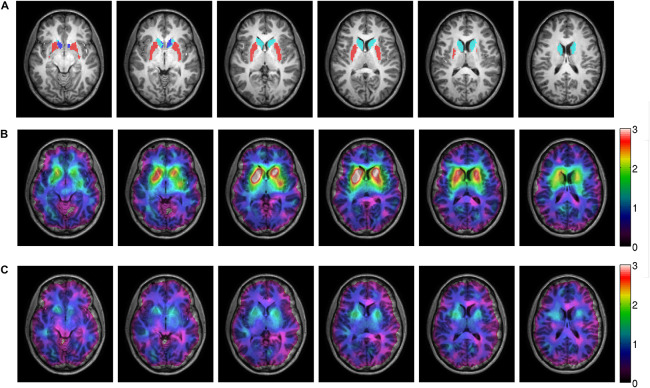
Patients with chronic schizophrenia often display enlarged striatal volumes, and antipsychotic drugs may contribute via the dopamine D receptor (DR) blockade. Separating the effects of disease from medication is challenging due to the lack of a proper placebo-group. To address this, we conducted a longitudinal study of antipsychotic-naïve, first-episode schizophrenia patients to test the hypothesis that selective blockade of DR would induce a dose-dependent striatal volume increase. Twenty-one patients underwent structural magnetic resonance imaging (sMRI), single-photon emission computed tomography (SPECT), and symptom severity ratings before and after six weeks of amisulpride treatment. Twenty-three matched healthy controls underwent sMRI and baseline SPECT. Data were analyzed using repeated measures and multiple regression analyses. Correlations between symptom severity decrease, volume changes, dose and receptor occupancy were explored. Striatal volumes did not differ between patients and controls at baseline or follow-up, but a significant group-by-time interaction was found ( = 0.01). This interaction was explained by a significant striatal volume increase of 2.1% in patients (Cohens = 0.45). Striatal increase was predicted by amisulpride dose, but not by either DR occupancy or baseline symptom severity. A significant reduction in symptom severity was observed at a mean dose of 233.3 (SD = 109.9) mg, corresponding to DR occupancy of 44.65%. Reduction in positive symptoms correlated significantly with striatal volume increase, driven by reductions in hallucinations. Our data demonstrate a clear link between antipsychotic treatment and striatal volume increase in antipsychotic-naïve schizophrenia patients. Moreover, the treatment-induced striatal volume increase appears clinically relevant by correlating to reductions in core symptoms of schizophrenia.
慢性精神分裂症患者的纹状体体积常常增大,抗精神病药物可能通过阻断多巴胺D受体(DR)起作用。由于缺乏合适的安慰剂组,区分疾病和药物的影响具有挑战性。为了解决这个问题,我们对未使用过抗精神病药物的首发精神分裂症患者进行了一项纵向研究,以检验选择性阻断DR会导致纹状体体积呈剂量依赖性增加这一假设。21例患者在接受氨磺必利治疗六周前后接受了结构磁共振成像(sMRI)、单光子发射计算机断层扫描(SPECT)以及症状严重程度评定。23名匹配的健康对照者接受了sMRI和基线SPECT检查。使用重复测量和多元回归分析对数据进行分析。探讨了症状严重程度降低、体积变化、剂量和受体占有率之间的相关性。患者和对照者在基线或随访时的纹状体体积没有差异,但发现了显著的组×时间交互作用( = 0.01)。这种交互作用可以通过患者纹状体体积显著增加2.1%来解释(科恩斯 = 0.45)。纹状体体积增加可由氨磺必利剂量预测,但不能由DR占有率或基线症状严重程度预测。在平均剂量233.3(标准差 = 109.9)mg时观察到症状严重程度显著降低,对应DR占有率为44.65%。阳性症状的减轻与纹状体体积增加显著相关,这是由幻觉减少所驱动的。我们的数据表明,在未使用过抗精神病药物的精神分裂症患者中,抗精神病治疗与纹状体体积增加之间存在明确的联系。此外,治疗引起的纹状体体积增加与精神分裂症核心症状的减轻相关,这在临床上似乎具有相关性。