Mohammed Ameer, Bayford Richard, Demosthenous Andreas
Department of Electronic and Electrical Engineering, University College London, London, United Kingdom.
Department of Mechatronic Engineering, Air Force Institute of Technology, Kaduna, Nigeria.
Front Neurosci. 2020 May 19;14:499. doi: 10.3389/fnins.2020.00499. eCollection 2020.
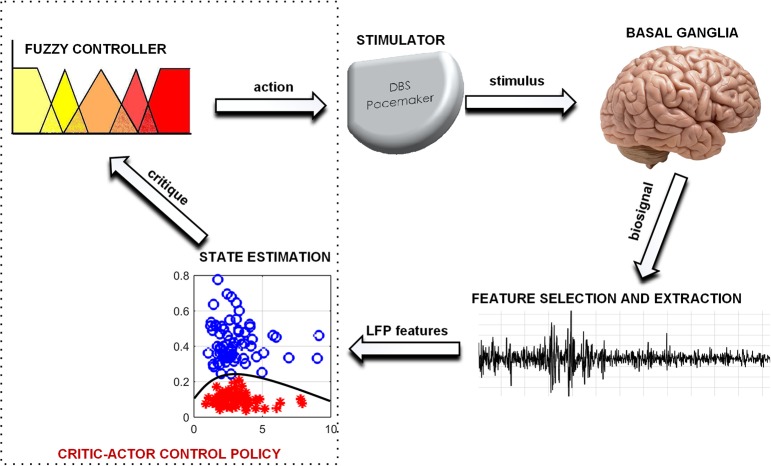
The mechanisms underlying the beneficial effects of deep brain stimulation (DBS) for Parkinson's disease (PD) remain poorly understood and are still under debate. This has hindered the development of adaptive DBS (aDBS). For further progress in aDBS, more insight into the dynamics of PD is needed, which can be obtained using machine learning models. This study presents an approach that uses generative and discriminative machine learning models to more accurately estimate the symptom severity of patients and adjust therapy accordingly. A support vector machine is used as the representative algorithm for discriminative machine learning models, and the Gaussian mixture model is used for the generative models. Therapy is effected using the state estimates obtained from the machine learning models together with a fuzzy controller in a control approach. Both machine learning model configurations achieve PD suppression to desired state in 7 out of 9 cases; most of which settle in under 2 s.
深部脑刺激(DBS)治疗帕金森病(PD)的有益效果背后的机制仍知之甚少,且仍存在争议。这阻碍了适应性深部脑刺激(aDBS)的发展。为了在aDBS方面取得进一步进展,需要对帕金森病的动态变化有更多了解,这可以通过使用机器学习模型来实现。本研究提出了一种方法,该方法使用生成式和判别式机器学习模型来更准确地估计患者的症状严重程度,并据此调整治疗方案。支持向量机用作判别式机器学习模型的代表性算法,高斯混合模型用于生成式模型。在一种控制方法中,使用从机器学习模型获得的状态估计以及模糊控制器来实现治疗效果。两种机器学习模型配置在9个案例中的7个中都能将帕金森病抑制到期望状态;其中大多数在2秒内稳定下来。