From the Clinical Center for Neurotechnologies, Neuromodulation, and Movement Disorders (M.A., S.M., F.C., T.B., F.C., P.R., S.B.), Fondazione IRCCS Ca'Granda Ospedale Maggiore Policlinico, Milano; Dipartimento di Ingegneria e Architettura (S.M., M.P.), Università degli Studi di Trieste, Italy; CINAC (G.F.), Hospital Universitario HM Puerta del Sur, and Hospital Nacional de Parapléjicos, Toledo, Spain; Department of Neurology (J.V.), University of Wurzburg, Germany; Division of Neurosurgery (A.M.L.), University of Toronto, ON, Canada; Division of Neurology (E.M.), Centre Hospitalier Universitaire de Grenoble, France; Department of Medico-Surgical Sciences and Biotechnologies (F.C.), Sapienza University Rome Polo Pontino, Rome; and "Aldo Ravelli" Research Center (A.P.), Department of Health Sciences, University of Milan & Ospedale San Paolo, Milan, Italy.
Neurology. 2018 Mar 13;90(11):e971-e976. doi: 10.1212/WNL.0000000000005121. Epub 2018 Feb 14.
To assess the feasibility and clinical efficacy of local field potentials (LFPs)-based adaptive deep brain stimulation (aDBS) in patients with advanced Parkinson disease (PD) during daily activities in an open-label, nonblinded study.
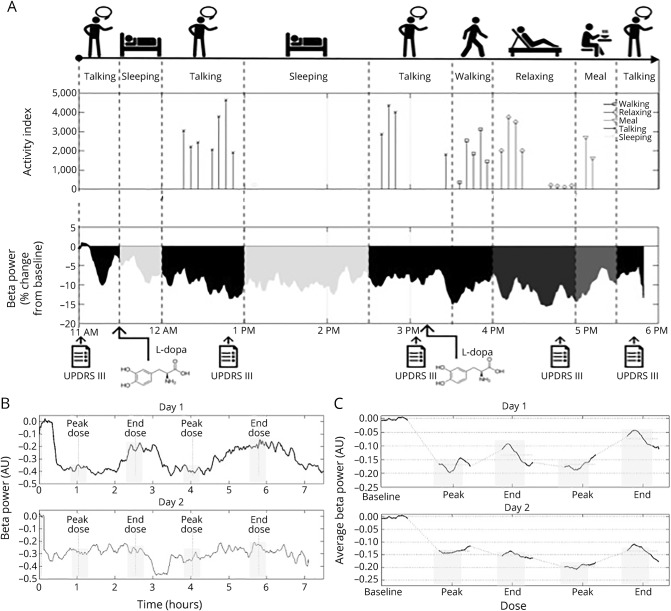
We monitored neurophysiologic and clinical fluctuations during 2 perioperative experimental sessions lasting for up to 8 hours. On the first day, the patient took his/her daily medication, while on the second, he/she additionally underwent subthalamic nucleus aDBS driven by LFPs beta band power.
The beta band power correlated in both experimental sessions with the patient's clinical state (Pearson correlation coefficient = 0.506, < 0.001, and = 0.477, < 0.001). aDBS after LFP changes was effective (30% improvement without medication [3-way analysis of variance, interaction day × medication = 0.036; 30.5 ± 3.4 vs 22.2 ± 3.3, = 0.003]), safe, and well tolerated in patients performing regular daily activities and taking additional dopaminergic medication. aDBS was able to decrease DBS amplitude during motor "on" states compared to "off" states (paired test = 0.046), and this automatic adjustment of STN-DBS prevented dyskinesias.
The main findings of our study are that aDBS is technically feasible in everyday life and provides a safe, well-tolerated, and effective treatment method for the management of clinical fluctuations.
This study provides Class IV evidence that for patients with advanced PD, aDBS is safe, well tolerated, and effective in controlling PD motor symptoms.
在一项开放标签、非盲研究中,评估基于局部场电位(LFPs)的适应性脑深部刺激(aDBS)在日常活动中治疗晚期帕金森病(PD)患者的可行性和临床疗效。
我们在长达 8 小时的 2 个围手术期实验中监测神经生理和临床波动。第一天,患者服用日常药物,第二天,他/她接受了由 LFPs β频段功率驱动的丘脑底核 aDBS。
在两个实验中,β频段功率均与患者的临床状态相关(Pearson 相关系数分别为 0.506,<0.001 和 0.477,<0.001)。在 LFPs 变化后进行 aDBS 是有效的(无药物治疗时提高 30%[三向方差分析,交互作用日×药物=0.036;30.5±3.4 与 22.2±3.3,=0.003]),并且在进行日常活动和服用额外多巴胺药物的患者中安全且耐受良好。与“关”状态相比,aDBS 能够降低运动“开”状态下的 DBS 幅度(配对 t 检验=0.046),并且这种 STN-DBS 的自动调节可预防运动障碍。
我们研究的主要发现是,aDBS 在日常生活中具有技术可行性,并为管理临床波动提供了一种安全、耐受良好且有效的治疗方法。
这项研究提供了 IV 级证据,表明对于晚期 PD 患者,aDBS 是一种安全、耐受良好且有效的控制 PD 运动症状的方法。