Munasinghe Sithum, Page Andrew, Mannan Haider, Ferdousi Shahana, Peek Brendan
Translational Health Research Institute, Western Sydney University, Campbelltown Campus, Locked Bag 1797, Penrith, NSW 2751 Australia.
Western Sydney Primary Health Network, Level 1/85 Flushcombe Road, Blacktown, NSW 2148 Australia.
Int J Ment Health Syst. 2020 May 26;14:37. doi: 10.1186/s13033-020-00368-5. eCollection 2020.
Regionally-specific approaches to primary mental health service provision through Primary Health Networks (PHNs) have been a feature of recent national mental health reforms. No previous studies have been conducted to investigate local patterns of primary mental health care (PMHC) services in Western Sydney. This study is designed to (i) understand the socio-demographic and economic profiles (ii) examine the inequalities of service access, and (iii) investigate the service utilisation patterns, among those referred to PMHC services in Western Sydney, Australia.
This study used routinely collected PMHC data (2005-2018), population-level general practice and Medicare rebates data (2013-2018) related to mental health conditions, for the population catchment of the Western Sydney PHN. Sex- and age-specific PMHC referrals were examined by socio-demographic, diagnostic, referral- and service-level factors, and age-specific referrals to PMHC services as a percentage of total mental health encounters were investigated.
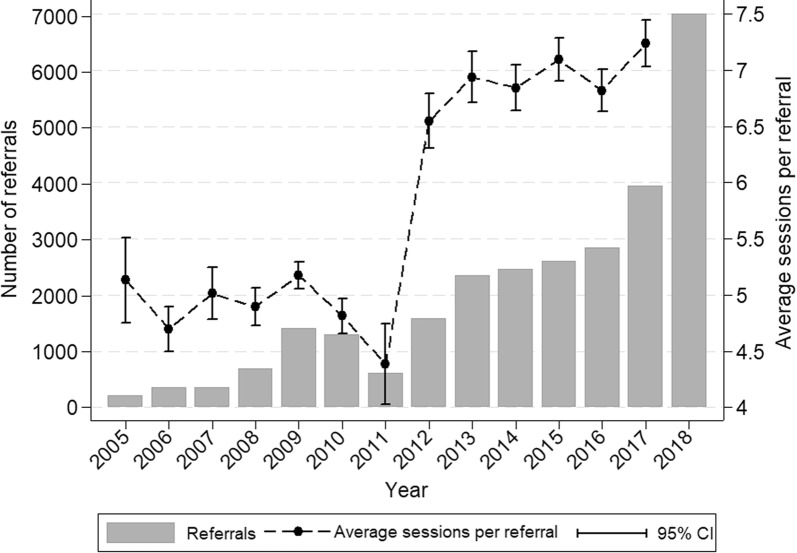
There were 27,897 referrals received for 20,507 clients, of which, 79.19% referrals resulted in follow-up services with 138,154 sessions. Overall, 60.09% clients were female, and median age was 31 years with interquartile ranged 16-46 years. Anxiety and depression were the predominant mental health condition, and 9.88% referred for suicidal risk. Over two-thirds of referrals started treatments during the first month of the referral and 95.1% of the total sessions were delivered by face to face. The younger age group (0-24) had greater referral opportunities as a percentage of total visits to a general practitioner and Medicare rebates, however demonstrating poor attendance rates with reduced average sessions per referral compared with older adults.
Children and young adults were more likely to be referred to PMHC services than older adults, but were less likely to attend services. Further research is needed to identify the strategies to address these differences in access to PMHC services to optimise the effectiveness of services.
通过初级卫生保健网络(PHNs)提供针对特定地区的初级心理健康服务,是近期国家心理健康改革的一个特点。此前尚未有研究调查悉尼西部初级心理健康护理(PMHC)服务的本地模式。本研究旨在:(i)了解社会人口统计学和经济概况;(ii)检查服务可及性的不平等情况;(iii)调查澳大利亚悉尼西部被转介至PMHC服务的人群的服务利用模式。
本研究使用了常规收集的PMHC数据(2005 - 2018年)、与心理健康状况相关的人群层面的全科医疗和医疗保险回扣数据(2013 - 2018年),这些数据来自悉尼西部PHN的服务人群。按社会人口统计学、诊断、转介和服务层面因素检查了按性别和年龄划分的PMHC转介情况,并调查了特定年龄组转介至PMHC服务的情况占心理健康诊疗总次数的百分比。
共收到针对20507名客户的27897次转介,其中79.19%的转介带来了后续服务,共计138154次诊疗。总体而言,60.09%的客户为女性,年龄中位数为31岁,四分位间距为16 - 46岁。焦虑和抑郁是主要的心理健康问题,9.88%的转介是因为有自杀风险。超过三分之二的转介在转介后的第一个月开始治疗,95.1%的诊疗是通过面对面方式进行的。较年轻年龄组(0 - 24岁)作为转介至全科医生的总就诊次数和医疗保险回扣次数的百分比而言,有更多的转介机会,然而与老年人相比,其就诊率较低,每次转介的平均诊疗次数也较少。
儿童和年轻人比老年人更有可能被转介至PMHC服务,但就诊可能性较小。需要进一步研究以确定解决这些在获得PMHC服务方面的差异的策略,以优化服务效果。