Madhavan Manju, Reddy Mahendra M, Chinnakali Palanivel, Kar Sitanshu S, Lakshminarayanan Subitha
Department of Preventive and Social Medicine, Jawaharlal Institute of Postgraduate Medical Education and Research (JIPMER), Puducherry, India.
J Family Med Prim Care. 2020 Mar 26;9(3):1538-1543. doi: 10.4103/jfmpc.jfmpc_1128_19. eCollection 2020 Mar.
Identification and documentation of risk factors for non-communicable diseases (NCDs) among an 'invisible community' like the transgenders (TGs) will throw light on the prevailing health status of one of the most marginalized populations in India, thereby paving way for initiating measures that would cater to their healthcare needs.
To estimate prevalence of risk factors for NCDs among TGs registered in a community-based organization in Puducherry.
A cross-sectional descriptive study among adult (≥18 years) TGs in a community-based organization in Puducherry.
Data on sociodemographic details, selected risk factors of NCDs-alcohol use, tobacco use, physical inactivity, obesity, unhealthy diet, hypertension, and self-reported diabetes mellitus (DM) were collected using a pre-tested structured questionnaire. Dependence levels on tobacco and/or alcohol were obtained using "Fagerstrom Addiction Scale" and "Alcohol Use Disorder Identification Test" scales, respectively.
Data were single entered using EpiData and analyzed using EpiData Analysis.
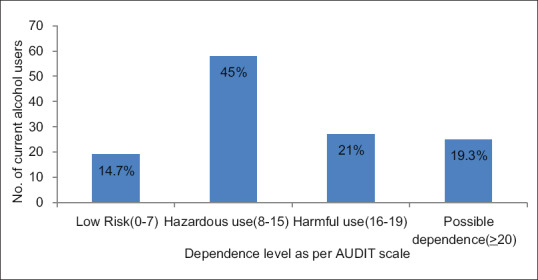
Of the 200 TGs included in the study, mean (SD) age was 30 (8.8) years. Around 47% belonged to upper-lower socioeconomic class. About 90% of the participants had unhealthy dietary practice, 84% were physically inactive, 41% had high waist hip ratio, 36% were obese, 16% had high blood pressure, and 8% had self-reported DM. Prevalence of tobacco use was 43.5% with high nicotine dependence noted in 29% (23/79) of smokeless tobacco users and 12% (2/17) of smokers. Alcohol use was reported among 64.5% of which one fifth had possible dependence.
Prevalence of selected risk factors for NCDs was high among TGs when compared to general population in Puducherry, which warrants targeted health interventions and priority in policy planning.
在像变性人(TGs)这样的“隐形群体”中识别和记录非传染性疾病(NCDs)的风险因素,将有助于了解印度最边缘化人群之一的当前健康状况,从而为采取满足其医疗保健需求的措施铺平道路。
估计在本地治里一个社区组织中登记的变性人中非传染性疾病风险因素的患病率。
对本地治里一个社区组织中年龄≥18岁的成年变性人进行横断面描述性研究。
使用经过预测试的结构化问卷收集社会人口学详细信息、非传染性疾病的选定风险因素——饮酒、吸烟、身体活动不足、肥胖、不健康饮食、高血压和自我报告的糖尿病(DM)的数据。分别使用“法格斯特罗姆成瘾量表”和“酒精使用障碍识别测试”量表获取对烟草和/或酒精的依赖程度。
数据使用EpiData单录入并使用EpiData Analysis进行分析。
在纳入研究的200名变性人中,平均(标准差)年龄为30(8.8)岁。约47%属于社会经济中下层阶级。约90%的参与者有不健康的饮食习惯,84%身体活动不足,41%腰臀比高,36%肥胖,16%患有高血压,8%自我报告患有糖尿病。吸烟率为43.5%,29%(23/79)的无烟烟草使用者和12%(2/17)的吸烟者有高尼古丁依赖性。64.5%的人报告饮酒,其中五分之一可能有依赖性。
与本地治里的普通人群相比,变性人中选定的非传染性疾病风险因素患病率较高,这需要有针对性的健康干预措施并在政策规划中给予优先考虑。