Setroikromo Rita, Zhang Baojie, Reis Carlos R, Mistry Rima H, Quax Wim J
Department of Chemical and Pharmaceutical Biology, Groningen Research Institute of Pharmacy, University of Groningen, Groningen, Netherlands.
Front Cell Dev Biol. 2020 May 19;8:318. doi: 10.3389/fcell.2020.00318. eCollection 2020.
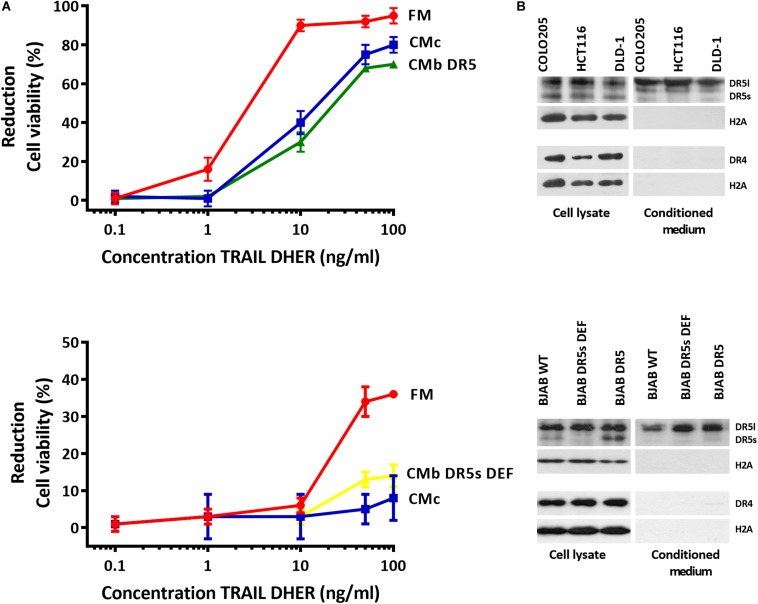
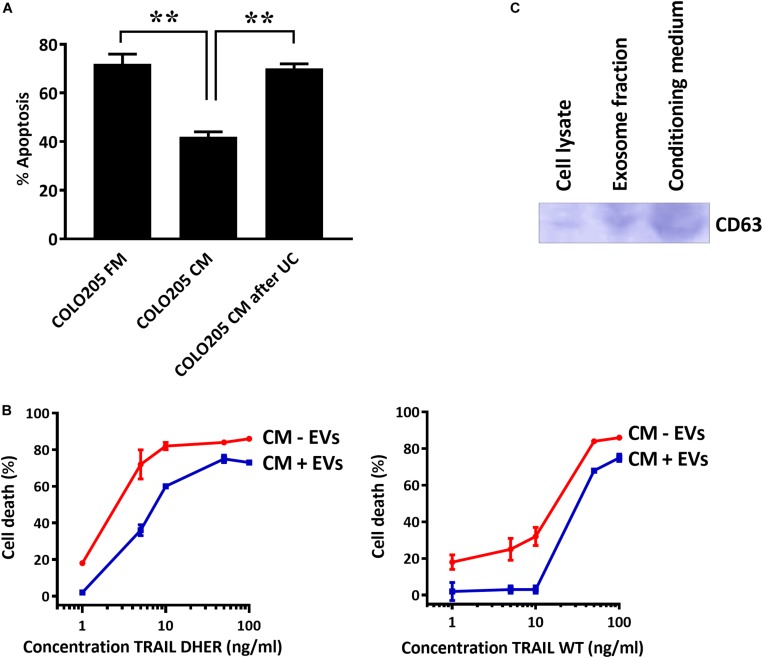
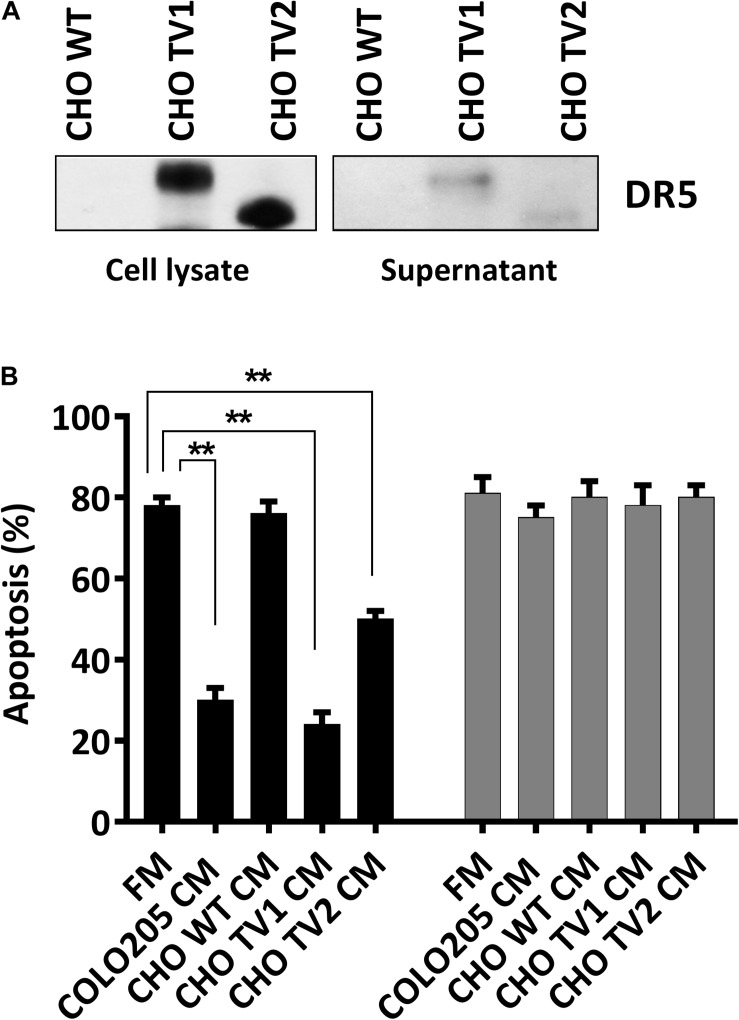
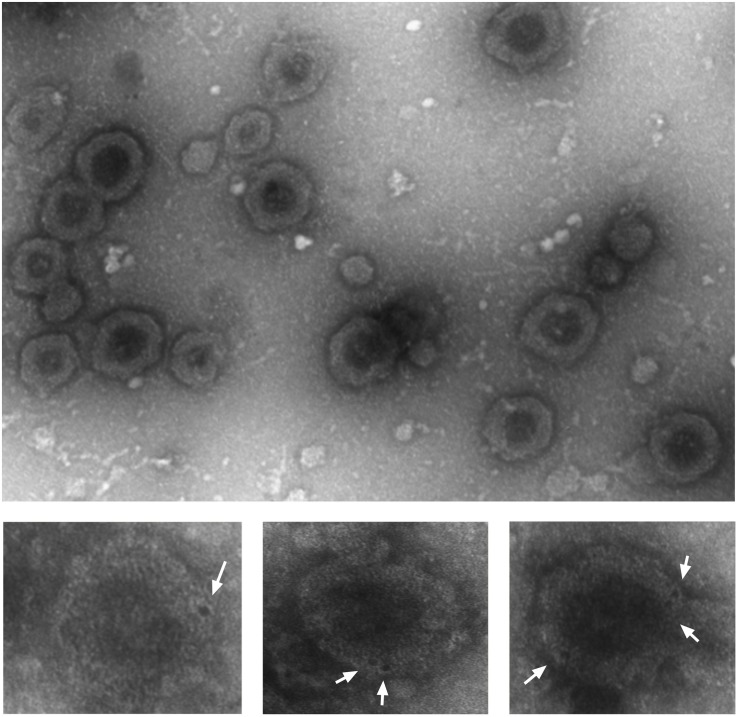
Tumor necrosis factor-related apoptosis inducing ligand (TRAIL) is considered to be a promising antitumor drug because of its selective proapoptotic properties on tumor cells. However, the clinical application of TRAIL is until now limited because of the resistance of several cancer cells, which can occur at various levels in the TRAIL signaling pathway. The role of decoy receptors that can side-track TRAIL, thereby preventing the formation of an activated death receptor, has been extensively studied. In this study, we have focused on extracellular vesicles (EVs) that are known to play a role in cell-to-cell communication and that can be released by donor cells into the medium transferring their components to recipient cells. TRAIL-induced apoptotic signaling is triggered upon the binding of two death receptors, DR4 and DR5. Here, we found that DR5 but not DR4 is present in the conditioned medium (CM)-derived from various cancer cells. Moreover, we observed that DR5 was exposed on EVs and can act as "decoy receptor" for binding to TRAIL. This results in a strongly reduced number of apoptotic cells upon treatment with DR5-specific TRAIL variant DHER in CM. This reduction happened with EVs containing either the long or short isoform of DR5. Taken together, we demonstrated that colon rectal tumor cells can secrete DR5-coated EVs, and this can cause TRAIL resistance. This is to our knowledge a novel finding and provides new insights into understanding TRAIL sensitivity.
肿瘤坏死因子相关凋亡诱导配体(TRAIL)因其对肿瘤细胞具有选择性促凋亡特性而被认为是一种很有前景的抗肿瘤药物。然而,由于几种癌细胞具有抗性,TRAIL的临床应用至今仍受到限制,这种抗性可能在TRAIL信号通路的各个层面出现。对能使TRAIL偏离正轨从而阻止活化死亡受体形成的诱饵受体的作用已进行了广泛研究。在本研究中,我们聚焦于细胞外囊泡(EVs),已知其在细胞间通讯中发挥作用,且供体细胞可将其释放到培养基中,将其成分转移至受体细胞。TRAIL诱导的凋亡信号是在两个死亡受体DR4和DR5结合后触发的。在此,我们发现来自各种癌细胞的条件培养基(CM)中存在DR5而非DR4。此外,我们观察到DR5暴露于EVs上,并且可以作为与TRAIL结合的“诱饵受体”。在用CM中的DR5特异性TRAIL变体DHER处理后,凋亡细胞数量大幅减少。含有DR5长或短异构体的EVs均会出现这种减少情况。综上所述,我们证明结肠直肠肿瘤细胞可分泌包被有DR5的EVs,这会导致TRAIL抗性。据我们所知,这是一个新发现,为理解TRAIL敏感性提供了新见解。