Industrial Engineering Department, King Saud University, Riyadh 11421, Saudi Arabia.
Biomed Res Int. 2020 May 15;2020:1437126. doi: 10.1155/2020/1437126. eCollection 2020.
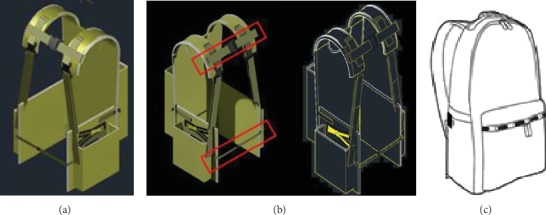
Carrying a heavy school backpack has extensively been reported as a prime cause of children's body strain. It is suggested that the load should not exceed 10 percent of the child's body weight; however, ensuring this requires continuous monitoring. The study explores how ergonomically designed school backpack based on the user anthropometric data ( = 280) and ergonomic parameters help reduce force concentration on shoulders and back. It provides a validation process of the developed prototype by experimental verification. The developed design was assessed in a comparison experiment with a commercially available local school backpack. An experimental study was used which recruited thirty healthy college students (aged 19 to 23 years). Two independent variables evaluated were school backpack type (developed backpack versus commercial one) and load levels as a percentage of body weight. Three load levels were employed 10%, 15%, and 20%. These variables were measured on the responses: bag comfort scale and the percent of maximum voluntary contraction (%MVC) of six muscles (right and left of erector spine, right and left of external abdominal oblique muscle, and right and left of trapezius). The developed backpack provided astonishing performance at levels of 15% and 20% of body weight in terms of subjective measure and electromyography (EMG) responses. It also showed that increasing the carried weight more than 10% result in reducing activity on the erector spinal muscles, while it increases on abdominal oblique muscles. The developed backpack design confirmed the efficiency of its bases by distributing the carried weight among the trunk through side pockets, attached to the body through two upper and lower straps. It helped the body to distribute the carried weight and avoid concentrating pressure on specific areas.
背负沉重的书包被广泛认为是儿童身体劳损的主要原因。建议书包的重量不应超过儿童体重的 10%;然而,要做到这一点需要持续监测。本研究探讨了基于用户人体测量数据(n=280)和人体工程学参数的符合人体工程学设计的书包如何帮助减少肩部和背部的力集中。它提供了一个开发原型的验证过程,通过实验验证。通过与当地商用书包进行比较实验,评估了所开发的设计。采用实验研究,招募了三十名健康大学生(年龄 19 至 23 岁)。评估了两个独立变量:书包类型(开发的书包与商用书包)和作为体重百分比的负载水平。使用了三个负载水平:10%、15%和 20%。这些变量在以下方面进行了测量:书包舒适度量表和六块肌肉(脊柱伸肌的右侧和左侧、腹外斜肌的右侧和左侧以及斜方肌的右侧和左侧)的最大随意收缩百分比(%MVC)。在 15%和 20%的体重水平下,开发的书包在主观测量和肌电图(EMG)反应方面表现出色。研究还表明,携带的重量超过 10%会导致脊柱伸肌的活动减少,而腹外斜肌的活动增加。开发的书包设计通过将携带的重量分配到通过两个上下肩带附在身体上的侧袋中,从而证实了其基础的效率。它有助于身体分配携带的重量,避免将压力集中在特定区域。