Lynch Anne M, Palestine Alan G, Wagner Brandie D, Patnaik Jennifer L, Frazier-Abel Ashley A, Mathias Marc T, Siringo Frank S, Holers Vernon Michael, Mandava Naresh
Department of Ophthalmology, University of Colorado Denver School of Medicine, Aurora, Colorado, USA
Department of Ophthalmology, University of Colorado Denver School of Medicine, Aurora, Colorado, USA.
BMJ Open Ophthalmol. 2020 Jan 14;5(1):e000361. doi: 10.1136/bmjophth-2019-000361. eCollection 2020.
Systemic activation of the complement system in intermediate age-related macular degeneration (AMD) is understudied. Moreover, links between the presence of reticular pseudodrusen (RPD) and systemic complement dysregulation have not been studied. The aim of this study was to determine if there is a difference in plasma complement factor levels in intermediate AMD compared with controls, and if complement levels are related to the presence of RPD.
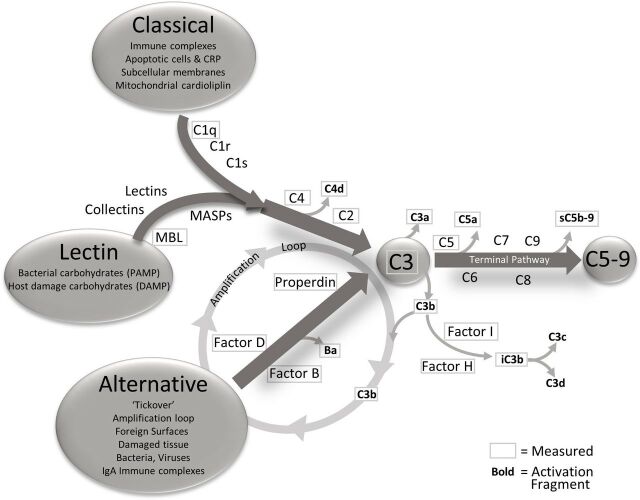
Levels of complement factors C1q (µg/mL), C4 (µg/mL), C2 (µg/mL), Mannose Binding Lectin (ng/mL), C4b (µg/mL), C3 (µg/mL), factor B (µg/mL), factor D (µg/mL), properdin (µg/mL), C3a (ng/mL), iC3b/C3b (ng/mL), Ba (ng/mL), factor H (µg/mL), factor I (µg/mL), C5 (µg/mL), C5a (pg/mL) and SC5b-9 (ng/mL) were measured in plasma.
109 cases and 65 controls were included in the study. Thirty-nine (36%) cases had RPD. Significantly lower systemic levels of: C1q (OR 0.96, 95% CI 0.94 to 0.98), factor B (OR 0.98, 95% CI 0.96 to 0.99), iC3b/C3b (OR 0.97, 95% CI 0.95 to 0.98), factor H (OR 0.99, 95% CI 0.98 to 0.99), factor I (OR 0.83, 95% CI 0.77 to 0.89) and C5 (OR 0.94, 95% CI 0.90 to 0.98) were found in cases versus controls. Significantly elevated levels of: C2 (OR 1.29, 95% CI 1.07 to 1.59), C3a (OR 1.03, 95% CI 1.01 to 1.05) Ba (OR 1.03, 95% CI 1.01 to 1.05) and C5a (OR 1.04, 95% CI 1.02 to 1.07) were found in cases versus controls. Systemic levels of complement factors measured were not related to the presence of RPD.
Levels of several systemic complement pathway factors were found to be altered in intermediate AMD. Systemic levels of complement factors were not related to RPD.
中间型年龄相关性黄斑变性(AMD)中补体系统的全身激活情况研究较少。此外,网状假性玻璃膜疣(RPD)的存在与全身补体失调之间的联系尚未得到研究。本研究的目的是确定中间型AMD患者与对照组相比血浆补体因子水平是否存在差异,以及补体水平是否与RPD的存在相关。
测量血浆中补体因子C1q(μg/mL)、C4(μg/mL)、C2(μg/mL)、甘露糖结合凝集素(ng/mL)、C4b(μg/mL)、C3(μg/mL)、B因子(μg/mL)、D因子(μg/mL)、备解素(μg/mL)、C3a(ng/mL)、iC3b/C3b(ng/mL)、Ba(ng/mL)、H因子(μg/mL)、I因子(μg/mL)、C5(μg/mL)、C5a(pg/mL)和SC5b-9(ng/mL)的水平。
本研究纳入了109例患者和65名对照。39例(36%)患者有RPD。与对照组相比,患者全身水平显著降低的有:C1q(比值比[OR]0.96,95%置信区间[CI]0.94至0.98)、B因子(OR0.98,95%CI0.96至0.99)、iC3b/C3b(OR0.97,95%CI0.95至0.98)、H因子(OR0.99,95%CI0.98至0.99)、I因子(OR0.83,95%CI0.77至0.89)和C5(OR0.94,95%CI0.90至0.98)。与对照组相比,患者全身水平显著升高的有:C2(OR1.29,95%CI1.07至1.59)、C3a(OR1.03,95%CI1.01至1.05)、Ba(OR1.03,95%CI1.01至1.05)和C5a(OR1.04,95%CI1.02至1.07)。所测量的补体因子全身水平与RPD的存在无关。
发现中间型AMD中几种全身补体途径因子的水平发生了改变。补体因子的全身水平与RPD无关。