Chamberlain Rebecca, Huyton Jan, James Delyth
Cardiff School of Education and Social Policy, Cardiff Metropolitan University, Cardiff CF5 2YB, UK.
Cardiff School of Sport and Health Sciences, Cardiff Metropolitan University, Cardiff CF5 2YB, UK.
Pharmacy (Basel). 2020 Jun 4;8(2):97. doi: 10.3390/pharmacy8020097.
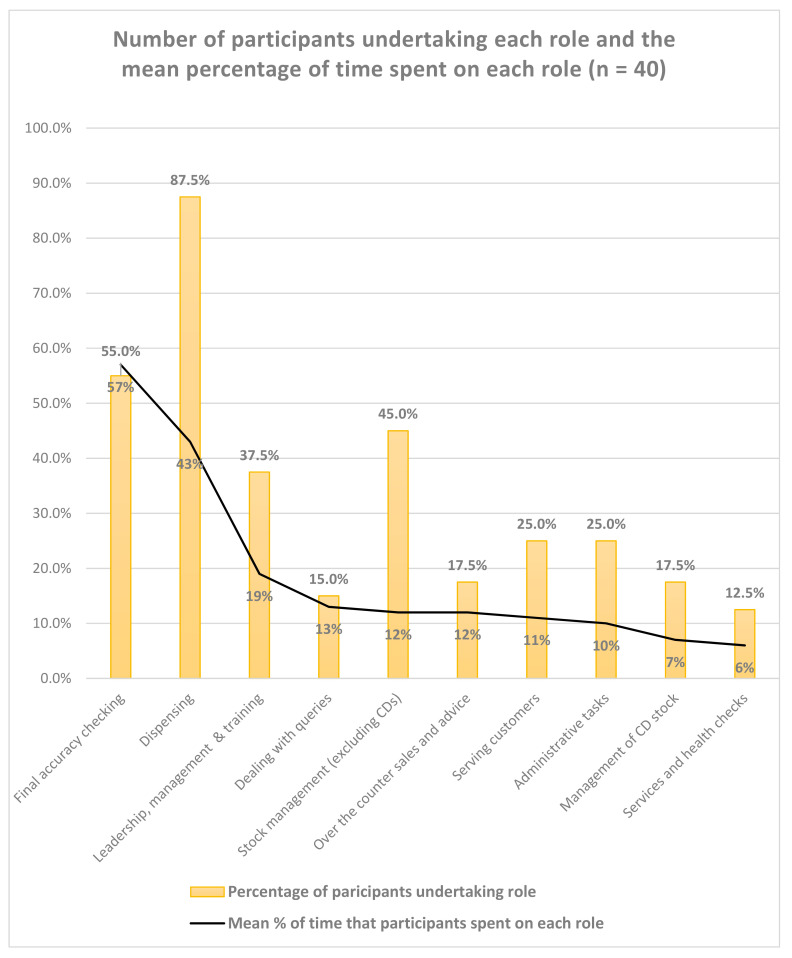
Healthcare delivery models in Wales are changing in response to unprecedented pressure on the National Health Service UK (NHS). Community pharmacies will be prioritised to address public health and clinical needs at a local level. To support the delivery of the new model, pharmacy technicians must be enabled and developed to optimize their roles. The aim of the study was to establish existing roles of pharmacy technicians working in the community pharmacy sector in Wales and to explore barriers and enablers to development. A combination of quantitative and qualitative methodologies was used, with the main focus on quantitative methods. A total of 83 participants completed an online questionnaire and additional qualitative data were obtained from four semi-structured telephone interviews. : The dispensing and final accuracy checking of medicines were reported as core functions of the community pharmacy technician role, with an average of 43% and 57% of time being spent on these roles, respectively. There was some evidence of engagement in leadership and management roles (average of 19%) and limited evidence of delivery of services (average of 6%). There is scope to enable community pharmacy technicians to optimize and further develop their roles. Enablers include the effective use of delegation, workplace support, improved staffing levels and the prioritisation of extended pharmacy technician roles.
威尔士的医疗服务提供模式正在发生变化,以应对英国国民医疗服务体系(NHS)前所未有的压力。社区药房将被优先考虑,以满足地方层面的公共卫生和临床需求。为支持新模式的实施,必须赋能并培养药房技术员,以优化其角色。本研究的目的是确定威尔士社区药房领域药房技术员的现有角色,并探索其发展的障碍和促进因素。研究采用了定量和定性方法相结合的方式,主要侧重于定量方法。共有83名参与者完成了一份在线问卷,并通过四次半结构化电话访谈获得了额外的定性数据。药品调配和最终准确性检查被报告为社区药房技术员角色的核心职能,分别平均花费43%和57%的时间在这些职能上。有一些证据表明他们参与了领导和管理角色(平均占19%),而提供服务的证据有限(平均占6%)。社区药房技术员有空间来优化和进一步发展他们的角色。促进因素包括有效利用授权、工作场所支持、改善人员配备水平以及优先考虑扩展药房技术员角色。