
多耐药结核病短程治疗的经济学评价,埃塞俄比亚和南非:STREAM 试验。
Economic evaluation of short treatment for multidrug-resistant tuberculosis, Ethiopia and South Africa: the STREAM trial.
机构信息
Warwick Medical School, University of Warwick, Coventry, England.
Centre for Applied Health Research and Delivery, Liverpool School of Tropical Medicine, Pembroke Place, Liverpool, L3 5QA, England.
出版信息
Bull World Health Organ. 2020 May 1;98(5):306-314. doi: 10.2471/BLT.19.243584. Epub 2020 Feb 25.
OBJECTIVE
To investigate cost changes for health systems and participants, resulting from switching to short treatment regimens for multidrug-resistant (MDR) tuberculosis.
METHODS
We compared the costs to health systems and participants of long (20 to 22 months) and short (9 to 11 months) MDR tuberculosis regimens in Ethiopia and South Africa. Cost data were collected from participants in the STREAM phase-III randomized controlled trial and we estimated health-system costs using bottom-up and top-down approaches. A cost-effectiveness analysis was performed by calculating the incremental cost per unfavourable outcome avoided.
FINDINGS
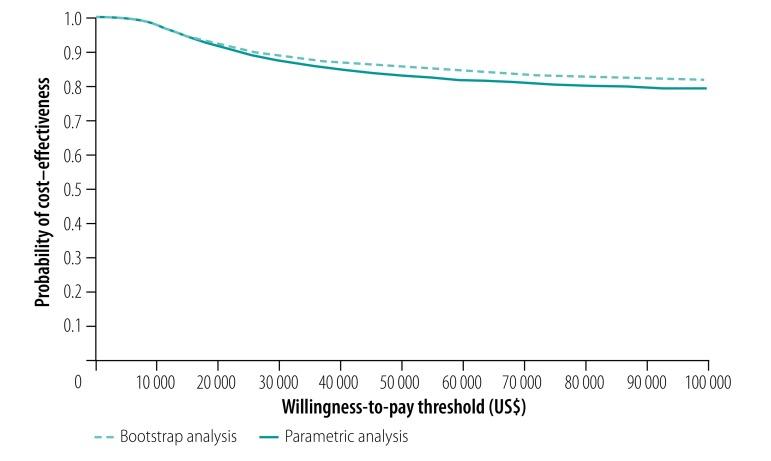
Health-care costs per participant in South Africa were 8340.7 United States dollars (US$) with the long and US$ 6618.0 with the short regimen; in Ethiopia, they were US$ 6096.6 and US$ 4552.3, respectively. The largest component of the saving was medication costs in South Africa (67%; US$ 1157.0 of total US$ 1722.8) and social support costs in Ethiopia (35%, US$ 545.2 of total US$ 1544.3). In Ethiopia, trial participants on the short regimen reported lower expenditure for supplementary food (mean reduction per participant: US$ 225.5) and increased working hours (i.e. 667 additional hours over 132 weeks). The probability that the short regimen was cost-effective was greater than 95% when the value placed on avoiding an unfavourable outcome was less than US$ 19 000 in Ethiopia and less than US$ 14 500 in South Africa.
CONCLUSION
The short MDR tuberculosis treatment regimen was associated with a substantial reduction in health-system costs and a lower financial burden for participants.
目的
研究耐多药结核病(MDR-TB)短程治疗方案转为长程治疗方案后对卫生系统和参与者造成的成本变化。
方法
我们比较了在埃塞俄比亚和南非,长程(20-22 个月)和短程(9-11 个月)MDR-TB 方案对卫生系统和参与者的成本。我们从 STREAM 三期随机对照试验中的参与者那里收集了成本数据,并使用自下而上和自上而下的方法估算了卫生系统成本。通过计算避免不良结局的增量成本,进行成本效益分析。
结果
南非每名参与者的医疗费用分别为长程方案 8340.7 美元和短程方案 6618.0 美元;埃塞俄比亚分别为 6096.6 美元和 4552.3 美元。节省的最大部分是南非的药物费用(67%,即总费用 1722.8 美元中的 1157.0 美元)和埃塞俄比亚的社会支持费用(35%,即总费用 1544.3 美元中的 545.2 美元)。在埃塞俄比亚,接受短程方案的试验参与者在补充食品上的支出较低(每名参与者平均减少 225.5 美元),工作时间增加(即 132 周内增加 667 小时)。在埃塞俄比亚,当避免不良结局的价值低于 19000 美元,在南非低于 14500 美元时,短程方案具有成本效益的可能性大于 95%。
结论
MDR-TB 短程治疗方案与卫生系统成本的大幅降低以及参与者的经济负担降低有关。



 Zotero 插件