Nakao Akira, Hiranuma Osamu, Uchino Junji, Sakaguchi Chikara, Araya Tomoyuki, Hiraoka Noriya, Ishizuka Tamotsu, Takeda Takayuki, Kawasaki Masayuki, Goto Yasuhiro, Imai Hisao, Hattori Noboru, Nakatomi Keita, Uramoto Hidetaka, Uryu Kiyoaki, Fukuda Minoru, Uchida Yasuki, Yokoyama Toshihide, Akai Masaya, Mio Tadashi, Nagashima Seiji, Chihara Yusuke, Tamiya Nobuyo, Kaneko Yoshiko, Mouri Takako, Yamada Tadaaki, Yoshimura Kenichi, Fujita Masaki, Takayama Koichi
Department of Respiratory Medicine, Faculty of Medicine, Fukuoka University, Fukuoka 814-0180, Japan.
Department of Respiratory Medicine, Otsu City Hospital, Shiga 520-0804, Japan.
J Clin Med. 2020 Jun 5;9(6):1762. doi: 10.3390/jcm9061762.
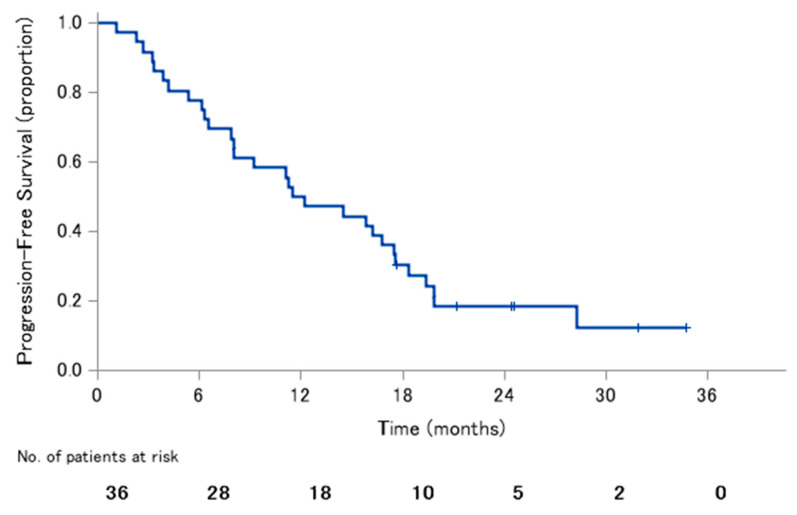
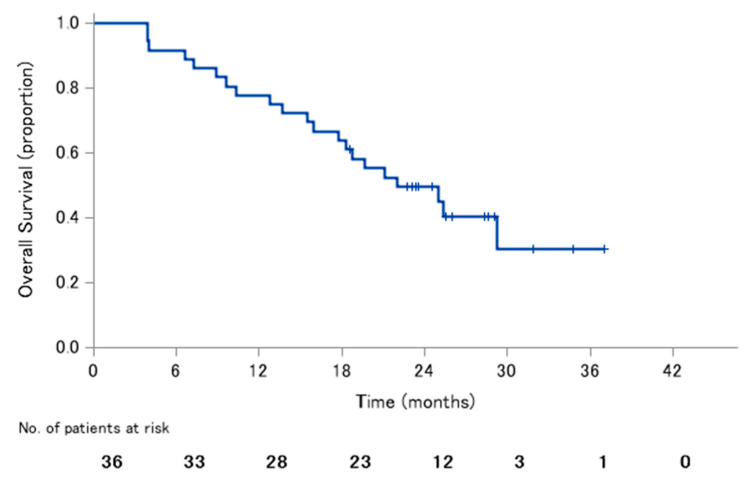
Epidermal growth factor receptor tyrosine kinase inhibitors (EGFR-TKIs) are used for treating EGFR-mutated lung cancer, and osimertinib is effective in cases that acquired T790M mutations after treatment with the first- and second-generation EGFR-TKIs. However, no study has evaluated its safety and efficacy in older patients. This phase II trial (jRCTs071180002) evaluated osimertinib in T790M mutation-positive Japanese patients who were ≥75 years old and had experienced relapse or progression after previous EGFR-TKI treatment. Our previous report that enrolled 36 patients showed the overall response rate (58.3%) and disease control rate (97.2%), while this report describes the results for the progression-free survival (PFS), overall survival (OS), and safety analyses. The median PFS was 11.9 months (95% confidence interval (CI): 7.9-17.5), and the median OS was 22.0 months (95% CI: 16.0 months-not reached). The most frequent adverse events were anemia/hypoalbuminemia (27 patients, 75.0%), thrombocytopenia (21 patients, 58.3%), and paronychia/anorexia/diarrhea/neutropenia (15 patients, 41.7%). Pneumonitis was observed in four patients (11.1%), including two patients (5.6%) with Grade 3-4 pneumonitis. These results suggest that osimertinib was relatively safe and effective for non-small cell lung cancer that acquired T790M mutations after previous EGFR-TKI treatment, even among patients who were ≥75 years old.
表皮生长因子受体酪氨酸激酶抑制剂(EGFR-TKIs)用于治疗EGFR突变型肺癌,奥希替尼对在用第一代和第二代EGFR-TKIs治疗后获得T790M突变的病例有效。然而,尚无研究评估其在老年患者中的安全性和疗效。这项II期试验(jRCTs071180002)评估了奥希替尼在年龄≥75岁、既往接受EGFR-TKI治疗后出现复发或进展的T790M突变阳性日本患者中的疗效。我们之前纳入36例患者的报告显示了总缓解率(58.3%)和疾病控制率(97.2%),而本报告描述了无进展生存期(PFS)、总生存期(OS)和安全性分析结果。中位PFS为11.9个月(95%置信区间(CI):7.9 - 17.5),中位OS为22.0个月(95%CI:16.0个月 - 未达到)。最常见的不良事件为贫血/低白蛋白血症(27例患者,75.0%)、血小板减少症(21例患者,58.3%)以及甲沟炎/厌食/腹泻/中性粒细胞减少症(15例患者,41.7%)。4例患者(11.1%)出现肺炎,其中2例患者(5.6%)为3 - 4级肺炎。这些结果表明,奥希替尼对于既往接受EGFR-TKI治疗后获得T790M突变的非小细胞肺癌相对安全有效,即使在年龄≥75岁的患者中也是如此。