Guerrero-Muñoz Daniel, Salazar Diana, Constain Victoria, Perez Alvaro, Pineda-Cañar Carlos Andrés, García-Perdomo Herney Andrés
Department of Family Medicine, Universidad del Valle, Cali, Colombia.
School of Medicine, Universidad del Valle, Cali, Colombia.
Korean J Fam Med. 2021 Mar;42(2):172-180. doi: 10.4082/kjfm.19.0166. Epub 2020 Jun 10.
Different scales have attempted to assess various aspects of family dynamics and structures. Good family function seems to allow for better prognoses for basic diseases and appears to be a predictor of depression. The aim of this study was to determine the association between family functionality and depression.
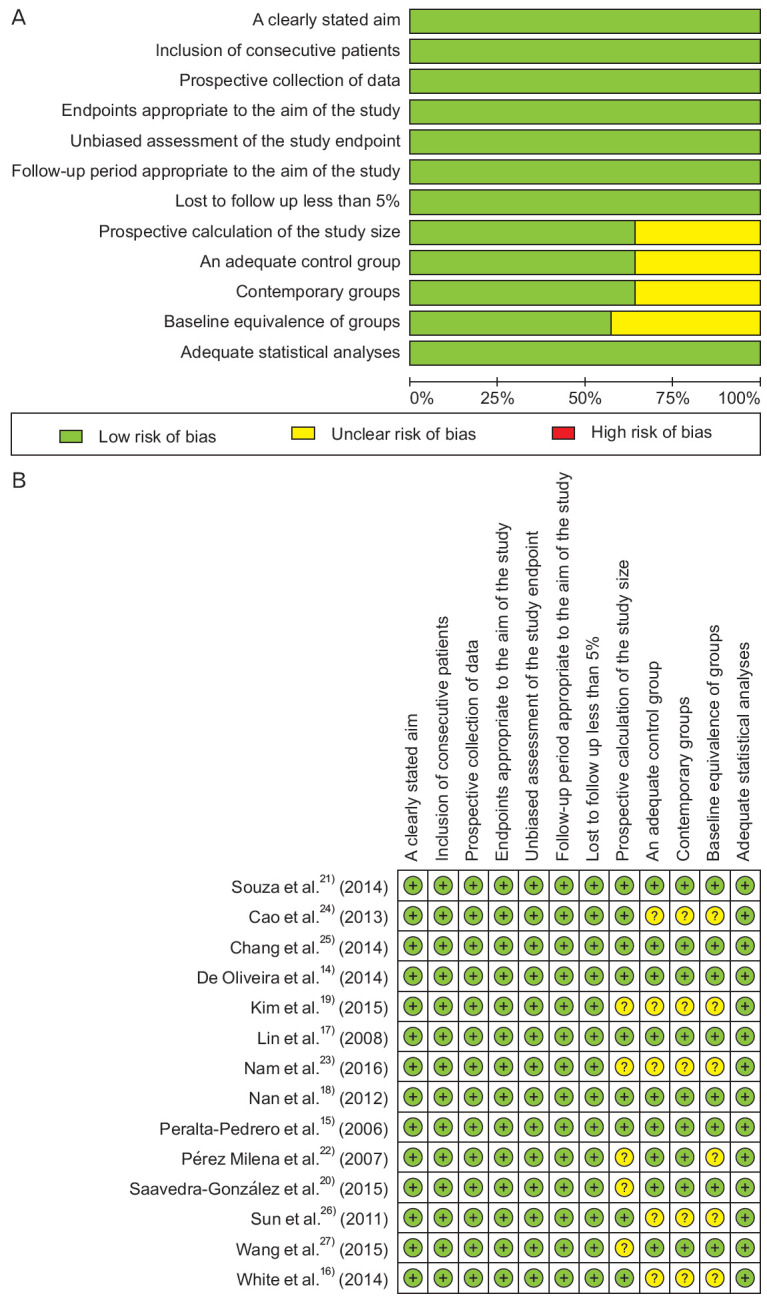
This is a systematic review and meta-analysis including cross-sectional, cohort, and case-control studies using validated instruments such as the Family APGAR (Adaptability, Partnership, Growth, Affection, and Resolve) and Family Adaptability and Cohesion Evaluation Scale III. A search strategy was designed for the MEDLINE, Embase, Central, and LILACS databases along with data saturation through a search of unpublished literature from the onset of the databases to the present. The categorical variables are expressed in terms of odds ratios (OR), and the statistical analysis was carried out using Review Manager ver. 5.31 (The Cochrane Collaboration, Oxford, UK) using forest plots with corresponding 95% confidence intervals (CI). A fixed-effect model was used according to the expected heterogeneity, expressed in terms of I2 . The risk of bias was evaluated using the MINORS (methodological index for non-randomized studies) tool.
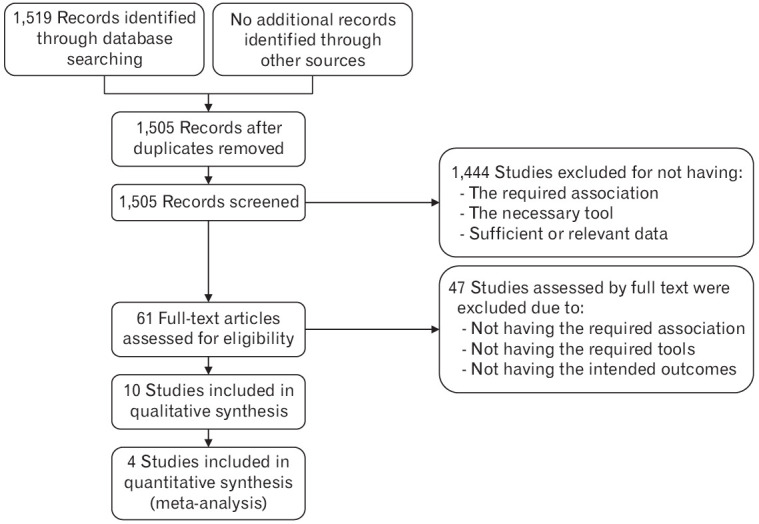
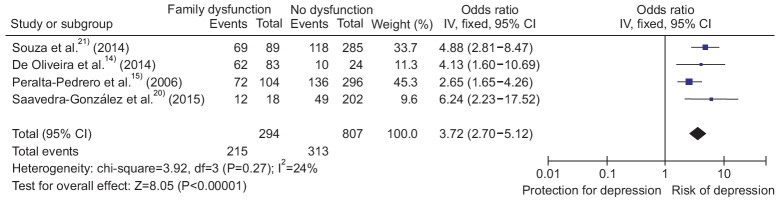
A total of 1,519 studies were found, of which 10 were selected for the qualitative synthesis and four were chosen for the meta-analysis. The result for the association between family dysfunction and depression yielded an OR (95% CI) of 3.72 (2.70 to 5.12) and I2 of 24%.
Family dysfunction and depression are strongly associated.
不同的量表试图评估家庭动态和结构的各个方面。良好的家庭功能似乎有助于基础疾病获得更好的预后,并且似乎是抑郁症的一个预测指标。本研究的目的是确定家庭功能与抑郁症之间的关联。
这是一项系统评价和荟萃分析,纳入了横断面研究、队列研究和病例对照研究,使用了经过验证的工具,如家庭APGAR(适应性、伙伴关系、成长、情感和解决能力)和家庭适应性与凝聚力评估量表III。针对MEDLINE、Embase、Central和LILACS数据库设计了检索策略,并通过检索从数据库建立之初到目前的未发表文献实现数据饱和。分类变量以比值比(OR)表示,使用Review Manager 5.31版(英国牛津科克伦协作网)进行统计分析,采用带有相应95%置信区间(CI)的森林图。根据预期的异质性(以I²表示)使用固定效应模型。使用MINORS(非随机研究方法学指数)工具评估偏倚风险。
共检索到1519项研究,其中10项被选入定性综合分析,4项被选入荟萃分析。家庭功能障碍与抑郁症之间关联的结果得出OR(95%CI)为3.72(2.70至5.12),I²为24%。
家庭功能障碍与抑郁症密切相关。