Liskova Alena, Koklesova Lenka, Samec Marek, Smejkal Karel, Samuel Samson Mathews, Varghese Elizabeth, Abotaleb Mariam, Biringer Kamil, Kudela Erik, Danko Jan, Shakibaei Mehdi, Kwon Taeg Kyu, Büsselberg Dietrich, Kubatka Peter
Clinic of Obstetrics and Gynecology, Jessenius Faculty of Medicine, Comenius University in Bratislava, 03601 Martin, Slovakia.
Department of Natural Drugs, Faculty of Pharmacy, Masaryk University, 61242 Brno, Czech Republic.
Cancers (Basel). 2020 Jun 8;12(6):1498. doi: 10.3390/cancers12061498.
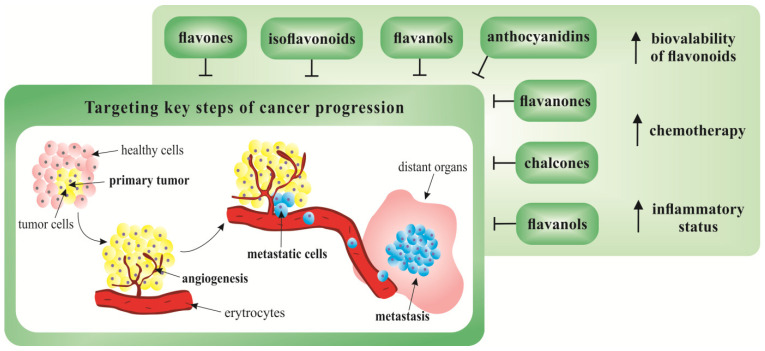
Metastasis represents a serious complication in the treatment of cancer. Flavonoids are plant secondary metabolites exerting various health beneficiary effects. The effects of flavonoids against cancer are associated not only with early stages of the cancer process, but also with cancer progression and spread into distant sites. Flavonoids showed potent anti-cancer effects against various cancer models in vitro and in vivo, mediated via regulation of key signaling pathways involved in the migration and invasion of cancer cells and metastatic progression, including key regulators of epithelial-mesenchymal transition or regulatory molecules such as MMPs, uPA/uPAR, TGF-β and other contributors of the complex process of metastatic spread. Moreover, flavonoids modulated also the expression of genes associated with the progression of cancer and improved inflammatory status, a part of the complex process involved in the development of metastasis. Flavonoids also documented clear potential to improve the anti-cancer effectiveness of conventional chemotherapeutic agents. Most importantly, flavonoids represent environmentally-friendly and wide spectrum of different flavonoids demonstrated safety and minimal side effects during long-termed administration. In addition, the bioavailability of flavonoids can be improved by their conjugation with metal ions or structural modifications by radiation. In conclusion, anti-cancer effects of flavonoids, targeting all phases of carcinogenesis including metastatic progression, should be implemented into clinical cancer research in order to strengthen their potential use in the future targeted prevention and therapy of cancer in high-risk individuals or patients with aggressive cancer disease with metastatic potential.
转移是癌症治疗中的一种严重并发症。黄酮类化合物是具有多种健康有益作用的植物次生代谢产物。黄酮类化合物对癌症的影响不仅与癌症进程的早期阶段有关,还与癌症进展以及扩散至远处部位有关。黄酮类化合物在体外和体内对各种癌症模型均显示出强大的抗癌作用,其作用是通过调节参与癌细胞迁移、侵袭和转移进展的关键信号通路介导的,这些信号通路包括上皮-间质转化的关键调节因子或诸如基质金属蛋白酶(MMPs)、尿激酶型纤溶酶原激活剂/尿激酶型纤溶酶原激活剂受体(uPA/uPAR)、转化生长因子-β(TGF-β)等调节分子以及转移扩散复杂过程的其他促成因素。此外,黄酮类化合物还调节了与癌症进展相关的基因表达并改善了炎症状态,炎症状态是转移发展复杂过程的一部分。黄酮类化合物还显示出明显的潜力来提高传统化疗药物的抗癌效果。最重要的是,黄酮类化合物是环境友好型的,多种不同的黄酮类化合物在长期给药过程中显示出安全性且副作用极小。此外,黄酮类化合物与金属离子结合或通过辐射进行结构修饰可提高其生物利用度。总之,黄酮类化合物针对包括转移进展在内的癌症发生的各个阶段的抗癌作用,应纳入临床癌症研究,以增强其在未来对高危个体或具有转移潜能的侵袭性癌症患者进行靶向预防和治疗中的潜在应用价值。