Rana Juie Nahushkumar, Mumtaz Sohail
Fels Cancer Institute for Personalized Medicine, Lewis Katz School of Medicine, Temple University, Philadelphia, PA 19140, USA.
Department of Chemical and Biological Engineering, Gachon University, 1342 Seongnamdaero, Sujeong-gu, Seongnam-si 13120, Republic of Korea.
Int J Mol Sci. 2025 Mar 16;26(6):2678. doi: 10.3390/ijms26062678.
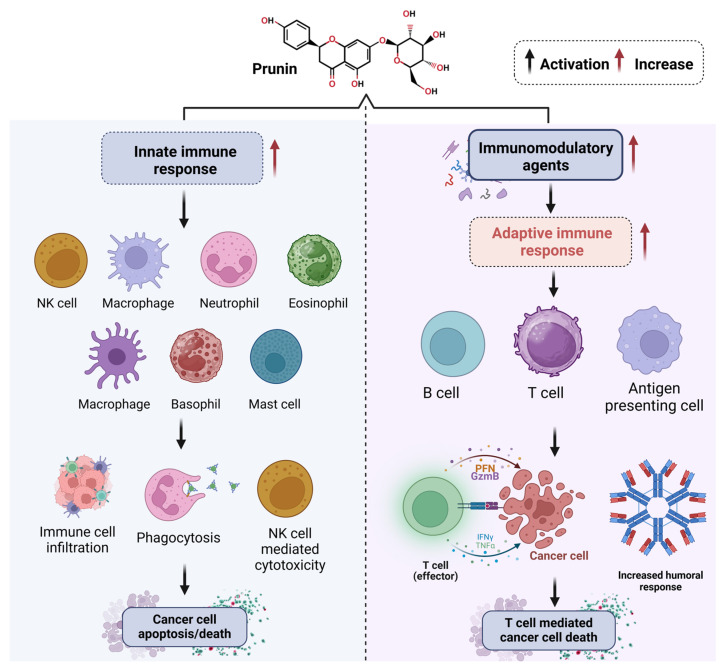
Despite the substantial advances in cancer therapies, developing safe and effective treatment methodologies is critical. Natural (plant-derived compounds), such as flavonoids, might be crucial in developing a safe treatment methodology without toxicity toward healthy tissues. Prunin is a flavonoid with the potential to be used in biomedical applications. Prunin has yet to undergo thorough scientific research, and its precise molecular mechanisms of action remain largely unexplored. This review summarizes the therapeutic potential of prunin for the first time, focusing on its underlying mechanisms as an anticancer compound. Prunin has gained significant attention due to its antioxidant, anti-inflammatory, and anticancer effects. This review aims to unlock how prunin functions at the molecular level to exert its anticancer effects, primarily modulating key cellular pathways. Furthermore, we have discussed the prunin's potential as an adjunctive therapy with conventional treatments, highlighting its ability to strengthen treatment responses while decreasing drug resistance. Moreover, the discussion probes into innovative delivery methods, particularly nanoformulations, that might address prunin's bioavailability, solubility, and stability limitations and optimize its therapeutic application. By providing a comprehensive analysis of prunin's properties, this review aims to stimulate further exploration of using prunin as an anticancer agent, thereby progressing the development of targeted, selective, safe, and effective therapeutic methods.
尽管癌症治疗取得了重大进展,但开发安全有效的治疗方法仍然至关重要。天然(植物来源的化合物),如黄酮类化合物,可能对开发一种对健康组织无毒性的安全治疗方法至关重要。李属苷是一种有潜力用于生物医学应用的黄酮类化合物。李属苷尚未经过全面的科学研究,其确切的分子作用机制在很大程度上仍未被探索。本综述首次总结了李属苷的治疗潜力,重点关注其作为抗癌化合物的潜在机制。由于其抗氧化、抗炎和抗癌作用,李属苷已受到广泛关注。本综述旨在揭示李属苷在分子水平上如何发挥其抗癌作用,主要是调节关键的细胞途径。此外,我们还讨论了李属苷作为传统治疗辅助疗法的潜力,强调了其增强治疗反应同时降低耐药性的能力。此外,讨论还探讨了创新的给药方法,特别是纳米制剂,这些方法可能解决李属苷的生物利用度、溶解度和稳定性限制,并优化其治疗应用。通过对李属苷特性的全面分析,本综述旨在激发对将李属苷用作抗癌剂的进一步探索,从而推动靶向、选择性、安全和有效治疗方法的发展。