Fu Xudong, Djekidel Mohamed Nadhir, Zhang Yi
Howard Hughes Medical Institute, Boston, MA, USA.
Program in Cellular and Molecular Medicine, Boston Children's Hospital, Boston, MA, USA.
Sci Adv. 2020 May 29;6(22):eaay5181. doi: 10.1126/sciadv.aay5181. eCollection 2020 May.
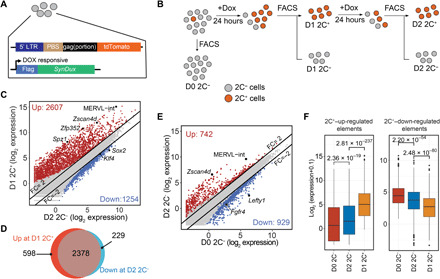
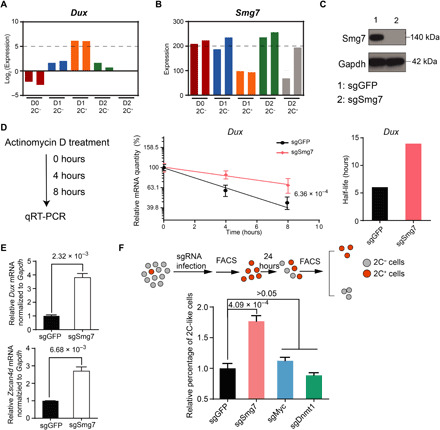
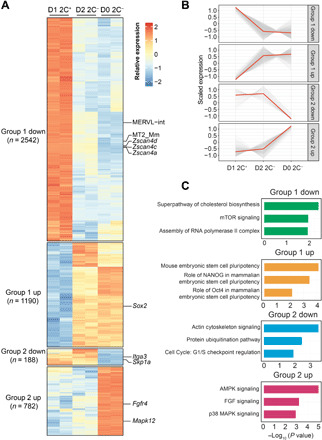
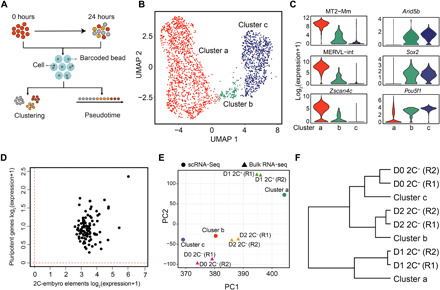
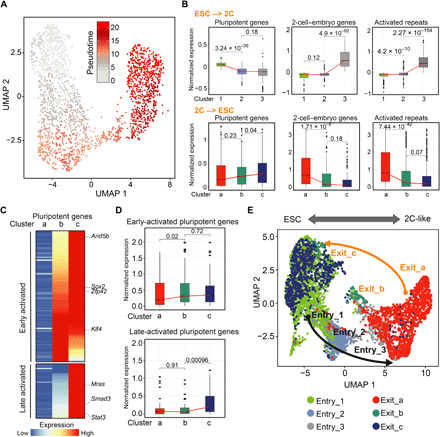
In mouse embryonic stem cell (ESC), a small cell population displays totipotent features by expressing a set of genes that are transiently active in 2-cell-stage embryos. These 2-cell-like (2C-like) cells spontaneously transit back into the pluripotent state. We previously dissected the transcriptional dynamics of the transition from pluripotency to the totipotent 2C-like state and identified factors that modulate the process. However, how 2C-like cells transit back into the pluripotent state remains largely unknown. In this study, we analyzed the transcriptional dynamics from the 2C-like state to pluripotent ESCs and identified an intermediate state. The intermediate state characterized by two-wave step up-regulation of pluripotent genes is different from the one observed during the 2C-like entry transition. Nonsense-mediated Dux mRNA decay plays an important role in the 2C-like state exit. Thus, our study not only provides a transcriptional roadmap for 2C-like-to-pluripotent state transition but also reveals a key molecular event driving the transition.
在小鼠胚胎干细胞(ESC)中,一小部分细胞群体通过表达一组在二细胞期胚胎中短暂活跃的基因来展现全能性特征。这些二细胞样(2C样)细胞会自发地转变回多能状态。我们之前剖析了从多能性向全能性2C样状态转变的转录动态,并鉴定了调控该过程的因子。然而,2C样细胞如何转变回多能状态在很大程度上仍然未知。在本研究中,我们分析了从2C样状态到多能性ESC的转录动态,并鉴定出一种中间状态。以多能基因的两波逐步上调为特征的中间状态与在2C样进入转变过程中观察到的状态不同。无义介导的Dux mRNA降解在2C样状态退出中起重要作用。因此,我们的研究不仅为2C样到多能状态的转变提供了转录路线图,还揭示了驱动该转变的关键分子事件。